#LinkedIn DMs vs Cold Email: The Data-Backed Verdict
Copy page
TL;DR: LinkedIn DMs reply at about 10% on average, while cold email sits near 3.4% to 5% in 2026. On a pure reply-rate basis, LinkedIn wins by roughly 2x. But cold email sends 300 to 500 touches a day per operator against LinkedIn's hard cap of 100 connection requests a week, so email wins on raw scale and cost per conversation.
The channel that books the most meetings per dollar is neither one alone. Teams that sequence both, a LinkedIn connection request followed by a context-aware email, consistently report 15% to 25% reply rates. The question is not which channel to pick.
It is how to layer them by persona and deal size.
#Table of contents
- The short answer
- Reply rate: the headline number
- The head-to-head comparison
- Scale and volume: where email pulls ahead
- Cost per conversation
- Deliverability limits vs connection limits
- Which channel wins by persona and deal size
- Region and industry fit
- The real answer: sequence both
- How to run the combined play
- FAQs
- Conclusion
#The short answer
If you only have time to read one paragraph: LinkedIn DMs get replies more often, cold email reaches more people, and running them together beats running either one alone. The reply-rate gap is real. LinkedIn averages around 10% while cold email has slipped under 5%.
The volume gap is also real, and it runs the other direction. One operator can fire 300 to 500 cold emails a day. LinkedIn throttles you at 100 connection requests a week.
So the right question depends on what you are short on. If you are short on prospects who fit, LinkedIn is your channel. If you have a large clean list and need throughput, email is your channel.
If you want the highest reply count per account you actually care about, you sequence both.
That nuance gets lost in most "which is better" posts. Neither channel is winning or losing in a vacuum. They are good at different jobs.
This post breaks down the numbers behind each one, then shows you where to point each channel so you stop wasting LinkedIn's limited slots on accounts email could have handled.
#Reply rate: the headline number
Start with the metric everyone argues about, because the data here is clearer than the debate suggests.
Cold email reply rates have been falling for years. Instantly's 2026 Benchmark Report puts the average cold email reply rate at 3.43%, down from roughly 5% in 2025 and 8.5% back in 2019. Belkins, working from a different dataset, reports a slightly higher 5.1% average.
Both numbers tell the same story. The typical cold email gets ignored more than 95 times out of 100. You can read the full year-over-year breakdown in our cold email reply rate benchmarks for 2026, but the headline is that the channel average keeps drifting down as inboxes get noisier.
LinkedIn sits in a different place. Across more than 70,000 campaigns, the average LinkedIn DM reply rate is 10.3%, roughly double cold email. And that is the floor, not the ceiling.
When someone accepts your connection request, and about 45% of people accept a personalized one, your follow-up message lands a reply 25% to 35% of the time. Personalized InMails to people you are not connected with run 18% to 25%, according to data compiled by Cleverly and Sales So. One dataset from Sbl.so covering 285,000 messages shows an 18% average reply rate, with tighter campaigns pushing past 25%.
There is a simple mechanical reason LinkedIn replies more. The message shows up next to a face, a name, and a shared context. An InMail opens at about 45%, while a cold email opens at 20% to 25%.
People answer messages on LinkedIn because the platform was built for professional conversation. They delete cold email because their inbox was built for everything else.
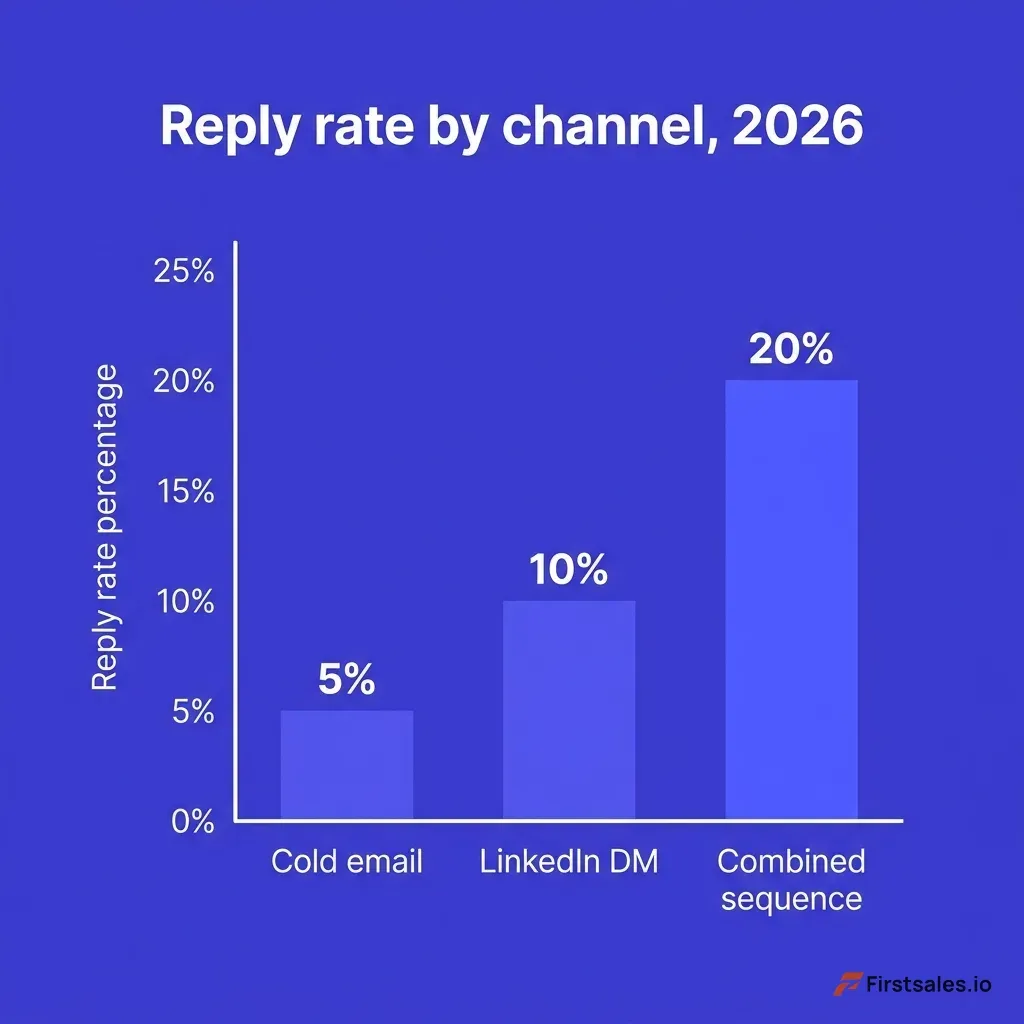 Grouped bar chart comparing reply rates across three outreach approaches: cold email at 5 percent, LinkedIn DM at 10 percent, and combined sequence at 20 percent, with the combined bar clearly tallest
So on reply rate alone, LinkedIn is the stronger channel. If that were the only number that mattered, this would be a short post. It is not the only number that matters, which is why so many teams that "switched to LinkedIn" ended up disappointed.
Reply rate is a percentage.
Pipeline is a count. A high percentage of a tiny number can still be a tiny number.
#The head-to-head comparison
Here is the full picture side by side, using the 2026 benchmark data from the platforms tracking each channel at scale.
| Dimension | LinkedIn DMs | Cold email |
|---|---|---|
| Average reply rate | ✓ ~10% (18-25% for InMail) | ✗ 3.4-5% |
| Daily reach per operator | ✗ ~20-25 requests | ✓ 300-500 emails |
| Weekly hard ceiling | ✗ 100 connection requests | ✓ Thousands across domains |
| Open visibility | ✓ InMail opens ~45% | ✗ Email opens 20-25% |
| Cost per conversation | ✗ Higher (time-intensive) | ✓ Lower at volume |
| Personalization context | ✓ Profile, posts, mutuals visible | ✗ Limited to enriched data |
| Best for senior buyers | ✓ Director, VP, C-suite | ✗ Often unread |
| Best for high volume | ✗ Capped by platform | ✓ Scales 10:1 vs LinkedIn |
| Account warmup risk | ✗ Restriction if you push limits | ✗ Domain burn if you push limits |
| Setup speed | ✓ No DNS, no warmup | ✗ SPF, DKIM, DMARC, ramp |
Read the table and the trade-off becomes obvious. LinkedIn wins the quality columns. Email wins the quantity columns.
Neither one sweeps the board. The teams that treat this as a binary choice end up optimizing one dimension and ignoring the cost on the other.
Notice the warmup risk row, where both channels carry an X. People assume LinkedIn is the safe, organic option and cold email is the spammy one. Both punish you for pushing volume. LinkedIn restricts accounts that send too many requests with low acceptance.
Email providers tank your deliverability when complaint rates climb. The discipline that protects you is the same on both: relevance over volume.
#Scale and volume: where email pulls ahead
LinkedIn's reply-rate advantage comes with a hard structural cap, and it is worth understanding exactly how tight that cap is before you bet a pipeline on it.
LinkedIn's connection request limit in 2026 is 100 invitations per week. That number is the same across every tier. Free, Premium, and Sales Navigator all hit the same wall.
There is no paid plan that buys you more invites. The daily soft cap sits around 20 to 25 for Free and Premium accounts and 25 to 30 for Sales Navigator, and going over it reliably triggers throttling within a few days even when you stay under the weekly ceiling. LeadLoft and LinkedRent both document the same limits.
Run the math. At 100 requests a week with a 45% acceptance rate, you open about 45 new conversations a week per account. At a 30% reply rate on those, you get roughly 13 to 14 replies a week.
That is a respectable number for one seat, but it is a fixed number. You cannot buy your way past it on a single account.
Cold email has no equivalent ceiling at the platform level. One operator can send 300 to 500 emails a day, which gives email roughly a 10:1 volume advantage over LinkedIn per the data Nousu Collective and Litemail published this year. Even at a 4% reply rate, 400 emails a day produces around 16 replies a day, more than LinkedIn's weekly output.
The catch is that email volume comes with its own constraints, which I will get to. But the structural point stands: when you need throughput, email is the channel that can give it to you.
This is the core reason the "LinkedIn is better" takes mislead people. LinkedIn is better per message. Email is better per day.
If your total addressable market is 200 perfect-fit accounts, LinkedIn's cap is irrelevant and its reply rate is everything. If your market is 50,000 accounts and you need to work through them this quarter, LinkedIn alone cannot move that list.
#Cost per conversation
Reply rate and volume both feed into the number that actually decides your channel mix: what does one real conversation cost you?
LinkedIn conversations cost more in human time. Each one needs a profile look, a personalized request note, an accepted connection, and a follow-up that references something real. Cleverly's data shows personalized requests hit 45% acceptance against 15% for generic ones, so the personalization is not optional.
That research time is the cost. You are trading minutes per prospect for a much higher hit rate.
Cold email conversations cost less per unit but waste more units. The per-email cost is low, sometimes fractions of a cent, but the 95% non-reply rate means most of that spend produces nothing. Where email gets expensive is the hidden infrastructure tax.
Domains degrade, complaint rates need monitoring, and bounce hygiene eats SDR hours. We covered that compounding cost in detail in the signal-based cold email breakdown, where the takeaway is that generic volume looks cheap until you price in domain replacement.
There is a useful data point on the paid-acquisition side too. LinkedIn's cost per lead runs about 28% lower than Google Ads while converting at roughly 2x, according to figures Cleverly cites. That is paid LinkedIn, not organic DMs, but it tells you something about intent quality on the platform.
People are in a buying-and-hiring headspace when they are on LinkedIn in a way they often are not when a cold email interrupts them.
The honest answer on cost is that it depends on your funnel. For low-priced, high-volume products, email's cost per conversation almost always wins because you need the throughput and the per-unit price is what matters. For high-priced, low-volume deals, LinkedIn's higher cost per conversation is trivial next to the deal size, and its reply rate gets you in front of buyers email never reaches.
#Deliverability limits vs connection limits
Both channels have a governor that caps how hard you can push. They work differently, and the difference shapes how you should run each one.
Cold email is governed by deliverability. In 2026, Google and Microsoft require SPF, DKIM, and DMARC for bulk senders, one-click unsubscribe, and a spam complaint rate that stays under 0.10%, with 0.08% being the practical safe ceiling. Cross those thresholds and inbox placement collapses, not just for the campaign that triggered it but for future sends from that domain.
The safe sending pattern most teams settle on is 10 to 20 emails per inbox per day on aged, warmed domains, scaled horizontally across many inboxes. Speed still matters on the response side, and the speed-to-lead data shows replies that sit untouched for hours convert far worse, so deliverability gets you to the inbox and response time closes the loop.
LinkedIn is governed by acceptance and account health. The platform watches your acceptance rate as a proxy for whether you are spamming. Low acceptance is one of the strongest predictors of restriction, according to LinkedIn automation analysis from LinkedHelper and PhantomBuster.
The fix is the same discipline email demands, just measured differently. Personalized notes between 120 and 180 characters outperform notes that try to fill the full 300-character limit, and they keep acceptance high enough to avoid the throttle.
The practical upshot: email lets you scale wide if you spread volume across infrastructure you maintain carefully. LinkedIn lets you scale only as far as your acceptance rate stays healthy, on a single account that cannot be multiplied without more seats and more risk. Email's ceiling is a function of how many clean domains you run.
LinkedIn's ceiling is fixed by the platform and does not move.
#Which channel wins by persona and deal size
This is where the "which is better" question finally gets a clean answer, because the answer changes with who you are selling to and how much the deal is worth.
Seniority is the clearest signal. Senior buyers, the directors, VPs, and C-suite, guard their email and skim it fast. They get hundreds of cold emails a week and almost none get read.
The same people check LinkedIn deliberately.
A thoughtful connection request or InMail from someone relevant earns attention email never would. GetReplies and Cleverly both land on the same conclusion: for senior enterprise buyers, LinkedIn beats email, full stop. For operational and individual-contributor roles who live in their inbox all day, email often reaches them faster than a connection request that sits unaccepted.
Deal size sets the second rule, and the pattern is consistent across the 2026 guides:
- Deals under $5k: lead with cold email. Reserve LinkedIn for the senior buyers in the account where email tends to bounce off. The economics of a small deal do not justify the per-prospect research time LinkedIn demands at scale.
- Deals from $5k to $50k: run a true multichannel sequence. Lead with whichever channel your ideal customer profile actually lives on, and use the other as reinforcement.
- Deals over $50k: lead with LinkedIn. Use cold email as the warm-up and the follow-up touch, not the opener. At this deal size the buyer is senior, the sales cycle is long, and the relationship-first nature of LinkedIn matches how the deal actually gets done.
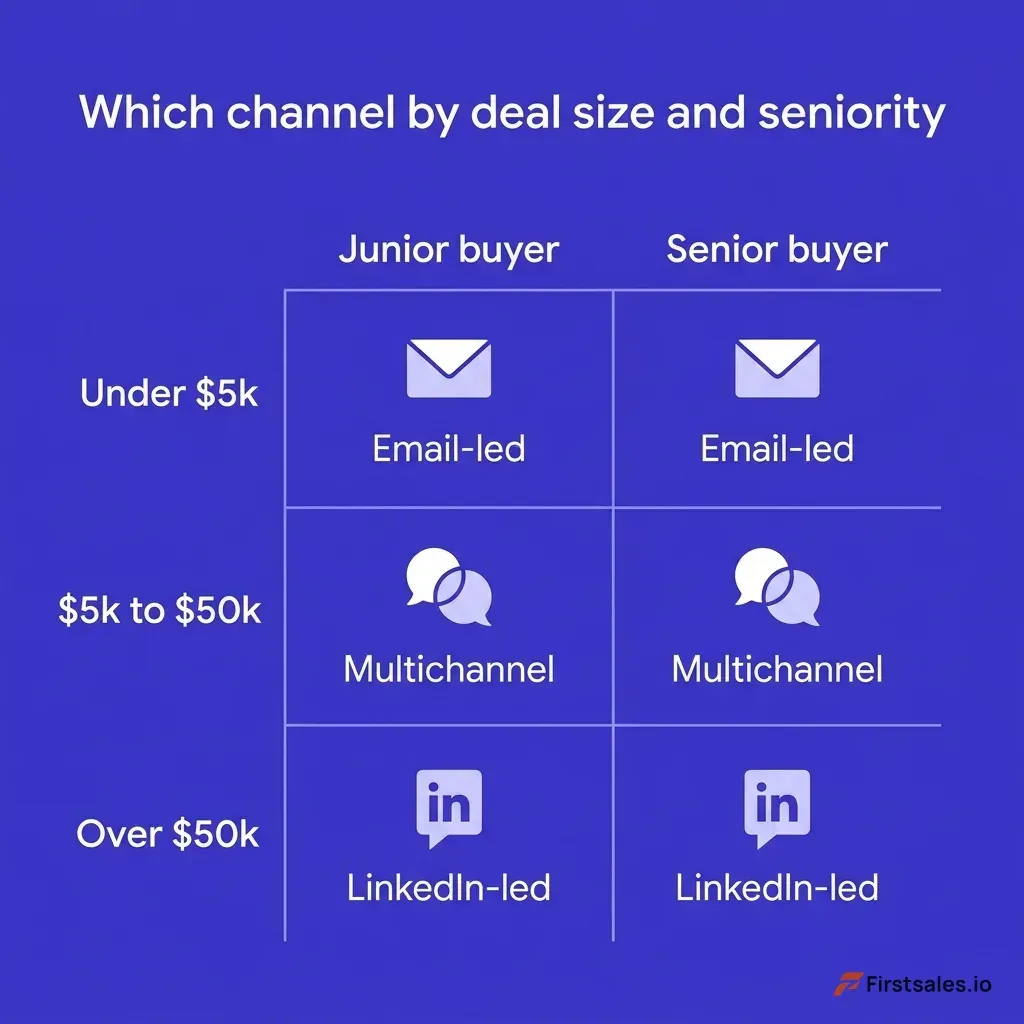 Decision matrix diagram mapping outreach channel to buyer profile: rows for deal size under 5k, 5k to 50k, and over 50k, crossed with columns for junior and senior buyers, each cell shaded to show email-led, multichannel, or LinkedIn-led, in deep indigo and white flat design
The matrix above is the mental model worth keeping. Most teams default to one channel for everything and then wonder why half their outreach underperforms. The fix is not a better template.
It is pointing the right channel at the right buyer.
A $3k deal with a RevOps manager and a $200k deal with a CRO should not get the same opening move.
#Region and industry fit
Channel fit also shifts by geography and vertical, and ignoring this is a common reason outbound underperforms in some markets.
LinkedIn penetration is deep in North America, Western Europe, India, and most English-speaking B2B markets, which makes it a reliable primary or co-primary channel there. In markets where LinkedIn adoption is thinner among your buyers, or where local professional networks or messaging apps dominate, cold email stays the more dependable reach channel because nearly everyone has a work email regardless of which social platform they prefer.
Industry matters too. Tech, SaaS, marketing, recruiting, and professional services are saturated with active LinkedIn users, so DMs land in front of buyers who check the platform daily. More traditional sectors like manufacturing, logistics, construction, and parts of healthcare skew toward email as the channel where business actually happens, with LinkedIn used more for the senior decision-makers than the full buying committee.
Before you commit a channel mix, confirm where your specific buyers spend their professional attention rather than assuming the SaaS-world default applies everywhere.
#The real answer: sequence both
Here is the part the head-to-head framing tends to bury. The highest-performing teams in 2026 are not choosing. They are sequencing.
The combined numbers are hard to argue with. Multichannel outreach generates roughly 50% more replies than either channel run alone, per Sproutworth's analysis. Sending a personalized LinkedIn connection request followed by a context-aware email within 24 to 48 hours can lift reply rates by more than 2.7x.
Prospects engaged across at least two channels are 30% to 50% more likely to respond. When teams coordinate the sequence properly with tight ICP targeting and real personalization, the full-sequence reply rate lands in the 15% to 25% range, the same band that signal-based outreach hits on its own.
The reason is psychological, not technical. A cold email from a stranger is easy to ignore. A cold email from someone whose name you already saw in a LinkedIn connection request two days ago is not a stranger anymore.
The channels reinforce each other. LinkedIn supplies recognition and a face. Email supplies a place to make the actual case at length without burning a connection slot.
Each touch makes the next one more likely to land.
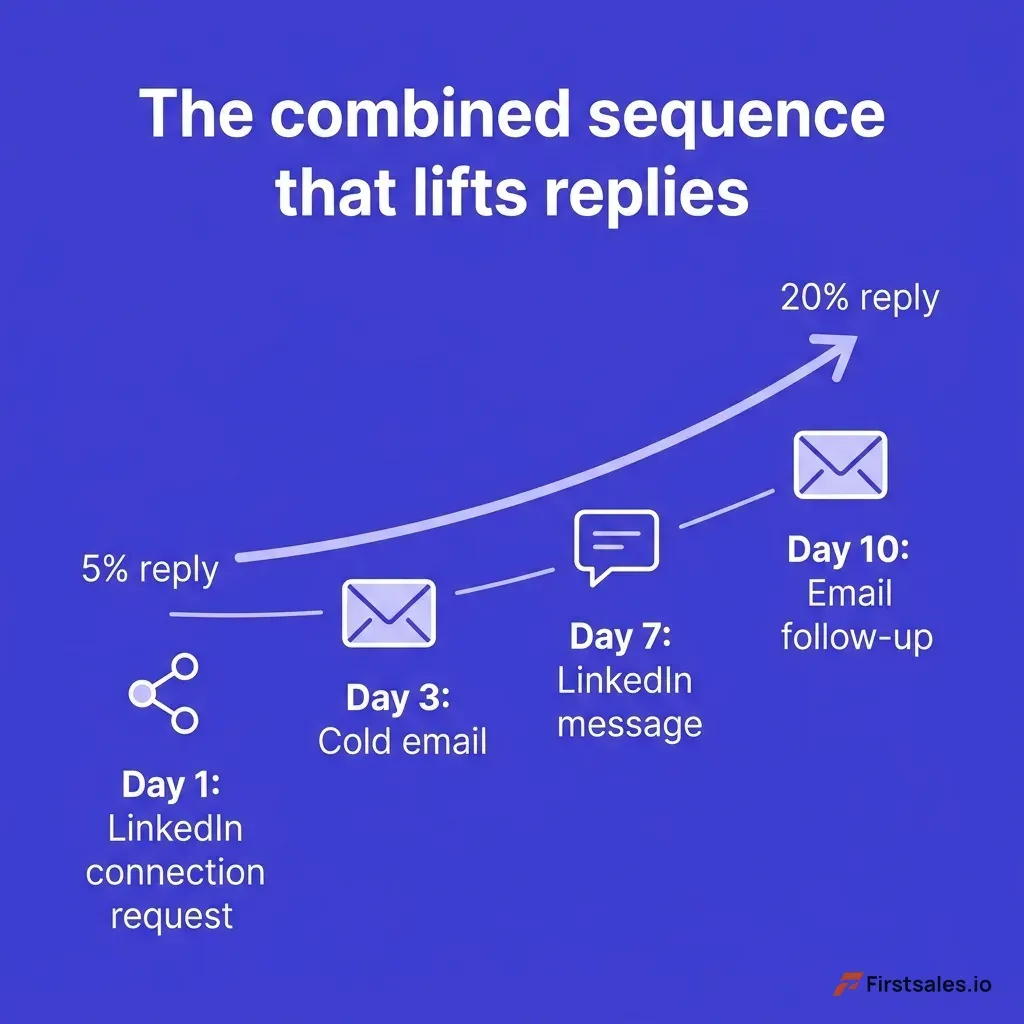 Infographic showing a 14-day combined outreach sequence: day 1 LinkedIn connection request, day 3 cold email, day 7 LinkedIn message, day 10 email follow-up, with a rising reply-rate arrow climbing from 5 percent to 20 percent across the steps, deep indigo and white flat design
A proven structure looks like this: LinkedIn connection request on day one, cold email on day three, a LinkedIn message on day seven once the connection is accepted, and an email follow-up around day ten. GetReplies documents this exact 14-day cadence among the teams hitting 15% to 25%. The sequence respects LinkedIn's limits by using only one connection request per prospect, and it respects email deliverability by keeping the daily send modest.
You can dig into the full cadence design in our email and LinkedIn multichannel outreach playbook.
One caution worth stating plainly: multichannel is not the same as more channels for the sake of it. Adding LinkedIn and a poorly timed cold call and three more emails does not stack into a higher number. It stacks into annoyance.
The lift comes from coordination, two or three well-spaced touches that each carry a real reason, not from saturating someone across every channel you can reach them on. If you are also weighing the phone, our cold calling vs cold email comparison covers where a call earns its place in the sequence and where it just adds noise.
#How to run the combined play
Knowing that you should sequence both is the easy part. Running it without drowning in manual work, or tripping a LinkedIn restriction, is where most teams stall. Here is the operating model that holds up.
Start with the signal, not the channel. Before you decide whether to open with LinkedIn or email, find the reason this account is worth contacting this week. A funding round, a new VP, a hiring spike in the department you serve.
That signal is what makes both the connection request and the email worth answering. Without it, you are just adding a second channel to the same generic message and doubling the indifference. Signal-first targeting is the single biggest reply-rate lever on either channel, which is why it sits at the center of how signal-based cold email works.
Match the channel to the buyer using the deal-size and seniority rules above. A senior buyer on a large deal gets a LinkedIn-led sequence. An IC on a small deal gets an email-led one.
Do not run the same opening move for everyone, because that is exactly the habit that wastes LinkedIn's limited slots on accounts email could have closed.
Keep the human in the loop on the opener and the call to action. AI can draft the structure, pull the signal context, and pace the follow-ups. It should not be the last set of eyes on the first line.
The teams getting 15% to 25% are the ones where a person reads the signal and writes one sentence that could not have gone to anyone else. The supervision is the feature, not the overhead.
This is the model FirstSales is built around. It runs signal-based prospecting across both LinkedIn and email, drafts the outreach with the buying signal already in the message, sequences the touches so you stay inside LinkedIn's limits and email's deliverability rules, and keeps a human review step on every send. You get the LinkedIn reply rate and the email scale in one coordinated motion instead of bolting two tools together and hoping the timing works out.
If you have been running one channel and feeling the ceiling, that combined sequence is usually the unlock.
#FAQs
#Do LinkedIn DMs really get better reply rates than cold email?
Yes, by a clear margin on average. LinkedIn DMs reply at about 10.3% across more than 70,000 campaigns, while cold email averages 3.43% per Instantly's 2026 report and 5.1% per Belkins. Personalized InMails push higher, into the 18% to 25% range, and messages to accepted connections can hit 25% to 35%.
The reply-rate edge is real and consistent. The catch is that LinkedIn caps how many people you can reach, so a higher percentage applies to a much smaller pool.
#If LinkedIn replies more, why use cold email at all?
Volume and reach. LinkedIn limits you to 100 connection requests a week per account, while one operator can send 300 to 500 cold emails a day, roughly a 10:1 advantage. Email also reaches buyers who are not active on LinkedIn and works in markets and industries where LinkedIn penetration is thinner.
For large lists, low-priced products, or any motion that needs throughput, email is the channel that can actually move the numbers. LinkedIn cannot scale past its platform cap.
#What reply rate should I expect from a combined LinkedIn and email sequence?
Teams that coordinate both channels with tight targeting and real personalization typically report 15% to 25% reply rates across the full sequence. Multichannel outreach generates around 50% more replies than either channel alone, and a LinkedIn request followed by a context-aware email within 24 to 48 hours can lift replies more than 2.7x. The gains come from coordination, not from blasting more channels.
Two or three well-spaced, relevant touches beat a flood of them.
#How many LinkedIn connection requests can I safely send per day in 2026?
The weekly hard cap is 100 invitations across all account tiers, including Sales Navigator. The safe daily pattern is roughly 20 to 25 requests for Free and Premium accounts and 25 to 30 for Sales Navigator. Going over the daily soft cap can trigger throttling within a few days even if you stay under the weekly limit.
Keeping your acceptance rate high with personalized notes is the best protection against restriction, since low acceptance is a strong predictor of getting limited.
#How many cold emails can I send per inbox per day?
For a warmed, aged domain with good reputation, the sustainable ceiling is 10 to 20 emails per inbox per day. You scale by adding more inboxes and domains, not by pushing one inbox harder. Bulk senders also need SPF, DKIM, and DMARC, one-click unsubscribe, and a spam complaint rate under 0.10%.
Cross those thresholds and your inbox placement drops for future sends, not just the current campaign. Distributing volume across properly warmed domains is what makes email scale safely.
#Which channel works better for senior executives?
LinkedIn, in most cases. Senior buyers like directors, VPs, and C-suite get hundreds of cold emails a week and read almost none of them, but they check LinkedIn deliberately. A relevant connection request or InMail earns attention that email rarely does at that level.
For deals over $50k, lead with LinkedIn and use email as the warm-up and follow-up. For junior and operational roles who live in their inbox, email often reaches them faster than a connection request that sits unaccepted.
#Does deal size change which channel I should use?
It does, and it is one of the cleaner rules in outbound. Under $5k, lead with cold email and reserve LinkedIn for the senior buyers email cannot reach, because small deals do not justify LinkedIn's per-prospect research time at scale. From $5k to $50k, run a true multichannel sequence led by whichever channel your ICP lives on.
Over $50k, lead with LinkedIn since the buyer is senior and the cycle is relationship-driven, with email as a supporting touch.
#Is LinkedIn outreach safer than cold email?
Not inherently. Both channels punish volume without relevance. LinkedIn restricts accounts with low acceptance rates, and email providers tank your deliverability when complaint rates climb.
The discipline that protects you is identical on both: send fewer, more relevant messages with a real reason behind them. The teams that treat LinkedIn as a safe place to spam get their accounts limited just as fast as the teams that blast generic cold email burn their domains.
#Should I personalize differently on LinkedIn versus email?
The principle is the same, but the surface differs. On LinkedIn you can see the person's posts, mutual connections, and recent activity, so your personalization can reference something they said or did this week. On email you are usually working from enriched data and external signals like funding or hiring, so your personalization anchors on a company event.
Both should contain at least one line that could not be sent to anyone else. The channel changes the input, not the standard.
#Can I automate both channels without sounding like a bot?
Yes, if you keep a human on the opener and the call to action. Automation should handle the structure, the signal research, and the timing so you stay inside LinkedIn's limits and email's deliverability rules. It should not write the first line unsupervised.
The teams hitting 15% to 25% reply rates use AI for the scaffolding and a person for the one sentence that proves they paid attention. That review step is what separates a coordinated sequence from automated noise.
#Conclusion
The "LinkedIn DMs vs cold email" debate has a frustrating answer for anyone hoping to pick one and move on: it depends, and the best teams refuse to choose. LinkedIn wins on reply rate, roughly 10% against email's 3.4% to 5%, and wins decisively with senior buyers and large deals. Cold email wins on scale, with a 10:1 volume advantage that LinkedIn's 100-requests-a-week cap cannot touch, and stays the more reliable reach channel for high-volume motions and buyers who live in their inbox.
Run the comparison honestly and you stop seeing two competitors and start seeing two specialists. LinkedIn is your precision instrument for the accounts and people who matter most. Email is your reach engine for everything that needs throughput.
Point each one where it is strong, sequence them so the LinkedIn touch warms up the email and the email extends the LinkedIn conversation, and you land in the 15% to 25% reply band that neither channel reaches alone.
If you are running one channel and feeling its ceiling, the fastest improvement is not a better subject line or a cleverer connection note. It is layering the second channel with proper timing and a real signal behind every touch. FirstSales runs that combined sequence for you, signal-based prospecting across LinkedIn and email, AI-drafted messages with the buying signal built in, human review on every send, and pacing that respects both platforms' limits.
Start your first campaign for $1 at https://app.firstsales.io and see what a coordinated two-channel motion does to your reply count.