#Cold email for recruiting: reaching passive candidates in 2026
Copy page
TL;DR: Cold email to passive candidates outperforms job board postings for niche technical and executive roles, with top recruiters reporting 30-50% reply rates against a roughly 5% general cold email average. It works because 73% of the workforce is not actively job hunting, and email reaches them where job boards cannot. The format still needs the same deliverability discipline as sales outbound, plus specific compliance rules job boards handle automatically.
Job boards only reach people who are already looking.
That is a shrinking share of the talent pool a company actually wants.
Cold email reaches everyone else, the engineer three years into a role they are good at but not excited by, the ops leader who has never updated a resume, the specialist who would move for the right offer but has never gone looking for one.
The mechanics look a lot like sales outbound, research, deliverability, a specific reason to reach out, but the compliance rules and candidate psychology carry their own wrinkles.
This piece covers the full workflow, from sourcing to reply handling, along with the specific mistakes that tank recruiting reply rates fastest.
#Why passive candidates respond to email at all
Roughly 73% of the workforce qualifies as passive talent, not actively applying anywhere but open to hearing about the right opportunity.
That is the entire addressable market job boards cannot touch, since job boards only capture people already in active search mode.
Cold email response rates for recruiting specifically run well above general B2B cold email benchmarks.
Top recruiters running well-targeted, well-researched outreach report reply rates between 30% and 50% from passive candidates, while agencies running less targeted campaigns see closer to 15-20%.
For context, general cold email response rates across all use cases sit around 5% in 2025 benchmarks, down from roughly 8.5% in 2019 as inbox competition has intensified.
HR and recruiting-focused outreach specifically has held up better than generic sales cold email, with specialist response rates reported around 8.5% even in less targeted campaigns, likely because a well-crafted recruiting message carries an inherent value proposition, a potential new opportunity, that a sales pitch does not.
The gap between the top and bottom of that range comes down to one thing: how specific and researched the message is before it ever gets sent.
#Why generic recruiting emails fail
"We're hiring" subject lines are one of the most consistently cited reasons recruiting response rates have declined.
A message that reads like it was sent to five hundred people at once gets the same treatment as a sales blast: ignored or deleted within seconds.
Passive candidates, by definition, were not looking.
The message has to do more work than an active-candidate application flow, since there is no existing intent to build on.
That means the subject line, the opening line, and the specific reason for reaching out all carry more weight in recruiting email than they do in a job posting a candidate opted into seeing.
#What a working recruiting cold email actually contains
Reference something specific and true about the candidate's actual work.
A recent conference talk, a GitHub contribution, a promotion announcement, a specific project mentioned in a public post.
Generic "your background looks impressive" language reads as templated even when it is not, because it could apply to anyone.
State the role and the company clearly and early, since passive candidates decide within the first two sentences whether the message is worth their time.
Skip corporate boilerplate about mission and culture in the first message.
That content matters later in the process, not as the reason to open a first email.
Include a real, specific reason this candidate in particular might be a fit, tied to the detail referenced in the opening line, not a generic requirements list copied from the job description.
End with a low-friction ask.
A short call is a big commitment for someone not looking.
"Worth a quick reply if you're open to hearing more?" invites a smaller yes than "let's schedule 30 minutes."
#A sourcing workflow that scales without losing specificity
Manual, fully bespoke research on every candidate does not scale past a handful of searches a week for most recruiters.
The workflow that does scale looks like this: build a target list using specific, verifiable signals, a skill, a tool used, a company worked at, a public contribution, then draft an opening line for each candidate referencing that specific signal before writing the rest of the email from a consistent template.
The signal changes per candidate.
The structure around it stays consistent.
This mirrors the waterfall enrichment approach sales teams use to build accurate contact data before outreach, just applied to candidate sourcing instead of buyer sourcing.
#A ✓/✗ table for recruiting cold email
| Element | ✓ Works | ✗ Backfires |
|---|---|---|
| Subject line | Specific to the role or candidate | "We're hiring" or generic |
| Opening line | References a real, verifiable detail | "Your background looks impressive" |
| Company pitch | One sentence, saved for later in the thread | Full culture deck in message one |
| Ask | Low-friction reply, not an immediate call | "Book 30 minutes" as the first ask |
| Volume | Researched batches of 20-40 a week | Mass blast to a scraped list |
| Follow-up | One or two, spaced days apart, new angle each time | Repeated identical nudges |
| Sending domain | Verified, warmed, separate from company's main domain if volume is high | Sending from a brand-new domain with no warmup |
#Deliverability rules recruiters skip and pay for
 Deliverability rules recruiters skip and pay for
Recruiting teams often treat email like an ATS feature rather than a cold outbound channel, and that mismatch causes deliverability problems sales teams learned to avoid years ago.
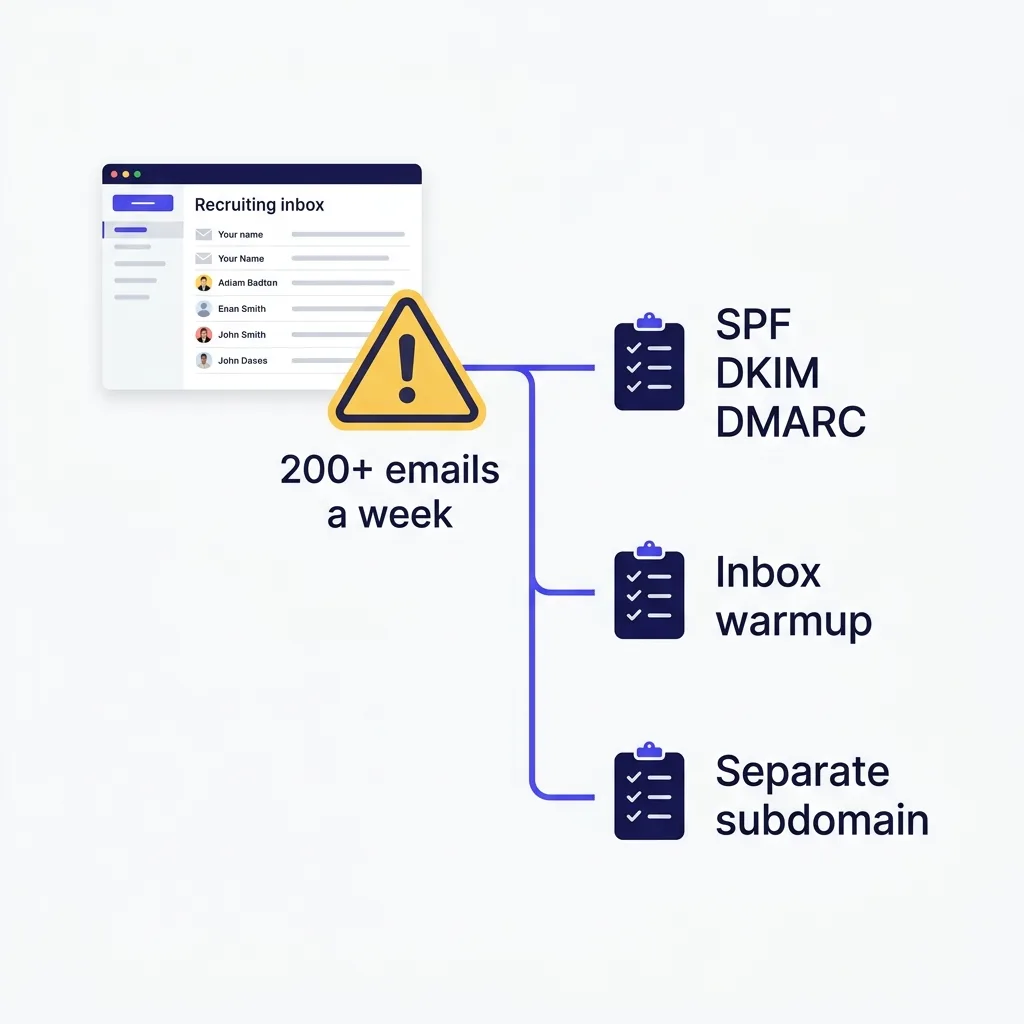
A recruiting inbox sending 200+ personalized cold emails a week needs the same SPF, DKIM, and DMARC setup any sales team running volume outbound needs.
It also needs inbox warmup before ramping volume, since a brand-new domain sending 100 cold emails on day one gets flagged fast by the bulk sender rules Google and Microsoft now enforce.
Verify email addresses before sending, since recruiting lists sourced from public profiles carry a higher bounce risk than purchased B2B contact data, and a high bounce rate on a recruiting domain damages the same domain's reputation for future hiring campaigns and, if shared, for company sales outreach too.
Keep recruiting sends on a separate subdomain from the company's primary sales domain when volume climbs past a few dozen emails a day, so one program's deliverability problems do not spill into the other.
#The compliance layer job boards handle that email does not
Job board applications come with built-in consent, a candidate applying has opted in.
Cold recruiting email does not have that built-in protection, and the same legal frameworks that govern cold email generally, CAN-SPAM in the US, GDPR in the EU, apply to recruiting outreach the same way they apply to sales outreach.
That means a working unsubscribe mechanism, accurate sender identification, and, in GDPR jurisdictions, a legitimate interest basis for processing the candidate's contact data.
Recruiting-specific nuance: several jurisdictions have additional rules around processing employment-related personal data, and some professional communities, certain engineering and legal networks in particular, have stronger norms against unsolicited recruiting contact than the general population.
Respect opt-outs immediately and permanently.
A candidate who declines interest today may be the right fit in eighteen months, and burning that relationship with a non-compliant follow-up removes that future option entirely.
#In-house recruiters versus agencies: different playbooks
An in-house recruiter sourcing for a single company can afford more research time per candidate, since the volume needed to fill a handful of roles a quarter is much lower than an agency running multiple client searches simultaneously.
In-house outreach also carries more inherent trust, since the message comes directly from the hiring company rather than a third party the candidate has never heard of.
Agency recruiters need a tighter, more repeatable process to sustain volume across multiple open searches, and they carry an extra credibility hurdle: candidates are more skeptical of agency outreach by default, having likely received generic agency spam before.
Agencies that succeed at cold email lean harder into demonstrating specific market knowledge in the opening message, naming the client's actual stack, team structure, or a real open problem the role solves, rather than a generic "great opportunity" pitch.
Both models benefit from tools built for recruiting-specific cold email, since general sales sequencers often lack the candidate-tracking fields recruiting workflows need.
#Where AI fits and where it does not
AI can meaningfully speed up the research step, pulling a candidate's public contributions, recent role changes, or published work into a research brief a recruiter can turn into a specific opening line in seconds rather than the ten to fifteen minutes manual research used to take.
What AI should not do is write the entire outreach message from a generic prompt and send it unreviewed.
Recruiting messages carry more scrutiny than typical sales cold email, since candidates are evaluating whether the company itself feels genuine, and a message with the smooth, slightly generic cadence of unedited AI writing undercuts exactly the trust signal recruiting outreach needs most.
FirstSales applies this same principle to sales outbound: AI drafts based on real research, a human reviews and approves before anything sends. The same human-in-the-loop model works well for recruiting outreach, where the stakes of a message feeling impersonal are, if anything, higher than in sales.
#Handling the reply, not just the send
A 30-50% reply rate from a well-run campaign means a recruiter needs a fast, personal response ready, not a templated auto-reply.
Passive candidates who reply are taking a small risk, engaging with an unsolicited message, and a slow or generic response after that first reply erodes the goodwill the outreach built.
Reply within one business day where possible.
Move quickly from the initial reply to a short, low-pressure call rather than an immediate formal interview ask, since passive candidates are still deciding whether they are even open to a real process at this stage.
Our guide to reply handling in outbound covers the same principles that apply here, adapted for a recruiting context where trust-building matters even more than speed alone.
#A template structure worth borrowing
Most working recruiting cold emails follow a similar four-part structure, even though the specific content varies by role.
Line one names the candidate and the specific, real detail that prompted the outreach.
Line two states the role and company in a single sentence, without a mission statement.
Line three connects the specific detail from line one to why this particular opening might be relevant to that candidate, not a generic list of requirements.
Line four makes a small, easy ask: a reply, not a call booking, not a resume request.
A working example: "Saw your talk on event-driven architecture at the meetup last month. We're building out a platform engineering team at [company] and the problem you described solving there is close to what we're tackling now. Worth a quick reply if you're open to hearing more, even just to compare notes?"
That message is short, specific, and low-pressure, three qualities that consistently separate high-reply-rate recruiting outreach from generic blasts.
#Handling common candidate objections in the reply thread
 Handling common candidate objections in the reply thread
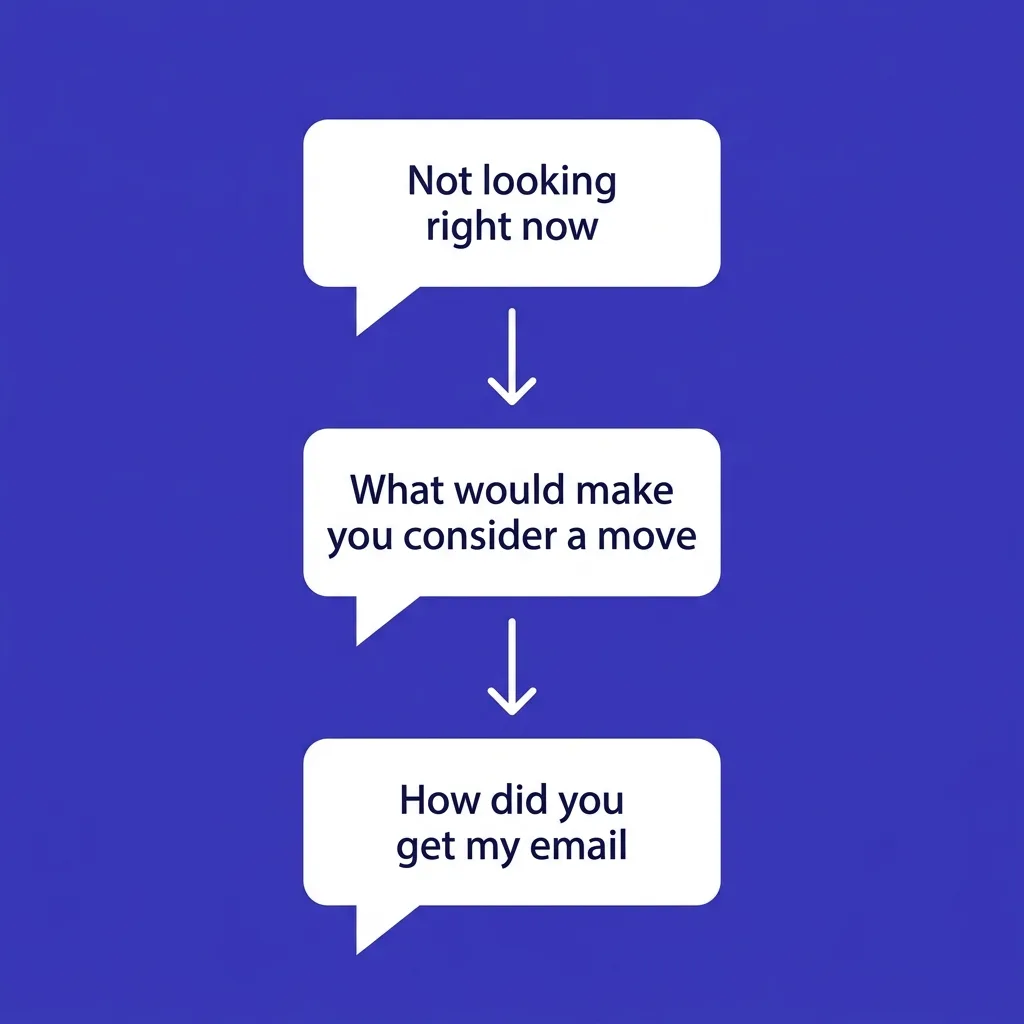
"I'm not looking right now" is the most common reply to a well-targeted recruiting email, and it is not a rejection, it is an honest answer from someone who was not actively searching.
The right response acknowledges that directly and asks permission to stay in touch, rather than pushing for an immediate call.
"What would make you consider a move" is a useful follow-up question that often surfaces real information, comp expectations, remote flexibility, team structure, that shapes whether the role is worth pursuing further or worth revisiting in six months.
"How did you get my email" comes up often enough to prepare for.
A direct, honest answer, naming the public source, a conference talk, a GitHub profile, a LinkedIn post, builds more trust than a vague non-answer, and it reinforces that the outreach was genuinely researched rather than scraped in bulk.
#Metrics worth tracking beyond reply rate
Reply rate alone does not tell a recruiting team whether the pipeline is actually working.
Track reply-to-call conversion, since a high reply rate with a low call conversion rate suggests the messaging attracts curiosity but not real interest.
Track call-to-process conversion, how many candidates who take an initial call move into a formal interview process, since this reveals whether the sourcing criteria matched the role's actual requirements.
Track time from first email to accepted offer for candidates sourced via cold email specifically, and compare it against candidates sourced through referrals or inbound applications.
Cold-sourced candidates often take longer to move through a process since they started from a lower baseline of interest, and knowing that upfront helps set realistic pipeline timelines rather than expecting cold-sourced candidates to move as fast as an inbound applicant.
#Technical hiring versus executive search: different research depth
Technical roles, particularly niche ones like specific infrastructure or machine learning specializations, benefit from research grounded in public technical contributions: open source commits, conference talks, technical blog posts, Stack Overflow activity in some cases.
The specific detail referenced in the opening line carries real technical credibility when it is accurate, and it falls flat fast when it is slightly wrong, since technical candidates notice inaccuracies immediately and it undermines the entire message.
Executive search research leans more on business outcomes: a specific initiative the candidate led, a public statement about strategy, a company milestone during their tenure.
Executive candidates also expect more discretion in the outreach itself, since a poorly worded cold email to a sitting executive at a public company carries real reputational risk for both the recruiter and the candidate if it were to become visible internally.
Slower, more careful outreach cadences and smaller batch sizes fit executive search better than the higher-volume approach that works for broader technical hiring.
#A note on volume and burnout
Recruiting teams that scale cold email volume aggressively without matching research depth see reply rates collapse toward the general 5% average within a few weeks, as candidates in shared networks start recognizing the pattern.
Technical and executive candidate pools are smaller and more networked than typical B2B buyer lists, meaning a reputation for generic, high-volume outreach spreads faster and does more lasting damage than in broader sales markets.
Cap volume at what genuine research can support.
Twenty to forty well-researched sends a week from one recruiter consistently outperforms two hundred generic ones, both in reply rate and in the longer-term reputation of the recruiting brand within a specific talent community.
That discipline matters more in recruiting than in most sales contexts, since the same senior engineer or executive candidate a company ignores today with a lazy blast may be the exact hire it needs in a year, and a damaged reputation in a tight talent network is far harder to repair than a burned sales prospect.
#Internships and early-career outreach follow a different curve
Cold outreach for internships and early-career hires works differently than senior technical or executive search, since the candidates rarely have a large public body of work to research.
The specific detail worth referencing shifts toward coursework, a class project, a hackathon result, or a specific student organization role, rather than years of professional output.
Response rates for well-targeted internship outreach can run high, since students actively building a resume are more receptive to unsolicited contact than an established professional deep into a settled career, but the same specificity rule still applies.
A message referencing an actual project a student built outperforms a generic "great opportunity for students" blast by the same margin generic sales email underperforms personalized outreach.
Our related piece on cold emails for internships covers the student-side mechanics of this same dynamic in more depth.
#Building a repeatable process instead of one-off campaigns
The recruiters who sustain high reply rates over time treat cold email as an ongoing pipeline-building habit, not a one-time push when a role opens.
A standing weekly block of time for sourcing and outreach, even just a few hours, keeps a warm pipeline of passive candidates in progress before a specific role even opens, which shortens time-to-fill dramatically when a real opening does appear.
This mirrors how sales teams treat ideal customer profile work: define the target precisely, source consistently against that definition, and keep the pipeline moving rather than starting from zero every time a new need appears.
Recruiting teams that only turn on cold email reactively, after a role has been open for weeks with no inbound applicants, tend to see lower reply rates, since the compressed timeline pushes toward less-researched, higher-volume outreach exactly when quality matters most.
#Frequently asked questions
#What is a good reply rate for recruiting cold email?
Top recruiters running well-targeted outreach report 30-50% reply rates from passive candidates. Less targeted campaigns land closer to 15-20%, still well above the roughly 5% general cold email average.
#Is cold email better than job boards for hiring passive candidates?
Yes, for candidates not actively searching. Roughly 73% of the workforce is passive, and job boards structurally cannot reach that group since they only capture active applicants.
#Do I need SPF, DKIM, and DMARC set up for recruiting email?
Yes, if sending any meaningful volume of cold recruiting email. The same deliverability rules that govern sales cold email apply, and Google and Microsoft's bulk sender rules do not distinguish recruiting mail from sales mail.
#Is cold email for recruiting legal?
Yes, subject to the same rules governing any cold email: CAN-SPAM in the US, GDPR in the EU, working unsubscribe mechanisms, and accurate sender identification. See our full breakdown of cold email legality.
#What is the biggest reason recruiting cold emails get ignored?
Generic "we're hiring" language with no specific reference to the individual candidate. This is repeatedly cited as the primary driver of declining reply rates in recruiting outreach.
#Should I use AI to write recruiting outreach emails?
AI works well for the research step, surfacing specific candidate details quickly. Sending fully AI-generated messages without human review tends to undercut the trust and authenticity recruiting outreach depends on.
#How is agency recruiting outreach different from in-house recruiting outreach?
Agencies face an extra credibility hurdle since candidates are more skeptical of third-party recruiters by default. Agency messages need to demonstrate specific market and client knowledge more explicitly than in-house outreach does.
#How many recruiting cold emails should one recruiter send per week?
Twenty to forty well-researched sends per week tends to outperform higher volumes with less research, both in reply rate and long-term reputation within a specific talent community.
#What should the first line of a recruiting cold email say?
A specific, verifiable detail about the candidate's actual work, a project, a talk, a contribution, not a generic compliment about their background.
#How quickly should I respond when a passive candidate replies?
Within one business day where possible. A slow response after a candidate takes the small risk of replying erodes the trust the initial outreach built.
#Should recruiting email come from a separate domain than sales email?
Yes, once volume climbs past a few dozen emails a day. Keeping recruiting and sales sending domains separate prevents one program's deliverability issues from affecting the other.
#Can I buy a list of candidate emails for recruiting outreach?
Purchased lists tend to carry higher bounce risk and lower relevance than lists built from verified public profiles and specific research. Verify any list before sending regardless of source.
#What is the difference between recruiting cold email and a job application follow-up?
A job application follow-up has built-in consent, the candidate applied. Cold recruiting email reaches candidates with no prior contact, which is why it carries stricter compliance requirements around consent and opt-out.
#How do I follow up after a recruiting cold email gets no response?
One or two follow-ups, spaced several days apart, each from a slightly different angle rather than a repeated identical nudge. Stop and revisit in six to twelve months if there is still no response.
#Does cold email work for entry-level recruiting, or only senior roles?
It works best for niche, specialized, or senior roles where the candidate pool is smaller and job boards are less effective. High-volume entry-level hiring typically still relies more heavily on job boards and referral programs.
#What subject lines perform best for recruiting cold email?
Specific subject lines referencing the role, company, or a shared connection outperform generic "opportunity" or "we're hiring" subject lines by a wide margin.
#Should I mention salary in the first recruiting cold email?
Practices vary by market and role level, but naming a real, competitive range earlier tends to filter for genuinely interested candidates faster than withholding it until later conversations.
#How does GDPR affect recruiting cold email in the EU?
The same legitimate interest and consent principles that apply to sales cold email under GDPR apply to recruiting outreach. Some jurisdictions add extra rules specific to processing employment-related personal data, so check local guidance before scaling EU recruiting outreach.
#What tools work best for recruiting cold email specifically?
Tools built with recruiting-specific fields, candidate stage tracking, resume attachments, pipeline status, tend to outperform generic sales sequencers for this use case. See our roundup of cold email tools for recruiters.
#Can cold email replace a recruiter's network entirely?
No. Cold email expands reach beyond an existing network, but warm referrals and an existing relationship still convert at higher rates than any cold channel. Use cold email to fill the gap a personal network cannot cover.
#Key takeaways
Cold email reaches the 73% of the workforce job boards cannot, and reply rates for well-researched recruiting outreach run far above general cold email benchmarks, often 30-50% for the most targeted campaigns.
The format fails the same way sales cold email fails: generic messages, no deliverability groundwork, and volume that outpaces genuine research.
Treat recruiting domains with the same warmup and authentication discipline sales teams use, keep research specific per candidate, and respond fast when a passive candidate takes the risk of replying.
The mechanics are closer to sales outbound than most recruiting teams assume, right down to the value of AI-assisted research paired with human review before a message ever reaches a candidate's inbox.
Treat every cold recruiting email as a first impression of the company itself, not just a pitch for a role, and the reply rate tends to follow.
Candidates remember how they were approached long after they decide whether to reply, and that memory shapes whether they, or someone in their network, is open to hearing from the same company again.
Get the outreach right once, and it keeps paying off well past the single role it was written for.
Every well-run search compounds into a stronger talent network for the next one, which is the real return on the extra research time this approach demands.