#Case-study cold emails: proof that doesn't read as fake
Copy page
TL;DR: A case-study cold email works when the proof point is specific, named, and relevant to the recipient's situation, not when it is loud. One believable number beats three vague claims, and the placement of that number inside the email matters as much as the number itself.
#Table of contents
- Why most proof in cold email reads as fake
- What makes a proof point believable
- The anatomy of a case-study line
- Formats that work in two to three sentences
- Where proof belongs in a sequence
- Building a reusable proof-point library
- Case-study lines by deal size and industry
- Objection-proofing your proof point
- Mistakes that kill credibility
- Matching the case study to the recipient
- Testing proof points like you test subject lines
- FAQs
#Why most proof in cold email reads as fake
"We help companies grow faster" tells the reader nothing.
It could describe any vendor in any category.
Cold email readers have seen thousands of versions of that sentence, and their pattern recognition is fast.
The moment a claim sounds interchangeable, it gets treated as noise and skipped.
Real proof works differently.
It names a company, a number, and a timeframe, and those three details are hard to fake convincingly.
That is exactly why they carry weight.
A reader who sees "cut onboarding time from 12 days to 3" believes it faster than "dramatically improved onboarding," because the specific version could not have been generated by a template.
Vagueness is the tell.
Specificity is the proof.
This matters even more given how crowded the average inbox has become.
Bulk sender rules now enforce a complaint threshold under 0.3% and a bounce rate under 2% before a sending domain even reaches the primary inbox reliably.
That means the emails that do land are competing for attention against a smaller, more scrutinized pool of senders, and a generic claim stands out for the wrong reason inside that pool.
A specific, checkable number stands out for the right one.
#What makes a proof point believable
Four things separate a proof point that lands from one that gets deleted.
Specificity. A number beats an adjective every time. "Reduced reply-to-meeting drop-off by 40%" beats "significantly improved conversion."
A name or a category. You do not always have permission to name the client. When you do not, name the category precisely: "a 200-person fintech" instead of "a company."
A timeframe. Results without a timeframe are unfalsifiable. "Grew pipeline 3x" means nothing without knowing if that took six weeks or three years.
Relevance to the reader. A result from a company nothing like the recipient's does not transfer. Match industry, size, or specific pain point when you can.
"The most persuasive case studies read like a data point someone forgot to remove from an internal report, not like marketing copy." That is how one growth lead at a mid-market SaaS company described the difference to her team after testing both formats.
Miss any one of these four and the proof point starts to feel manufactured, even if every number in it is true.
#The anatomy of a case-study line
A case-study line in cold email is not a case study.
It is one sentence, sometimes two, that carries the weight of proof without the format of a document.
The structure that works most consistently: who, what changed, over what period.
"A 40-person agency in your space cut client onboarding from three weeks to four days after switching their intake process."
That sentence has a recognizable buyer (agency, your space), a measurable change (three weeks to four days), and an implied mechanism (switching their intake process) without over-explaining it.
Compare that to a longer version stuffed with methodology, and the shorter one wins almost every time in a cold email, because the reader has not yet earned the longer explanation.
Save the mechanism, the graph, and the full narrative for the reply thread or the deck.
The cold email only needs enough proof to justify one more sentence of the reader's attention.
Look at two more transformations to see the pattern hold across different contexts.
Weak: "Our platform has helped hundreds of companies improve their sales process."
Strong: "A 150-person logistics company we work with went from 6 qualified meetings a month to 22, without adding headcount."
Weak: "Customers see incredible results with our onboarding flow."
Strong: "A fintech client cut new-hire ramp time from five weeks to nine days after we rebuilt their first-week checklist."
Notice that both strong versions skip the adjective entirely.
There is no "incredible," no "significant," no "dramatic."
The number does the emotional work that the adjective was trying and failing to do.
That single substitution, a specific fact for a vague claim, is the entire skill of writing a case-study line.
#Formats that work in two to three sentences
 Formats that work in two to three sentences
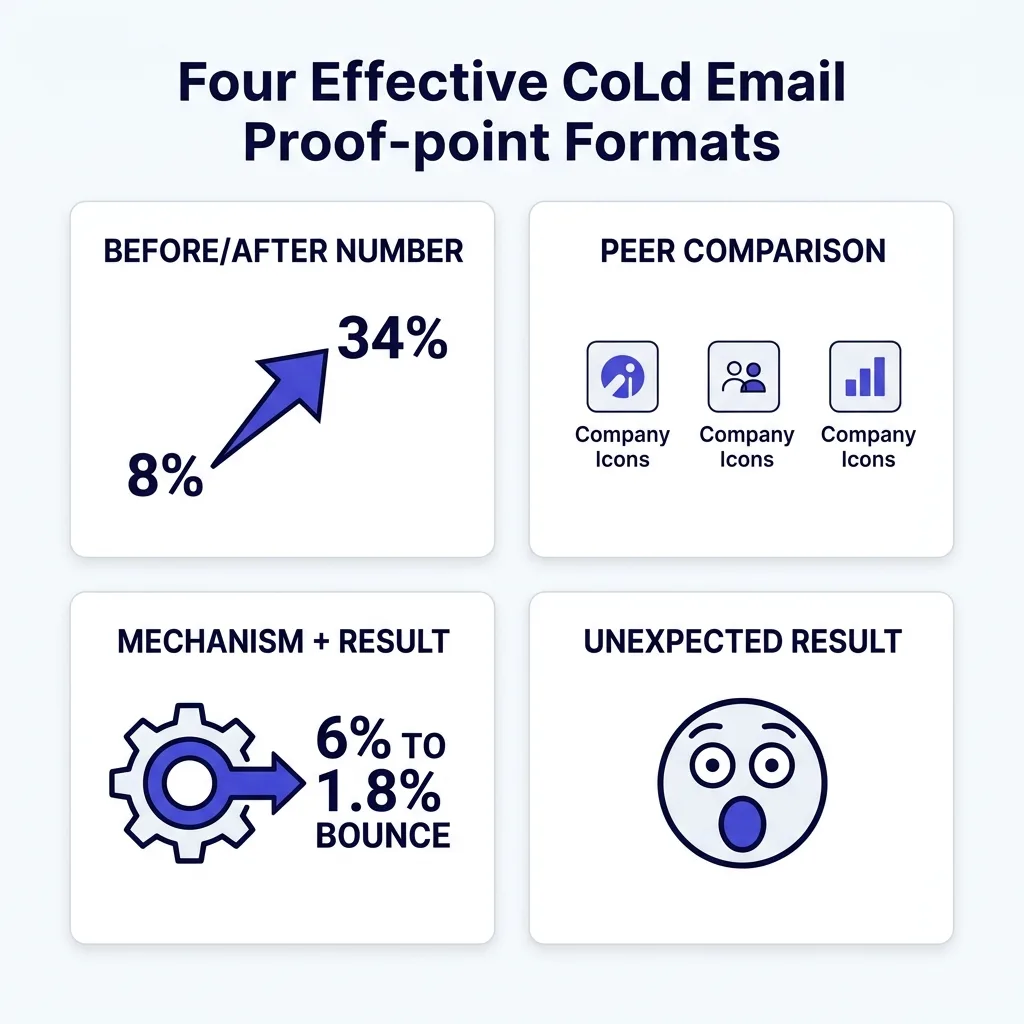
Four formats show up again and again in emails that get replies.
The before/after number. "Went from an 8% show rate to 34% in six weeks." Clean, measurable, hard to dismiss.
The peer comparison. "Three other [industry] teams we work with hit this exact wall before fixing X." This works because it implies a pattern, not a one-off.
The mechanism-plus-result. "They stopped manually verifying every list and cut bounce rate from 6% to 1.8% in a month." This pairs the how with the what, which builds more trust than a bare number.
The unexpected result. "The surprise wasn't speed, it was that reply quality went up once volume went down." Counterintuitive proof gets read more carefully because it breaks the pattern of predictable sales claims.
Pick one format per email. Stacking two or three proof formats in a single message dilutes each one and starts to read like a highlight reel instead of a relevant example.
#Where proof belongs in a sequence
Proof placement changes what it needs to do.
| Sequence position | Job of the proof point | Tone |
|---|---|---|
| ✓ Email 1 | Earn one more sentence of attention | Light, one line, no elaboration |
| ✓ Email 2-3 | Build specific relevance to the reader's situation | Slightly deeper, tie to a stated pain point |
| ✓ Breakup email | Give one last reason to reconsider | Sharpest, most specific number you have |
| ✗ Email 1 with full case study | Overloads a cold reader before trust exists | Reads as a pitch deck disguised as an email |
| ✗ Every email, same proof point | Repetition without new information | Feels automated, reduces credibility over time |
The first email should carry the lightest proof, almost a passing reference, because the reader has not yet decided whether to trust anything you say.
By the third or fourth touch, once they have opened multiple emails without unsubscribing, a slightly deeper proof point earns more attention.
The breakup email is often the best place for your single strongest number, because it is the last message and the reader has nothing left to lose by reading closely.
This flow maps how proof weight should build across a sequence, from a light touch to the strongest close.
Every arrow that ends in a reply means the proof point did its job and the conversation no longer needs scripted evidence.
#Building a reusable proof-point library
Writing a fresh proof point for every email wastes time and produces inconsistent quality.
The teams that use case-study lines well maintain a short, living document instead: a proof-point library.
Each entry needs four fields to stay usable: the result (with real numbers), the customer category (industry, size, role), the timeframe, and which segment it applies to.
A library entry might read: "Show rate 8% to 34% in six weeks, 40-person marketing agency, applies to agencies under 75 people."
That structure makes it fast to pull the right proof point for the right recipient instead of reaching for whatever number comes to mind first.
Update the library every time a new result closes, and retire entries once they pass roughly six months old unless the result is still your strongest available.
A stale library is worse than no library, because it trains reps to reach for numbers that no longer represent current performance.
Keep the library short. Ten to fifteen strong, current entries beat sixty half-remembered ones nobody actually uses.
#Case-study lines by deal size and industry
Proof that lands for a 20-person startup often falls flat for an enterprise buyer, and the reverse is just as true.
Startup and SMB. Speed and resourcefulness matter more than scale. "A 15-person team automated their outbound research and freed up 6 hours a week without hiring" resonates because it speaks to constrained headcount.
Mid-market. Process and consistency carry more weight here. "A 200-person team standardized their intake process and cut variance in response time from days to hours" fits a buyer worried about scaling operations without losing control.
Enterprise. Risk reduction and compliance often matter as much as growth. "A regulated financial services team reduced manual review time by 30% while maintaining full audit trail" speaks directly to a buyer who cares about governance, not just speed.
Agencies and services firms. Client-facing metrics work best. "An agency cut client onboarding from three weeks to four days, which let them take on 20% more accounts without adding staff" ties the result to revenue capacity.
Recruiting and talent. Time-to-fill and candidate quality dominate. A number like "cut sourcing time per role from 14 hours to 3" speaks the language recruiters already track daily.
The pattern across all five: match not just the industry, but the specific metric that segment already watches internally.
A logistics buyer thinks in on-time percentages.
A finance buyer thinks in compliance and audit trails.
A recruiter thinks in days and candidate quality, not abstract efficiency gains.
Use their vocabulary, not yours.
Pulling this off at scale is exactly why waterfall enrichment and account research tools have become standard in most modern outbound stacks: the segment data has to exist before the matching can happen.
#Objection-proofing your proof point
 Objection-proofing your proof point
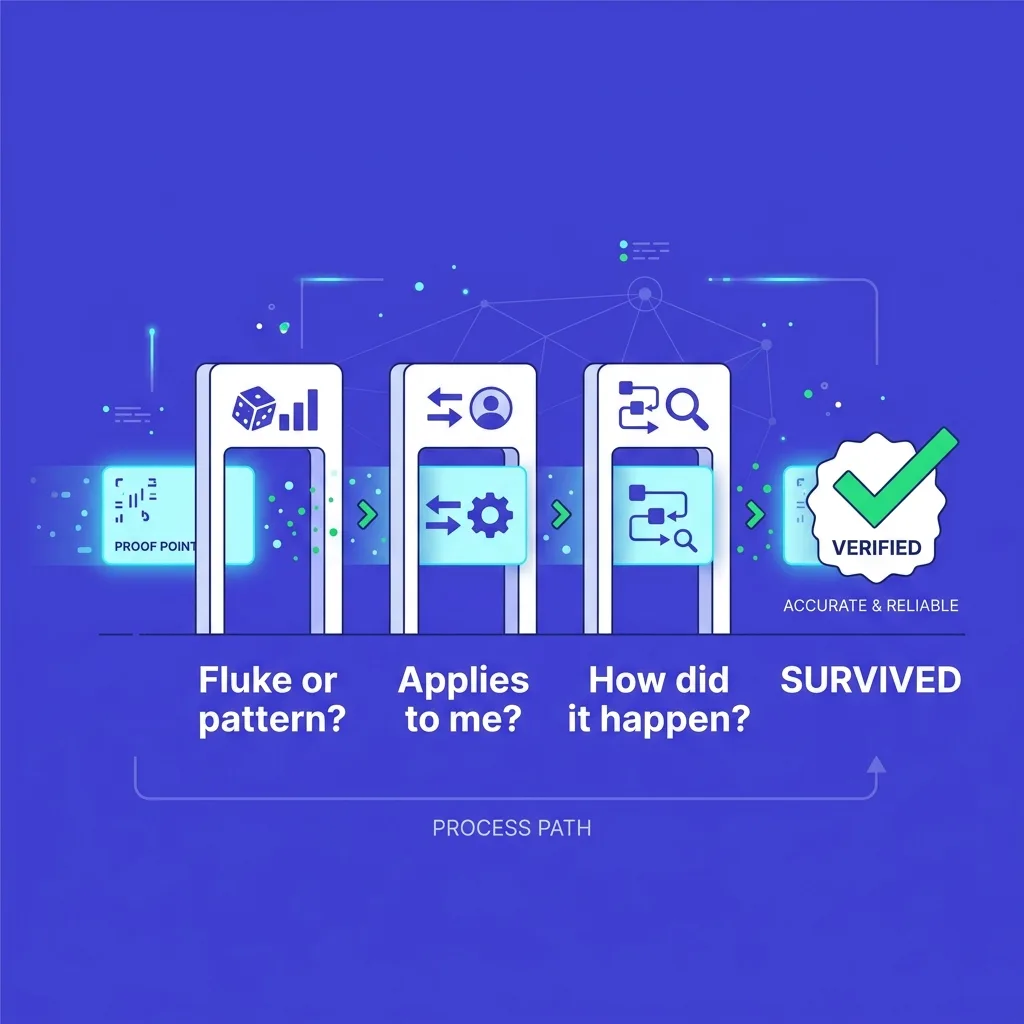
Before a proof point goes into a sequence, run it through three questions a skeptical reader might silently ask.
"Is that a fluke or a pattern?" If you only have one result, say so honestly rather than implying it repeats. "One client saw this" is fine and often more believable than an implied trend you cannot support.
"Does that apply to someone like me?" This is why segment-matching matters more than raw impressiveness. A reader dismisses proof that clearly targets a different kind of company.
"How did that actually happen?" You do not need to answer this fully in the cold email, but the proof point should hint at a plausible mechanism, not just state a result that seems to come from nowhere.
A proof point that survives all three questions without contradiction will hold up under a skeptical read, which is the read every cold email gets by default.
Run this check before every new proof point goes live, not just once when the library entry gets written.
A number that survived scrutiny six months ago can fail the same three questions today if your product, market, or the reader's context has shifted since then.
#Mistakes that kill credibility
Inflated or rounded numbers. "10x growth" sounds impressive and unverifiable at the same time. "Grew from 40 to 340 signups in 90 days" sounds specific enough to be true.
Proof that does not match the recipient's context. Citing an enterprise result to a 12-person startup signals you have not thought about who they are.
Too much detail up front. A three-paragraph case study inside a first-touch cold email overwhelms the reader before they have decided to engage at all.
No source for the number. If someone could ask "wait, is that real?" and you would not have an answer ready, do not use it.
Recycled proof across every campaign. The same stat in email after email, quarter after quarter, starts to feel less like evidence and more like a slogan.
Proof stacked on top of proof. Two or three numbers crammed into one sentence force the reader to do math instead of absorbing a single clear idea. Pick the one number that matters most for this recipient and cut the rest.
A result with no plausible mechanism. "We tripled their pipeline" without any hint of how invites suspicion. Even a five-word mechanism ("by fixing their list hygiene") makes the claim feel earned rather than magical.
Each of these mistakes shares one root cause: prioritizing how impressive the claim sounds over how believable it reads to a stranger with no context.
Cold outbound already sits in a skeptical environment.
Average reply rates across cold email hover around 3.4%, with top-performing, well-targeted segments reaching 10-20%.
That gap between average and top performers rarely comes down to a bigger claim.
It comes down to a more believable one, aimed at the right reader.
#Matching the case study to the recipient
The single highest-leverage move in case-study cold email is matching the proof to the reader, not picking your best overall number.
A result from a company similar in size, industry, or specific workflow transfers faster than a bigger but less relevant one.
If you sell to both 20-person startups and 2,000-person enterprises, keep at least two proof points ready and route them by segment.
Matching goes deeper than industry and size.
Role matters too.
A proof point about saving a VP of sales time on pipeline reviews lands differently with a VP than the same result framed around individual rep productivity, even though it describes the same underlying change.
Write two or three angles on your strongest results, each aimed at a different buyer role, rather than assuming one framing serves every reader in the buying committee.
A finance buyer cares about cost per outcome.
An operations buyer cares about time saved and process reliability.
A founder often cares about growth velocity above both.
The underlying result can stay the same. The framing around it should not.
This is where signal-based cold email and account research pay off directly.
Knowing that a prospect just changed CRM systems, hired a new VP of sales, or hit a specific operational bottleneck lets you choose the proof point that answers their exact situation instead of a generic best-case number.
AI pre-call research can surface that context fast enough to personalize which case study goes into which email, at a scale a single rep could not match doing it manually.
FirstSales approaches this by keeping a human reviewing every AI-drafted email before it sends, so a mismatched or overreaching proof point gets caught before it reaches a prospect's inbox.
That review step matters more for proof points than almost any other part of the email.
A wrong subject line costs an open.
A mismatched or exaggerated proof point costs trust, and trust is much harder to rebuild once a prospect has flagged your claim as questionable, even silently.
Manual matching does not scale past a certain list size, which is exactly where most reps default back to their single favorite number regardless of who is reading it.
The fix is not more effort per email.
It is a system, whether that is a shared spreadsheet, a CRM field, or an AI research layer, that surfaces the right proof point automatically based on what is known about the account before the email gets written.
#Testing proof points like you test subject lines
Most teams A/B test subject lines and ignore proof points entirely, which is backwards given how much weight proof carries in the body.
Run the same sequence with two different proof formats: a before/after number against a peer comparison, for instance.
Track reply rate and, more importantly, reply sentiment, since a proof point that generates skeptical replies ("is that real?") is worse than one that generates no reply at all.
Rotate proof points across a large enough send volume to get a real signal, not a handful of anecdotal replies.
Over a quarter, most teams find one or two formats consistently outperform the rest for their specific audience, and that becomes the default going forward.
Keep testing new proof points as new results come in.
A number from a case closed eight months ago starts to feel stale even if it is still technically accurate, and refreshing it with something recent keeps the email feeling current.
#What to measure beyond reply rate
Reply rate alone hides which part of the message earned the response.
Track three additional signals when you test proof points: time-to-reply (faster replies often correlate with proof that resolved doubt quickly), meeting-book rate from replies (not just any reply, but replies that convert to a booked call), and objection type in replies that decline.
If declines cluster around "not sure this applies to us," the proof point is mismatched to the segment, not weak on its own.
If declines cluster around "not the right time," the proof point likely worked and the issue is timing, not credibility.
Segmenting your losses this way tells you whether to fix the proof point or fix your targeting, which are two very different problems that look identical in a raw reply-rate number.
#Running a simple two-cell test
Keep the test structure simple enough to actually run consistently.
Split your list into two equal, randomly assigned groups.
Group A gets a before/after number.
Group B gets a peer comparison.
Everything else in the email, subject line, CTA, send time, stays identical between the two groups.
Run the test for at least 200 sends per cell before drawing conclusions, since smaller samples produce noisy results that look meaningful but are not.
Once you have a clear winner, retire the losing variant and start a new test between the winner and a third format.
This rolling test structure means your default proof point keeps improving instead of calcifying around whatever felt right when you first wrote it.
#FAQs
#What is a case-study cold email?
A case-study cold email uses a specific, named or categorized result from an existing customer, condensed into one or two sentences, to build credibility inside an otherwise short outreach message.
#How long should the proof point be in a cold email?
One to two sentences. A full case study belongs in a follow-up, a deck, or a landing page, not the first cold touch.
#Should I name the client in the email?
Only with explicit permission. Without it, describe the client by category and size instead, such as "a 50-person logistics company."
#What if I do not have permission to share any client details?
Use an anonymized but specific description: industry, size, and the specific result, without a name. Specificity still works without a name attached.
#Is a percentage or a raw number more convincing?
Raw numbers with context often read as more real, because percentages can imply a small base ("100% increase" from 1 to 2 customers). Pair a percentage with the actual numbers when possible.
#How do I avoid sounding like I am bragging?
Frame the proof point as relevant information for the reader, not as a boast. "This might be useful given what you're dealing with" reads differently than "Look what we did."
#Should every email in a sequence include a proof point?
No. Repeating the same or similar proof point in every email dilutes it. Reserve strong proof for email one (light touch), a mid-sequence email, and the breakup email.
#What is the biggest mistake teams make with proof points?
Using their single most impressive number for every recipient regardless of fit, instead of matching the proof to what that specific reader would find relevant.
#Can I use industry-wide stats instead of a customer result?
Yes, when you do not have a directly relevant customer result yet. A well-sourced industry statistic can substitute, as long as it is real and cited, not invented.
#How specific does the timeframe need to be?
Specific enough to be checkable in spirit. "In six weeks" is stronger than "recently" or "quickly," which carry no verifiable weight.
#Does case-study proof work better early or late in a sequence?
Light proof works early to earn attention. Deeper, more specific proof works better once the reader has engaged with at least one prior email.
#What if my case study result is smaller than a competitor's?
A smaller, more relevant, more specific number beats a bigger, vague, or irrelevant one. Relevance to the reader matters more than the size of the number.
#Should I include a case study in a video cold email too?
Yes, in condensed form. A single spoken proof point, delivered naturally, works well in video cold email and reinforces what the written email states.
#How do I know if my proof point is landing?
Track reply sentiment, not just reply rate. Replies asking follow-up questions about the result signal the proof point is working; silence or skepticism signals it is not.
#Can I use a competitor's public failure as proof by contrast?
Use it carefully and only with verifiable, public information. Naming a competitor's shortfall without solid sourcing risks credibility and can read as an attack rather than proof.
#What tone should the case-study line carry?
Matter-of-fact, not celebratory. State the result the way you would mention a fact to a colleague, not the way you would announce a win.
#Do proof points work the same across every industry?
No. Regulated or risk-averse industries (finance, healthcare) often respond better to conservative, precisely sourced numbers than to bold percentage claims.
#How often should I refresh the proof points I use?
Every quarter at minimum. A stale but still-accurate number starts to feel disconnected from your current results, and readers notice when the same stat appears for years.
#Is it better to lead with proof or with a question?
Test both. Some segments respond better to proof-first framing, others to a question that surfaces the pain point before proof arrives to answer it.
#Where does case-study proof fit relative to cold email personalization?
Personalization determines who the email speaks to; the proof point determines why they should believe you. Both need to work together, and mismatched personalization with generic proof undercuts the whole email.
#Key takeaways
Believable proof beats impressive proof.
A specific number tied to a relevant company or category, delivered in one or two sentences, does more work than a paragraph of vague claims.
Match the proof point to the reader's actual situation, place it deliberately across your sequence, and refresh it before it goes stale.
Test proof formats the same way you test subject lines, because the format you assume works best is rarely the one your data confirms.
None of this requires a bigger case study team or a slicker template.
It requires treating the proof point with the same discipline you already apply to subject lines and CTAs: write it specifically, test it honestly, and retire it once it stops earning replies.
The teams that do this consistently are not the ones with the most impressive numbers.
They are the ones whose numbers are believable to the exact person reading them.