
TL;DR: Transactional receipts, marketing newsletters, and cold outbound behave nothing alike, and sending all three from the same domain lets any one of them poison the others' reputation. Split each stream onto its own subdomain (or domain) with its own SPF, DKIM, and DMARC records, and ideally its own sending IPs, so a spam-flagged newsletter blast never touches your password reset emails or your outbound replies. As of August 2026, Google, Yahoo, and Microsoft enforce bulk sender rules that make this separation close to mandatory for anyone sending real volume.
Password reset emails and cold outbound pitches have nothing in common except the word "email."
One is expected. The other is a stranger knocking.
Gmail, Yahoo, and Microsoft now score every message before a human ever opens it, and they score the sending identity behind it just as hard.
If your [email protected] domain is also blasting a promotional newsletter that gets marked as spam by 0.4% of recipients, your password reset emails inherit that risk.
That is the entire argument for stream separation, and it is why more infrastructure teams are treating it as a 2026 baseline rather than a nice-to-have.
#What "stream separation" actually means
Stream separation means giving each type of email its own sending identity: its own subdomain or domain, its own authentication records, and often its own dedicated IP.
The three streams almost every company sends are transactional, marketing, and outbound.
Transactional mail includes password resets, receipts, shipping confirmations, and two-factor codes.
Marketing mail includes newsletters, promotional blasts, and product announcements sent to opted-in subscribers.
Outbound (cold) mail includes first-touch prospecting emails sent to people who have not opted in and do not expect to hear from you.
Each stream has a different expected volume, a different expected complaint rate, and a different relationship with the recipient.
Mixing them on one domain means the strictest stream (outbound) drags down the reputation of the most fragile stream (transactional).
#Why the three streams can't share infrastructure
Transactional email has to land instantly and reliably. A delayed password reset is a support ticket.
Marketing email tolerates some friction. A newsletter landing in Promotions is annoying but not catastrophic.
Outbound cold email is the riskiest of the three because recipients never asked for it, so complaint and spam-report rates run naturally higher.
"Sender reputation is now evaluated per sending domain and per IP, not per company." That's the operating assumption behind Google's and Yahoo's 2024 bulk sender requirements, and it hasn't loosened since.
When all three streams share a domain, mailbox providers can't tell them apart. A spike in complaints from an aggressive outbound campaign gets attributed to the whole domain, including the transactional traffic riding on it.
#The 2026 enforcement backdrop
Google and Yahoo's bulk sender requirements, first enforced in February 2024, are no longer a grace-period item.
As of August 2026, any sender pushing 5,000+ messages a day to Gmail addresses must have valid SPF, DKIM, and DMARC, keep spam complaint rates under 0.3%, and keep bounce rates under 2%.
Microsoft rolled out its own 5,000-sender threshold rules for Outlook.com in 2025, mirroring most of Google's floor requirements.
Cross the complaint threshold on a shared domain, and every stream on that domain takes the hit, not just the campaign that caused it.
That single fact is the strongest case for SPF, DKIM, and DMARC setup that treats each stream as its own authentication surface, not a shared configuration.
Yahoo's requirements were published alongside Google's in October 2023 and took effect on the same February 2024 timeline, which means the two largest consumer inbox providers have now enforced identical floor requirements for over two years.
Neither company has signaled any intention to loosen the rules. If anything, both have quietly tightened enforcement as AI-generated spam volume climbed through 2025 and into 2026.
That makes the 5,000-message threshold less of a ceiling to avoid and more of a permanent baseline every growing sender eventually crosses.
#AI has raised the bar on precision
2026 also brought a flood of AI-generated cold email into every inbox.
Inbox providers responded by getting sharper at AI inbox screening for cold email, scoring tone, personalization, and sending patterns before a human ever sees the subject line.
Average cold email reply rates across industries sit around 3.4%, according to multiple 2026 benchmark studies, while top-performing, well-targeted segments reach 10 to 20%.
That gap is mostly about targeting and copy, but infrastructure sets the floor. A great email from a domain with a damaged reputation never reaches the inbox to get read.
Precision now beats volume, and precision starts with the sending identity being clean before the message is even opened.
#Why volume alone stopped working
For years, cold outbound rewarded senders who simply sent more emails to more people.
That approach is now actively penalized. High volume with low personalization triggers exactly the complaint and low-engagement signals that mailbox providers use to demote a sender.
A domain sending 500 highly targeted emails a week with a 6% reply rate builds reputation faster than a domain sending 5,000 generic emails a week with a 1% reply rate, even though the second domain moves more total volume.
That shift changes how outbound infrastructure should be planned. Fewer, cleaner domains sending well-targeted mail now outperform sprawling domain farms sending everything to everyone.
#Domain and subdomain architecture
The standard pattern for 2026 is a root domain reserved for the brand website, with each email stream living on its own subdomain.
A company at acmehq.com might send transactional mail from mail.acmehq.com, marketing from news.acmehq.com, and cold outbound from a fully separate domain like acmereach.com or tryacme.com.
Using a separate root domain (not just a subdomain) for outbound is common because outbound domains sometimes need to be rotated or retired if they take reputation damage, and you never want to retire your actual brand domain.
This is the exact tradeoff covered in subdomain vs separate domain decisions, and the answer depends on how aggressive your outbound volume is.
#How the separation looks end to end
graph TD
    A[Root domain: acmehq.com] --> B[Website + brand pages]
    A --> C[mail.acmehq.com]
    A --> D[news.acmehq.com]
    E[Separate outbound domain: acmereach.com]

    C --> C1[Transactional: password resets, receipts, 2FA]
    D --> D1[Marketing: newsletters, promos]
    E --> E1[Outbound: cold first-touch, sequences]

    C1 --> F1{SPF + DKIM + DMARC on mail subdomain}
    D1 --> F2{SPF + DKIM + DMARC on news subdomain}
    E1 --> F3{SPF + DKIM + DMARC on outbound domain}

    F1 --> G1[Dedicated transactional IP pool]
    F2 --> G2[Shared or dedicated marketing IP pool]
    F3 --> G3[Dedicated outbound IP pool, rotated per rep or team]

    G1 --> H[Gmail / Yahoo / Outlook inbox scoring]
    G2 --> H
    G3 --> H
Each branch has its own authentication and its own IP pool, so a reputation event in one branch cannot cross over into another.
#Why the outbound branch needs the most isolation
Outbound domains take on the highest risk because they send unsolicited first-touch mail to unverified contacts.
That means higher bounce exposure from catch-all email addresses and stale records from ordinary B2B data decay and list hygiene problems.
Isolating outbound onto its own domain means a bad list or an aggressive send schedule burns that domain instead of the one processing customer receipts.
Teams running multiple outbound domains also lean on email domain rotation to spread volume and avoid any single domain crossing provider thresholds, while tracking cold email domain burn rate as a leading indicator of when a domain needs to rest.
#Choosing how many outbound domains to run
A single outbound domain works fine for a small team sending under 1,000 emails a day.
Teams sending higher volume, or running multiple reps in parallel, typically split outbound across 2 to 5 domains, each staying comfortably under the daily thresholds that trigger stricter provider scrutiny.
Splitting volume this way also limits the blast radius further. If one of five outbound domains takes reputation damage, 80% of pipeline activity keeps moving while that one domain is paused and rebuilt.
The tradeoff is operational complexity: more DNS records to manage, more warmup schedules to track, and more dashboards to watch. That complexity is worth it once outbound volume is a meaningful part of pipeline, but it's overkill for a two-person sales team sending a few hundred emails a week.
#Authentication: SPF, DKIM, and DMARC per stream
Each subdomain or domain needs its own SPF record listing the exact sending services authorized to send on its behalf.
Each needs its own DKIM key pair, generated and rotated independently of the other streams.
DMARC policy should escalate gradually: start at p=none to monitor, then move to p=quarantine, and eventually p=reject once you trust the setup.
Moving too fast into a strict DMARC quarantine policy before your SPF and DKIM alignment is verified can silently drop legitimate transactional mail, which is worse than the problem you were solving.
Because DMARC reporting is aggregated at the organizational domain level unless you configure otherwise, subdomain-level policies (sp= tag) let you apply different enforcement strength to outbound versus transactional without one policy overriding the other.
ARC (Authenticated Received Chain) headers matter more in 2026 because forwarded and relayed mail is common in B2B, and a correctly configured ARC email authentication setup keeps forwarded messages from failing DMARC checks they would otherwise pass.
#DKIM selector hygiene
Use a distinct DKIM selector per stream, even within the same DNS zone, so key rotation on one stream never touches the others.
A common pattern is transactional._domainkey, marketing._domainkey, and outbound._domainkey, each pointing to a separate key pair generated by the sending service.
Rotate keys on a fixed schedule, typically every 6 to 12 months, and rotate the outbound key more frequently if that domain sees any sign of reputation stress.
Never reuse a DKIM key across two different sending services, even for the same stream. If you switch outbound tools, generate a new key rather than porting the old one.
#IP separation and warmup
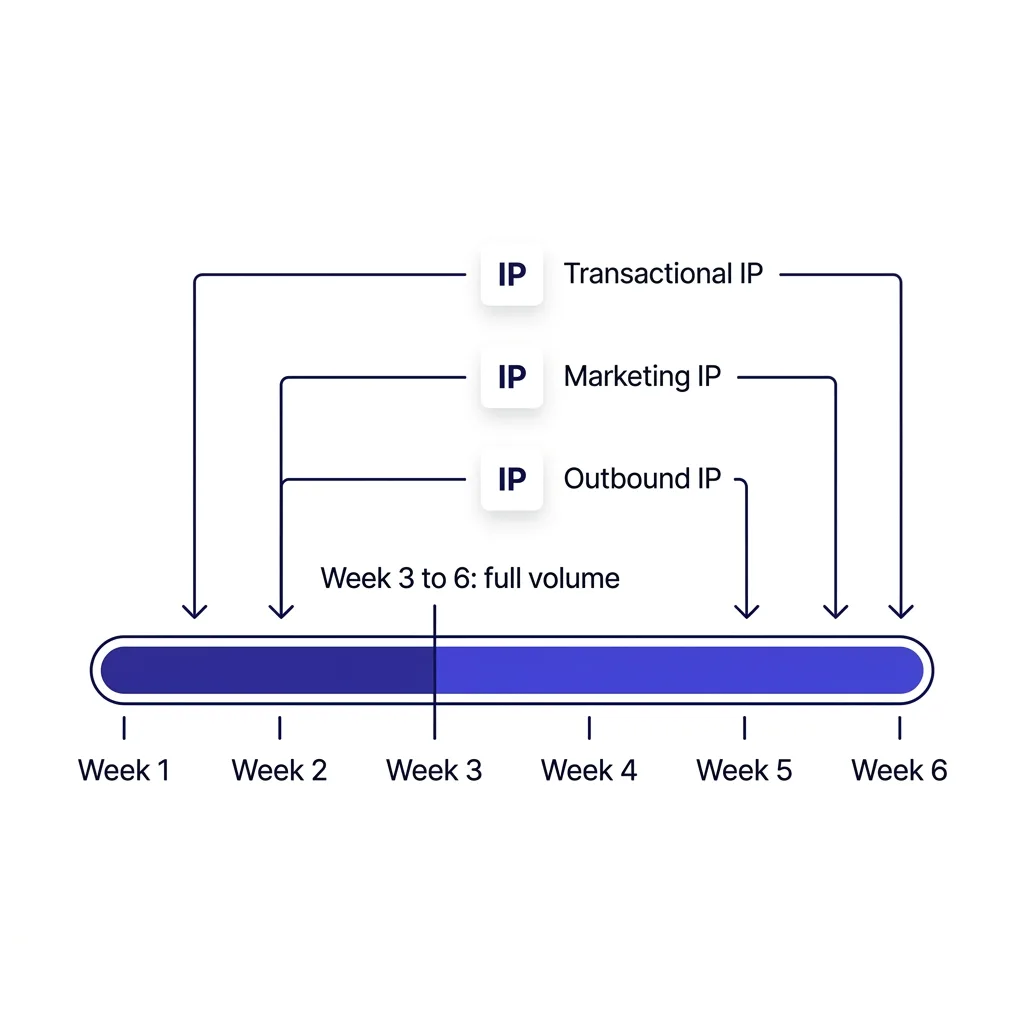 IP separation and warmup
Authentication solves who is allowed to send. IP reputation solves how mailbox providers treat what actually gets sent.
Dedicated IPs per stream mean a spike in outbound bounces never touches the IP reputation carrying your transactional traffic.
Smaller teams sometimes use a shared IP pool for marketing and outbound while keeping transactional fully separate, since transactional deliverability failures are the most expensive kind of mistake.
Every new domain and IP pair needs a real warmup period before full volume, following the same discipline covered in how to warm up an email account and sustained through ongoing email warmup, not a one-time ramp that stops once volume hits target.
Warmup data backs this up directly: accounts that skip a structured ramp show measurably worse email warm-up statistics on inbox placement in their first 30 days compared to accounts warmed gradually.
Some teams now buy pre-warmed inboxes specifically for outbound to skip the fragile early weeks, though the domain itself still needs its own authentication regardless of inbox age.
#Reputation isolation: the core mechanic
Mailbox providers build a reputation score per sending domain and per IP, based on complaint rate, bounce rate, spam trap hits, and engagement signals like opens and replies.
That score determines inbox placement rate: whether your mail lands in the primary inbox, gets filtered to spam, or gets silently dropped.
Separation means a reputation event stays contained to the stream that caused it.
If your marketing subdomain gets hit with complaints after an aggressive promo blast, your outbound domain's reputation is untouched, because inbox providers evaluate them as two distinct sending identities.
#What happens without separation
A single shared domain sending transactional, marketing, and outbound mail creates one combined reputation signal.
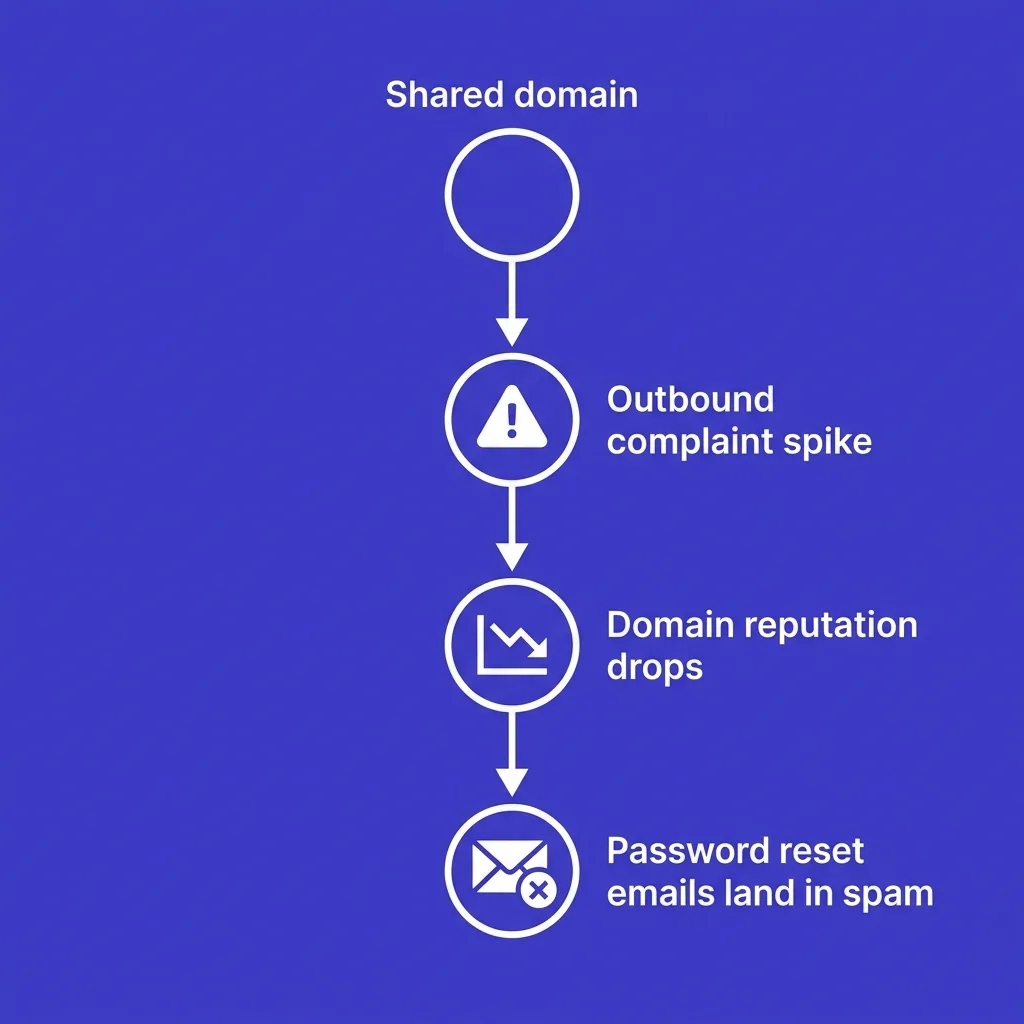
A marketing team's overly frequent send cadence pushes complaint rates above 0.3%, and suddenly password reset emails from the same domain start landing in spam.
That is not a hypothetical. It is the most common root cause when companies discover their transactional deliverability tanked with no code change on the transactional side.
| Setup | Domain isolation | IP isolation | Reputation blast radius | Complaint tolerance |
|---|---|---|---|---|
| Shared domain, all streams | ✗ | ✗ | Full domain, all streams | Very low |
| Subdomains, shared IP | ✓ | ✗ | Partial, IP still shared | Low |
| Subdomains, dedicated IPs | ✓ | ✓ | Contained per stream | Moderate |
| Separate domains, dedicated IPs | ✓ | ✓ | Fully contained | Highest |
| Separate domains + rotation for outbound | ✓ | ✓ | Fully contained, self-healing | Highest |
#BIMI, TLS, and pre-open scoring
Inboxes in 2026 score mail before the recipient opens it, using signals like BIMI logo verification, TLS transport encryption, and historical engagement with the sender.
BIMI requires a verified DMARC policy at enforcement level, which means your marketing and transactional subdomains need clean DMARC alignment before a BIMI logo will even render.
That's covered in depth in BIMI for cold email, including why outbound domains rarely qualify for BIMI the way transactional and marketing domains do.
TLS encryption in transit is now effectively a floor requirement, not a differentiator. Providers flag unencrypted connections as a risk signal that lowers pre-open trust scores.
#Monitoring each stream separately
Once separation is in place, monitoring has to follow the same split, because a combined dashboard hides exactly the signal you built separation to isolate.
Track bounce rate, complaint rate, and inbox placement per domain, not blended across your whole sending footprint.
Email deliverability monitoring tools that support per-domain and per-IP breakdowns are worth the setup time, because catching a reputation dip on your outbound domain three days earlier can be the difference between a slowdown and a full domain replacement.
Run through a cold email deliverability checklist monthly for outbound specifically, since that stream degrades fastest and needs the most active management.
General email deliverability practices (list hygiene, engagement-based sending, gradual volume increases) still apply within each stream, they just now apply independently to three separate reputations instead of one shared one.
#What breaks when teams skip this
 What breaks when teams skip this
The most common failure mode is a startup that grows fast enough to need real outbound volume, but is still sending transactional mail from the same domain used for the marketing newsletter.
A single overly aggressive outbound sequence, sent through a platform like FirstSales or any other outreach tool, can spike complaint rates on that shared domain within days.
Support tickets about missing password reset emails follow within a week, and by the time someone traces it back to the outbound campaign, the domain's reputation has already taken real damage that takes weeks to rebuild.
The fix at that point is not just adding SPF records. It usually means standing up a fresh outbound domain, warming it properly, and rebuilding the sending pattern from zero.
That is a far more expensive fix than separating the streams up front would have been.
The rebuild timeline is rarely quick. A fresh domain needs registration, DNS propagation, a full warmup cycle, and weeks of clean sending before providers trust it at normal volume again.
During that window, whichever function depended on the burned domain (transactional confirmations, marketing sends, or outbound pipeline) runs at reduced capacity or through a stopgap workaround.
Sales teams in particular feel this acutely, because a burned outbound domain during an active quarter means reps either pause outreach entirely or route it through unfamiliar backup infrastructure mid-campaign.
#The cost of consolidated infrastructure
Teams that try to save money by running everything through one cold email stack and one domain usually end up paying more later in lost transactional deliverability, domain replacement costs, and lost pipeline while outbound is rebuilding trust.
Separate domains and dedicated IPs cost more upfront in tooling and DNS management, but the alternative is a shared failure mode across three business functions that have nothing to do with each other.
#Migrating from one shared domain to three
Moving an existing setup into separated streams takes a few weeks, and the order matters.
Start with transactional, since it's usually the lowest-volume, most predictable stream and the easiest to test safely.
- Stand up the transactional subdomain, configure SPF, DKIM, and DMARC at
p=none, and run a two-week monitoring window before cutting real traffic over. - Move marketing next, following the same authentication sequence, watching complaint rates closely during the first few sends.
- Stand up the outbound domain last, since it needs the longest warmup and carries the highest risk, and begin warmup before any real outbound campaign touches it.
Keep the old shared domain active in read-only mode for a few weeks after cutover, so any bounced replies or delayed responses to prior sends still resolve correctly.
Only decommission the shared domain once all three new streams have run cleanly for at least a full billing cycle.
#Timing this for Q4
Q4 budget cycles bring a predictable spike in outbound volume as sales teams push to hit annual numbers during Q4 budget flush outbound season.
Standing up separated infrastructure now, in August, gives outbound domains roughly two months of proper warmup before the Q4 push, instead of trying to scale a fresh domain during the exact weeks when volume needs to be highest.
Domains that get rushed into high volume without warmup during Q4 are the ones most likely to burn out right when the pipeline needs them most.
#Common mistakes when separating streams
Teams frequently reuse the same DKIM selector across subdomains, which defeats part of the isolation because providers can sometimes correlate signing keys across domains.
Another common mistake is separating domains correctly but still routing all three streams through the same sending IP, which leaves the IP reputation shared even though the domains are not.
A third mistake is treating emails per inbox per day limits the same way across transactional and outbound, when transactional volume is usually predictable and outbound volume needs active throttling to stay under provider thresholds.
Teams also underestimate how fast a TAM reality check for outbound matters here: a small addressable market forces higher send frequency per contact, which raises complaint risk on a domain that has no room to absorb it.
#Frequently asked questions
#What is transactional marketing outbound separation?
It is the practice of sending transactional email, marketing email, and outbound cold email from separate domains or subdomains, each with independent SPF, DKIM, and DMARC records and ideally separate IPs, so a reputation problem in one stream cannot spread to the others.
#Why can't I just use one domain for everything?
Mailbox providers score reputation per sending domain and IP. One shared domain means a complaint spike from an aggressive marketing or outbound send drags down deliverability for transactional mail too, including password resets and receipts.
#Do I need a completely separate domain for outbound, or is a subdomain enough?
A subdomain gives partial isolation and is enough for light outbound volume. Heavier outbound programs typically use a fully separate root domain because outbound domains sometimes need to be rotated or retired, and you never want to retire your main brand domain.
#How many subdomains should a typical company set up?
Most companies land on three: one for transactional, one for marketing, and one (or a separate domain) for outbound. Larger organizations sometimes add a fourth for internal or partner communications.
#What happens if I skip DMARC on my outbound domain?
Without DMARC, you have no way to detect or prevent spoofing on that domain, and mailbox providers treat unauthenticated domains with more suspicion, which lowers inbox placement even for legitimate outbound mail.
#Should DMARC policy be the same across all three streams?
No. Transactional domains can typically move to p=reject fastest since sending sources are limited and predictable. Outbound domains often stay at p=quarantine longer while sending patterns and IP pools are still being tuned.
#How long does IP and domain warmup take before full outbound volume?
Most warmup schedules run 3 to 6 weeks, gradually increasing daily volume while watching bounce and complaint rates. Rushing this window is the single most common cause of a burned outbound domain.
#Can I use the same email service provider for all three streams?
You can use the same provider as long as it supports separate sending domains, separate IP pools, and independent authentication configuration per stream. Using the same provider is fine; sharing the underlying sending identity is not.
#What complaint rate threshold triggers provider penalties in 2026?
Google and Yahoo enforce a 0.3% complaint rate ceiling for bulk senders (5,000+ messages a day to their users), and bounce rates need to stay under 2%. Crossing either threshold risks filtering or blocking.
#Does stream separation help with Microsoft and Outlook too?
Yes. Microsoft's bulk sender requirements for Outlook.com mirror most of Google's thresholds, and Outlook applies its own reputation scoring per domain and IP, so the same separation logic protects deliverability there as well.
#How does BIMI fit into this setup?
BIMI requires DMARC at enforcement level (p=quarantine or p=reject) to display your verified logo in the inbox. Transactional and marketing subdomains usually qualify once DMARC is enforced; outbound domains rarely reach BIMI eligibility because of their higher-risk sending pattern.
#What is the biggest sign that streams aren't properly separated?
A drop in transactional deliverability, like password reset emails landing in spam, that coincides with a marketing or outbound campaign. If unrelated streams affect each other's inbox placement, the underlying infrastructure is still shared somewhere.
#Should small companies bother with this, or is it only for scale?
Any company sending outbound at meaningful volume benefits from at least subdomain-level separation. The cost of setting it up early is far lower than rebuilding a burned domain after transactional mail starts failing.
#How often should I rotate outbound sending domains?
There's no fixed schedule. Rotate when a domain's bounce or complaint metrics degrade past your internal threshold, or when overall send volume outgrows what a single domain can safely carry without tripping provider limits.
#Does separating streams reduce spam complaints on its own?
No. Separation contains the damage from complaints, it does not prevent them. You still need good targeting, clean lists, and reasonable send frequency to keep complaint rates low in the first place.
#What role does list quality play in outbound domain health?
A significant one. Verified lists get roughly double the reply rate of unverified lists and several times the reply rate of purchased lists, and unverified or purchased lists also drive up bounce rates that damage domain reputation faster.
#Can a shared IP pool undo the benefit of separate domains?
Partially. Domain-level authentication (SPF, DKIM, DMARC) still isolates authentication, but IP reputation is shared across whatever domains send through that IP, so a shared pool leaves one layer of risk unaddressed.
#How does AI-generated outbound volume affect this strategy?
Higher AI-driven outbound volume across the industry means inbox providers screen incoming cold email more aggressively. A clean, isolated outbound domain with a good reputation is more likely to survive that stricter screening than a shared domain carrying mixed traffic.
#What's the first step if I currently send everything from one domain?
Set up subdomains for transactional and marketing first, since those are lower-risk to migrate, then stand up a separate domain for outbound and begin its warmup period before moving live outbound volume off the old domain.
#Is there a tool that handles this setup automatically?
Some outbound platforms, including FirstSales, help configure separate sending domains and authentication as part of onboarding, but the DNS-level decisions (which subdomains, how many IPs, DMARC policy progression) are still worth understanding directly rather than delegating blind.
#The setup pays for itself once
Stream separation is one of those infrastructure decisions that feels like overhead until the first time a shared domain gets flagged.
At that point, it becomes the reason password resets stopped arriving and support tickets started piling up.
Set up separate domains, separate authentication, and separate IPs for transactional, marketing, and outbound before volume forces the issue, not after a reputation event forces a rebuild.
The two months before Q4 volume hits is the cheapest time this year to get it right.