TL;DR: BIMI puts your verified logo next to your emails in Gmail, Yahoo, and Apple Mail, but it only works on top of DMARC enforcement, and for most cold outbound domains a Verified Mark Certificate costs $750 to $1,500 a year and requires a registered trademark. It is worth building for a warmed sending domain tied to a real, trademarked brand chasing high volume into consumer inboxes; it is close to useless bolted onto a rotating burner domain that changes every quarter.
#What BIMI actually is
BIMI stands for Brand Indicators for Message Identification.
It is a DNS-published record that tells inboxes which logo to show next to your sender name.
Gmail, Yahoo, Apple Mail, and a growing list of clients read that record and, if your authentication checks out, render your avatar as the actual brand mark instead of a generic letter circle.
You do not install BIMI in a sending tool.
You publish a TXT record at a specific DNS host, point it at an SVG logo file, and optionally point it at a certificate that proves you own the trademark behind that logo.
That last part, the certificate, is where the cost and the friction live.
#Why inboxes score mail before anyone opens it
Inboxes stopped judging cold email at open time years ago.
By 2026, Gmail, Yahoo, and Microsoft evaluate a message before a human ever sees it: SPF, DKIM, and DMARC alignment, TLS on the connection, sender reputation history, and a growing set of visual trust signals including BIMI.
Google and Yahoo's bulk sender rules require SPF, DKIM, and DMARC at a minimum, a spam complaint rate under 0.3%, and a bounce rate under 2% just to clear the front door.
You can read the full breakdown of those thresholds in our Google bulk sender rules guide and the parallel Microsoft cold email rules for 2026.
BIMI sits one layer above that floor.
It does not replace authentication.
It is a reward you earn after authentication is already solid, and inboxes treat it as one more data point in a pre-open trust score, not a bypass for a shaky sender reputation.
#The DMARC floor you need before BIMI matters
BIMI has one non-negotiable prerequisite: DMARC at enforcement.
Your domain's DMARC policy needs to be p=quarantine or p=reject, not p=none.
A monitoring-only policy tells inboxes you have not committed to blocking spoofed mail from your domain, and every major mailbox provider ignores BIMI records on domains sitting at p=none.
Google's own BIMI guidance is explicit about this: DMARC enforcement is a hard gate, not a suggestion.
If you have not moved your DMARC record past monitoring mode, read DMARC quarantine policy before you spend a dollar on BIMI.
Getting SPF, DKIM, and DMARC aligned in the first place is its own project; our SPF, DKIM, DMARC setup for 2026 guide walks through the record syntax most teams get wrong on the first pass.
Skip this step and a BIMI certificate is a receipt for a feature that will never render.
#VMC vs CMC: what each certificate actually proves
Two certificate types exist, and picking the wrong one wastes money.
A Verified Mark Certificate, or VMC, requires a registered trademark on the logo you want to display.
The certificate authority checks that trademark against a national or international registry, confirms you control the domain, and issues a certificate tying the mark to your DNS.
A Common Mark Certificate, or CMC, is the newer, cheaper alternative for brands without a formal trademark.
It still verifies domain ownership and logo consistency but does not require registry-level trademark proof, which makes it faster to obtain and roughly half the price of a VMC.
Gmail accepts both as of 2026, but Apple Mail and some other clients still only render logos backed by a VMC, so the certificate you pick changes where your logo actually shows up.
| Requirement | VMC | CMC |
|---|---|---|
| Registered trademark required | ✓ | ✗ |
| Typical annual cost | $750 to $1,500 | $350 to $750 |
| Gmail logo rendering | ✓ | ✓ |
| Apple Mail logo rendering | ✓ | ✗ (varies by client, expanding slowly) |
| Works without DMARC enforcement | ✗ | ✗ |
| Suitable for a brand-new company with no trademark | ✗ | ✓ |
| Suitable for a rotating outbound sending domain | ✗ | ✗ |
#What a VMC costs in 2026
Pricing varies more than most vendors admit.
Sectigo lists VMCs around $749 a year through authorized resellers, while DigiCert and Entrust price closer to $1,416 to $1,499 a year for the same underlying protection, according to pricing pages reviewed by The SSL Store in 2026.
If your logo is not already trademarked, add legal fees to register the mark, which typically runs a few hundred dollars in filing costs plus attorney time, before a certificate authority will even start the verification process.
That means a company starting from zero, no trademark and no existing DMARC enforcement, is looking at $1,500 to $3,000 in year-one costs once trademark filing, DNS work, and the certificate itself are added up.
Renewal in year two drops closer to the certificate price alone, assuming the trademark stays active and the logo does not change.
#Does the logo actually move open and reply rates
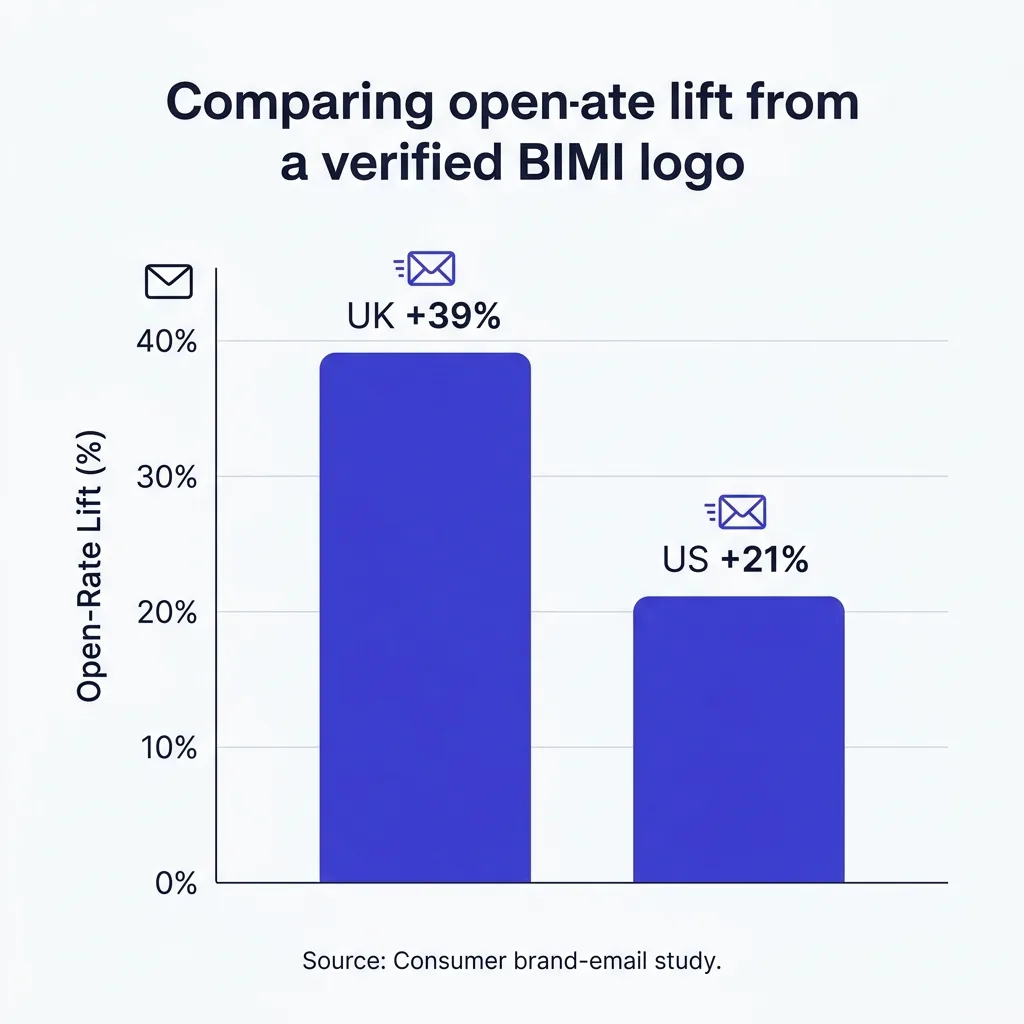 Does the logo actually move open and reply rates
The strongest published number comes from a joint Red Sift and Entrust study, "Consumer Interaction with Visual Brands in Email," which measured a 39% increase in open rates in the UK when a verified brand logo rendered next to the sender name.
The same study found a smaller but still meaningful 21% lift in the United States, reflecting slower BIMI adoption and lower brand-logo familiarity among US inbox users at the time of the study.
Those numbers come from established consumer and marketing email senders with recognized brand logos, not from cold outbound.
No published, named study isolates BIMI's effect on cold outbound reply rates specifically, so treat the consumer-email lift as a directional signal, not a guarantee your cold sequences will see the same jump.
What the data does support is the mechanism: a familiar, verified logo reduces the split-second hesitation a recipient feels before opening mail from an unfamiliar name, and that hesitation is exactly what kills cold email opens in the first place.
Given that context, prospecting from a company most recipients have never heard of gets a smaller trust bump from a logo than prospecting from a brand they already recognize.
#How each inbox provider handles BIMI
Gmail was the first major consumer inbox to support BIMI at scale and remains the most reliable renderer.
A correctly published record with DMARC enforcement typically shows the logo within a few days of the first authenticated send, and Gmail accepts both VMC and CMC certificates.
Yahoo, including AOL under the same infrastructure, follows similar rules to Gmail and has supported BIMI since 2021, making it the second most predictable renderer for cold outbound sending into consumer inboxes.
Apple Mail joined later and, as of 2026, still leans toward VMC-backed logos over CMC-backed ones, so a company without a trademark will see inconsistent rendering on iPhone and Mac mail clients even with a valid CMC.
Microsoft has been the slowest mover.
Outlook and Microsoft 365 rendering support has expanded gradually, and coverage still trails Gmail and Yahoo enough that teams sending heavily into corporate Microsoft inboxes, covered in our Outlook 5,000 sender rules for 2026, should not expect the same visual payoff they would get on Gmail.
That split matters for cold email specifically, since B2B outreach often lands in Microsoft 365 tenants at a much higher rate than B2C mail does.
#How to test whether BIMI is actually rendering
Do not assume a published record means a visible logo.
Send a real test message from your authenticated domain to a Gmail account you control and check whether the avatar shows the brand mark instead of a default letter circle.
Repeat the same test against a Yahoo account and, if you hold a VMC, an Apple Mail account, since each client verifies independently and one can render while another does not.
A handful of free BIMI record checkers will validate your TXT record syntax and confirm the logo URL and certificate URL both resolve correctly, which catches most configuration errors before you waste a test send.
If the record validates but the logo still will not render after two weeks, the most common remaining cause is a DMARC policy that technically enforces but has an alignment mode too loose for the certificate authority's automated checks to accept, which is worth a manual review rather than a guess.
#BIMI and the trust decision happening in half a second
Recipients decide whether to open, ignore, or report a message before they consciously register why.
A verified logo shortens that decision because it answers the "do I know this sender" question visually, without making the recipient read the sender name or the subject line first.
That mechanism is well understood in consumer marketing email, where the Red Sift and Entrust study measured its effect directly, but the same mechanism plausibly applies to any inbox interaction where trust forms before the message is even opened.
The catch for cold outbound is that the mechanism depends on some baseline familiarity or credibility already existing.
A logo on a company nobody has heard of does not create instant trust the way a logo on a known consumer brand does, it just replaces one unfamiliar signal with another unfamiliar signal that happens to look more official.
That is why BIMI's biggest lift shows up on established brands sending high volumes of recognizable marketing and transactional mail, not on early-stage companies running their first outbound motion.
#BIMI setup walkthrough
flowchart TD
    A[Confirm DMARC at p=quarantine or p=reject] --> B{Trademark registered?}
    B -->|Yes| C[Apply for VMC]
    B -->|No| D[Apply for CMC or file trademark first]
    C --> E[Prepare logo as SVG Tiny 1.2, square, centered]
    D --> E
    E --> F[Publish BIMI TXT record at default._bimi.yourdomain.com]
    F --> G[Point record to logo URL and certificate URL]
    G --> H[Test with a BIMI record checker]
    H --> I{Renders in Gmail test send?}
    I -->|No| J[Recheck DMARC alignment and SVG format]
    J --> F
    I -->|Yes| K[Monitor rendering across Yahoo, Apple Mail, Microsoft]
Six things trip people up during setup, in order of frequency.
The SVG file has to follow the SVG Tiny Portable/Secure 1.2 profile, not a regular SVG export from Illustrator or Figma, and most default exports fail validation on the first try.
The logo needs to sit inside a square canvas with the mark centered, because clients crop to a circle and off-center logos get clipped.
The BIMI TXT record goes at default._bimi.yourdomain.com, a specific subdomain most people get wrong the first time.
DMARC enforcement has to be live before you publish the BIMI record, not after, because some inbox providers cache a domain's non-BIMI status for days.
The certificate URL in the record has to be reachable over HTTPS with a valid, non-expired chain, or verification silently fails.
Rendering takes anywhere from a few hours to two weeks to show up consistently, and Gmail, Yahoo, and Apple Mail each run independent verification, so partial rendering across clients during the first week is normal, not broken.
#Why cold email breaks the BIMI model
BIMI was designed for a brand that sends from one stable domain for years and wants recipients to recognize it instantly.
Cold outbound infrastructure works the opposite way on purpose.
Most serious cold email programs run sending on dedicated subdomains, sometimes multiple domains in parallel, specifically to isolate reputation risk from the primary company domain; our guide on subdomain vs separate domain covers why that split exists.
A brand-new sending domain has no reputation, no volume history, and often gets rotated or retired within months if it trips spam thresholds, a pattern covered in cold email domain burn rate.
Paying $1,000 a year to put a verified logo on a domain you might abandon in six months is a bad trade.
BIMI also does nothing to fix the root causes of cold email landing in spam: bad list hygiene, aggressive sending velocity, or content that trips spam filters, all of which matter more day to day than a logo.
If your domain is still fighting basic deliverability, spend the budget on the fundamentals in our cold email deliverability checklist before touching BIMI at all.
#When BIMI pays for itself
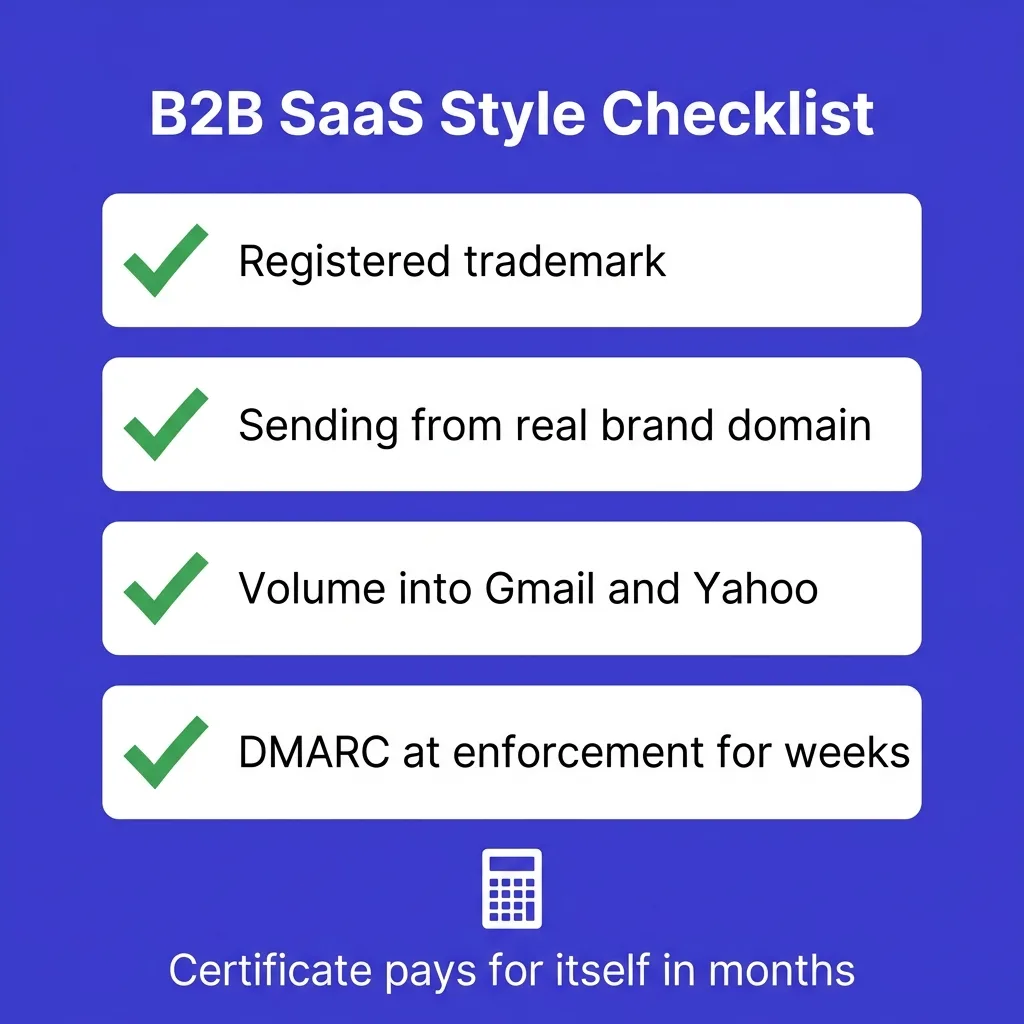 When BIMI pays for itself
BIMI earns its cost in a narrow set of conditions.
Your company has a real, registered trademark and a logo people would recognize if they saw it, not a placeholder wordmark from launch week.
Your sending domain is your actual brand domain, or a long-lived subdomain of it, not a disposable outbound-only domain you expect to retire.
You are sending meaningful volume into Gmail and Yahoo consumer or prosumer inboxes, where BIMI rendering is most mature and the Red Sift and Entrust study's lift numbers were measured.
Your DMARC policy has already been at enforcement for weeks without a spike in legitimate mail getting blocked, which means the authentication foundation is solid enough to build on.
Under those conditions, a $750 to $1,500 annual certificate is a rounding error against the pipeline a few extra points of trust can produce, especially heading into Q4 budget-flush outbound season when inbox volume and competition both spike.
#When to skip it
Skip BIMI if your company has no trademark and no near-term plan to file one.
Skip it if your primary sending infrastructure is a rotating set of new domains, which describes most aggressive cold outbound setups by design.
Skip it if your DMARC record is still at p=none, because the certificate will sit unused until that changes anyway.
Skip it if your actual bottleneck is reply rate on message quality, not brand recognition; our cold email reply rate benchmarks for 2026 show that average cold reply sits around 3.4%, with top-performing segments hitting 10% to 20%, and that gap is driven far more by targeting and copy than by whether a logo renders.
#Running the cost-benefit math
A VMC at $1,200 a year plus trademark filing is easy to justify against a real pipeline number, harder to justify against a hunch.
Take a mid-market team sending 5,000 cold emails a month into consumer or prosumer Gmail inboxes, with an existing 20% open rate.
Even a conservative 5% relative open rate lift, well below the 21% to 39% range the Red Sift and Entrust study measured for established consumer brands, adds roughly 50 extra opens a month on that volume.
If even a fraction of those extra opens convert to replies at your existing reply-to-open ratio, the certificate pays for itself within a few months on volume alone, before counting any brand-recognition effect that compounds over repeated sends to the same accounts.
Run the same math on a 500-email-a-month outbound motion from a two-person startup with no trademark and a domain that might get replaced next quarter, and the certificate cost outweighs any plausible return for at least a year.
Volume, sending domain stability, and existing brand recognition are the three inputs that actually decide the arithmetic, not gut feel about whether a logo "looks more professional."
#Common BIMI mistakes
Publishing the BIMI record before DMARC reaches enforcement is the single most common failure, and the record simply gets ignored until the DMARC policy catches up.
Using a non-square or non-centered logo is the second most common, since it renders cropped or blank in clients that expect a circular mark.
Letting the trademark registration lapse is a quiet one; certificate authorities revalidate periodically, and an expired trademark can silently break a working BIMI setup at renewal.
Assuming BIMI fixes spam placement is the most expensive mistake, since it addresses trust presentation after a message is already accepted, not whether the message gets accepted in the first place.
Forgetting to update the BIMI record after a logo redesign leaves the old mark rendering for weeks, which looks worse to recipients than no logo at all.
#Renewal, logo changes, and ongoing maintenance
VMCs and CMCs are not permanent.
Most certificate authorities issue them on one-year terms, and renewal requires the same trademark and domain verification as the original application, though it usually moves faster the second time.
Any logo change, even a minor color update, technically requires reissuing the certificate against the new SVG file, since the certificate is tied to the specific mark, not just the brand name.
Set a calendar reminder 60 days before expiration.
A lapsed certificate does not just stop showing the logo, it can also flag the domain as inconsistent to inbox providers that cache authentication signals over time.
#BIMI vs the rest of your trust stack
BIMI is one signal among several that inboxes weigh before a message ever gets opened.
TLS on the sending connection, consistent SPF and DKIM alignment, sender reputation built over weeks of ongoing email warmup, and engagement history all carry more weight in spam filtering decisions than a logo.
Authenticated Received Chain, or ARC, matters separately when mail forwards through intermediaries; see ARC email authentication for how that piece fits alongside DMARC.
Think of BIMI as the last five percent of trust signaling, applied on top of a foundation that has to be solid regardless.
Teams running email deliverability monitoring already have visibility into placement and reputation; BIMI is worth layering in only once those numbers are already healthy, not as a fix for numbers that are not.
At FirstSales, deliverability infrastructure, warmup, and authentication setup are handled as part of the platform, so BIMI becomes an incremental decision on top of a domain that is already authenticated correctly rather than a separate project competing for engineering time.
#FAQ
#What does BIMI stand for?
BIMI stands for Brand Indicators for Message Identification, an email standard that displays a verified logo next to sender names in supporting inbox clients.
#Do I need BIMI to pass Gmail's bulk sender requirements?
No. Gmail and Yahoo's bulk sender rules require SPF, DKIM, DMARC, a low complaint rate, and a low bounce rate. BIMI is optional and layered on top.
#What is the difference between a VMC and a CMC?
A VMC requires a registered trademark and typically costs $750 to $1,500 a year; a CMC skips the trademark requirement, costs roughly half as much, but renders in fewer email clients, notably not yet in Apple Mail in most cases.
#Can I get BIMI to work without a trademark?
Yes, through a Common Mark Certificate, though rendering support is narrower than a VMC and Apple Mail generally will not display the logo.
#Does BIMI work without DMARC?
No. DMARC has to be at p=quarantine or p=reject. A p=none policy means inboxes will not render the BIMI logo regardless of certificate status.
#How much does a BIMI setup cost in total?
Budget $750 to $1,500 a year for the certificate itself, plus $300 to $1,000 in one-time trademark filing costs if you do not already hold a registered mark.
#How long does BIMI take to start rendering after setup?
Anywhere from a few hours to about two weeks, since Gmail, Yahoo, and Apple Mail each run independent, asynchronous verification against your DNS records.
#Will BIMI improve my cold email reply rate?
There is no published, named study isolating BIMI's effect on cold outbound reply rates specifically. The closest data, a Red Sift and Entrust study on consumer email, found open rate lifts of 21% to 39% for established brands, which is a directional signal, not a guarantee for cold sequences.
#Does BIMI work on a brand-new sending domain?
Poorly. New domains lack sending history and reputation, and most cold outbound programs rotate or retire sending domains within months, which undercuts the long-term brand recognition BIMI is built around.
#Should I put BIMI on my outbound subdomain or my main domain?
If your outbound subdomain is a long-lived extension of your real brand domain with a stable sending history, BIMI can work there. If it is a disposable domain used purely to protect the primary domain's reputation, skip BIMI on it.
#What logo format does BIMI require?
An SVG file following the SVG Tiny Portable/Secure 1.2 profile, centered on a square canvas, not a standard SVG export from most design tools.
#Where does the BIMI DNS record go?
At default._bimi.yourdomain.com, as a TXT record pointing to the logo URL and, if using a VMC or CMC, the certificate URL.
#Does BIMI work in Outlook or Microsoft 365?
Support has expanded slowly. As of 2026, Microsoft's rendering support trails Gmail and Yahoo, so confirm current client support before budgeting for a Microsoft-focused campaign around BIMI.
#What happens if my trademark registration lapses?
Certificate authorities revalidate periodically, and a lapsed trademark can break an otherwise working BIMI setup at the next renewal cycle.
#Can a small startup with no trademark still show a logo in Gmail?
Yes, through a CMC, which verifies domain and logo consistency without requiring a registered trademark, at roughly half the cost of a VMC.
#Does changing my logo break BIMI?
Yes, until you reissue the certificate against the new SVG file. The old logo may keep rendering for a period after the change if the record and certificate are not updated together.
#Is BIMI worth it for a B2B company with a small, unfamiliar brand?
Less so. The published open rate lifts come from studies of established, recognizable consumer brands. An unfamiliar B2B logo carries less trust weight with recipients who have never seen it.
#Does BIMI affect spam folder placement directly?
Not directly. BIMI is a presentation layer that renders after a message is already accepted and delivered; it does not change spam filtering decisions on its own.
#How often do I need to renew a BIMI certificate?
Most VMCs and CMCs run on one-year terms and require revalidation of trademark and domain ownership at each renewal.
#What should I fix before I even consider BIMI?
DMARC enforcement, SPF and DKIM alignment, sender reputation from consistent warmup, and complaint and bounce rates under Google and Yahoo's thresholds. BIMI adds a small trust layer on top of a foundation that has to already be solid.
#Conclusion
BIMI is a real trust signal, backed by a named study showing double-digit open rate lifts for established brands, and it costs $750 to $1,500 a year to run once a trademark and DMARC enforcement are in place.
For a cold outbound program built on rotating, disposable sending domains, that investment mostly sits unused, because the logo only pays off on infrastructure stable enough to build brand recognition over time.
Get your DMARC policy to enforcement, get your sender reputation clean, and confirm your sending domain is one you intend to keep for years before spending on a certificate.
If those boxes are already checked and your brand has a trademark worth showing, BIMI is a low-cost addition on top of a deliverability program that is already working, not a substitute for one that is not.
FirstSales handles the authentication, warmup, and deliverability groundwork that has to exist before BIMI makes sense, so teams evaluating a verified logo can treat it as the last step, not the first one.