TL;DR: A conference is a trigger event even if you never book a flight. Attendee lists, speaker rosters, and sponsor pages tell you who is in market right now, and 80% of the leads a competitor collects at the booth will never get a real follow-up from that competitor's own sales team. That gap is the opportunity. This piece covers how to source attendee-based lists, time the send around the show, and write copy that does not read like a booth pitch mailed after the fact.
#Why a conference you skip is still a signal
Conference attendance is a strong buying signal because someone had to get budget approval, block calendar time, and justify travel to attend.
That is a higher-effort commitment than clicking a webinar link, which is why a conference attendee list converts better than most generic intent data.
The catch is that almost nobody working that room follows through.
The Center for Exhibition Industry Research has tracked this for years: 80% of trade show leads never get a real follow-up from the vendor who collected them.
Only 49% of the leads that do get contacted hear back within five days, and 94% of marketers admit their own company fails to turn event leads into real pipeline.
That is not a reason to skip the channel.
It is the actual opportunity.
Every attendee who scanned a badge at three booths and got nothing back is sitting on unresolved interest that nobody is servicing.
You are not competing with the sponsor's booth staff for attention at that point.
You are competing with silence, and silence is an easy bar to clear.
#The three data sources that actually work
You need attendee-level data before any of this works, and there are exactly three reliable sources, ranked by how hard they are to get.
Public speaker and agenda pages. Every conference site publishes a speaker list with name, title, and company weeks before the event. This is free, structured, and legal to scrape or copy by hand for a mid-size list.
LinkedIn event and "attending" signals. When a conference has a LinkedIn Event page, people who mark themselves as attending or interested are visible, along with anyone posting about the event with the hashtag. This skews toward more engaged, more senior attendees than the average badge-scan.
Sponsor and exhibitor pages. The list of companies paying to be there tells you who has budget for this specific problem space right now, distinct from who is merely attending.
Attendee lists sold by list brokers or "leaked" from registration systems are the fourth option, and they are the one to avoid.
Provenance is usually unclear, the data decays fast, and in several jurisdictions buying a scraped registrant list without consent creates real compliance exposure.
Build from public pages instead.
It takes longer per name but the list is clean, and clean beats large for this particular play.
flowchart TD
    A[Conference announced] --> B[Speaker + agenda page scraped]
    A --> C[LinkedIn event page tracked]
    A --> D[Sponsor and exhibitor list pulled]
    B --> E[Pre-event list, 3-4 weeks out]
    C --> E
    D --> E
    E --> F[Pre-event touch: relevant, no ask]
    F --> G[During-event touch: timely, specific]
    G --> H[Post-event touch: the actual pitch]
    H --> I{Reply?}
    I -->|Yes| J[Book call]
    I -->|No| K[Drop into standard nurture cadence]
#The timing window, mapped to the calendar
Timing is where most conference outbound goes wrong.
Sending a pitch three months after the show closes wastes the entire signal, because the attendee has moved on to the next thing and the context is gone.
Sending it the morning the conference opens competes with actual conference logistics and gets ignored.
There is a workable window, and it has three distinct moments inside it, each with a different job.
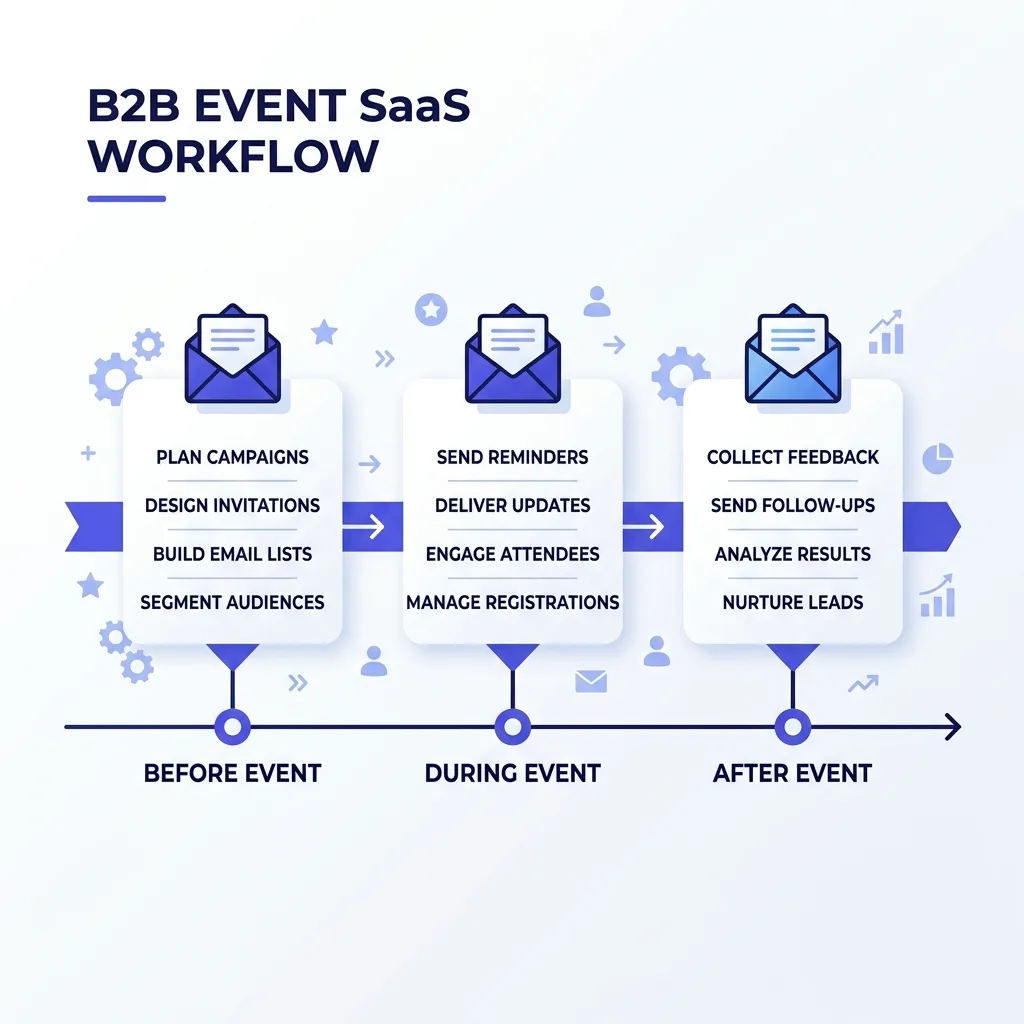
Three to four weeks before. This is a research touch, not a pitch. Reference the specific session or speaker slot the person is attending or presenting. No ask beyond a reply.
During the event, day one or two. A short, specific note tied to something happening live, a session topic, a keynote theme, works because it proves you are paying attention in real time, not running a templated blast.
Five to ten days after the event closes. This is where the actual pitch belongs, once people are back at their desks and processing what they saw. Send it midweek, mid-morning, after the initial post-travel inbox catch-up, the same window that works best for any B2B send.
Waiting past two weeks post-event loses most of the residual attention.
The topic has already been replaced by whatever came up that week.
#Message angles that are not a booth pitch
The single biggest mistake in conference-triggered outbound is writing the email a booth staffer would have said at the table.
"We were at [conference] and wanted to follow up" is exactly what the 20% of exhibitors who do follow up already send, and it reads as generic because it is.
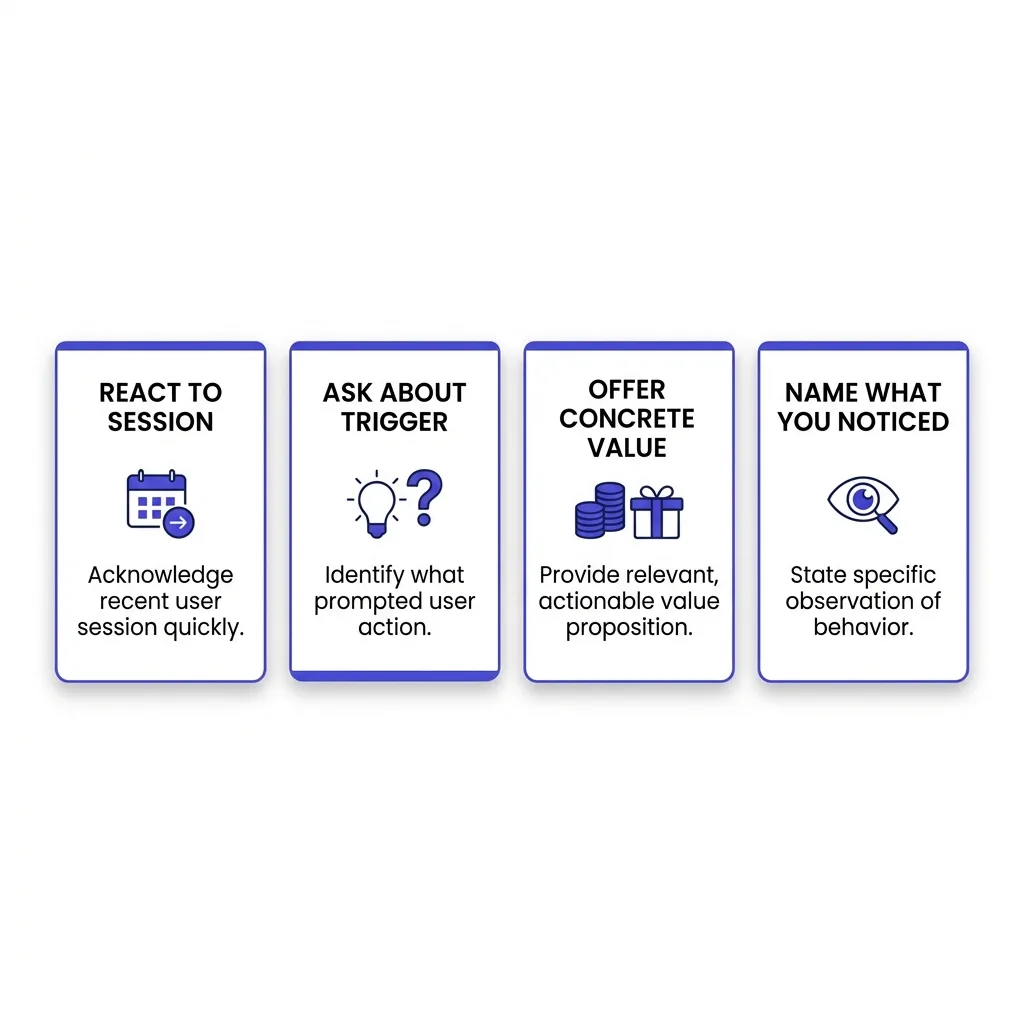 Four conference outbound message angles compared side by side
Four angles that actually differentiate:
React to a specific session, not the event. "Saw [speaker] was on the agenda for [session]. Curious if [specific claim from that talk] matches what you're seeing at [company]." This requires you to actually skim the session abstract, which most senders skip.
Ask about the trigger, not the show. People attend conferences because a project is active. "Guessing [topic] is live at [company] if someone's at [conference] for it" treats the conference as evidence of a project, which is a stronger buying signal than the event itself.
Offer something concrete tied to the theme, not your product. A short benchmark, a comparison, or a checklist related to the conference's core topic earns a reply on its own merit, independent of any pitch.
Name what you noticed, briefly. If the company is a sponsor at a certain tier, or a speaker holds a specific title, say so plainly. Specificity is the entire mechanism. Vague "I saw your company at the event" copy performs no better than a cold list send with zero context.
Avoid anything that implies you were physically there if you were not.
Claiming a booth conversation that never happened is the fastest way to get called out and lose the account permanently.
#What to do with speaker lists specifically
Speakers are a distinct, higher-value segment inside a conference list.
They accepted a public speaking slot on a topic, which means the topic is core to their role, not tangential interest.
They are also easier to research than a generic attendee, because their talk abstract, past talks, and often a full deck are public.
The angle that works with speakers is different from the general attendee angle.
Do not pitch a speaker on solving the exact problem they are presenting as solved.
That reads as either an insult or a misunderstanding of their talk.
Instead, reference a specific point from their abstract and ask a genuine question, or point out an adjacent problem their framework does not cover.
Speakers get pitched constantly in the weeks around a conference, so the bar for a reply is a message that clearly required reading their actual content, not just their name and title.
#Sponsor and exhibitor lists as a different kind of signal
Sponsors and exhibitors are not attendee prospects.
They are companies who already spent budget on this exact problem space, which makes them a fundamentally different kind of trigger: a spend signal, not an interest signal.
Two uses for this list.
First, if you sell adjacent tooling, a competitor's sponsor list is a filtered set of accounts that already believe in this category enough to pay for visibility inside it.
Second, exhibitor staff themselves, marketing and sales leaders who staffed the booth, are a strong prospect list for anything related to event ROI, lead follow-up, or pipeline tooling, since they just lived the exact 80%-follow-up-failure problem firsthand.
That second angle writes itself: "Curious how [company] tracked the leads from the [conference] booth, most teams we talk to lose track of more than half of them within two weeks."
#The competitor angle, handled carefully
If a direct competitor sponsors or exhibits at a conference, their attendee interactions become a usable, though delicate, signal.
The safe version: target the general attendee list for a topic-adjacent conference where a competitor has a large booth presence, without ever naming the competitor in copy.
The volume of interest in a well-attended booth tells you the topic is hot, which is useful targeting information on its own.
Naming a competitor directly in a cold email is a separate decision with its own risk profile, covered in full in our piece on naming competitors in cold email, and the short version is that it helps far more often in later-stage conversations than in a first cold touch.
Skip it here.
Use the competitor's presence as a targeting signal, not a talking point.
#A sample sequence, three touches
Here is a full example, aimed at a fictional data infrastructure conference, for a company selling observability tooling.
Touch one, three weeks before, to a confirmed speaker:
"Hi [name], saw you're speaking on [topic] at [conference] next month. Your abstract mentions [specific claim]. We've seen the opposite pattern at [type of company], curious which one matches what you're seeing at [company] day to day."
Touch two, day one of the event:
"Following the [conference] agenda today, [keynote theme] came up a lot in the first sessions. If that's part of why [company] sent someone, happy to send over the two-page version of what we do with that problem, no meeting required."
Touch three, eight days after the event:
"Hope [conference] was useful. The [specific topic] sessions this year suggest a lot of teams are mid-project on this right now. If [company] is one of them, worth a 15 minute call to compare notes, no pitch if it's not a fit."
Each touch has a different job: prove attention, prove timeliness, then make the actual ask once the person has bandwidth again.
None of the three reads as a booth follow-up, because none of them pretend a booth conversation happened.
#Where this fails
This does not work as a volume play.
Building a real speaker or attendee list by hand takes hours per hundred names, and cutting corners with scraped bulk lists produces the same generic-blast result you were trying to avoid.
It also fails on conferences too small or too niche to have public speaker pages, agenda detail, or a LinkedIn event with visible attendees.
If the source data does not exist publicly, this play does not scale down to that event, and forcing it produces guesswork dressed up as personalization, which prospects notice.
It fails when the timing window slips.
A message sent five weeks after the conference closes reads as a stale, low-effort mail-merge no matter how well it was researched, because the context has expired for the recipient even if it has not for you.
It also fails for anyone running high volume through this motion without multithreading the buying committee.
A single attendee at a conference is one signal from one person.
If the deal needs several stakeholders to move, one conference-triggered email to one name is not enough on its own, it is an opener.
 Timeline showing pre-event, during-event, and post-event outbound touches
#Measuring whether it worked
Compare conference-triggered sends against your standard cold baseline on the same segment, not against a vague industry number.
Reply rate is the primary metric, but track meeting-booked rate separately, since a conference-triggered reply is more likely to be a real conversation given the shared context.
Track how many of these sends convert within 30 days versus your normal outbound cadence by deal size, since conference-triggered leads that go cold fast are a sign the timing window was missed, not that the segment is bad.
Watch time-to-first-reply specifically.
Speed to lead research shows response time inside the first hour dramatically outperforms even a same-day response for inbound leads, and the same logic applies here in reverse: the faster you send inside the post-event window, the more of the residual attention you capture.
If reply tracking is scattered across a shared inbox and a spreadsheet, this kind of segment comparison never actually gets done. A platform like FirstSales that tags sends by campaign makes it possible to pull the conference-triggered segment's reply rate against baseline in a few minutes instead of an afternoon of manual sorting.
| Signal | ✓ Worth building the list | ✗ Skip this event |
|---|---|---|
| Public speaker or agenda page | Detailed abstracts, named speakers with titles | Agenda is a vague topic list, no names |
| LinkedIn event visibility | Hundreds marked attending, active hashtag posts | No LinkedIn event page exists |
| Sponsor tier list | Public, tiered, company names listed | Sponsors listed as logos with no names attached |
| Your ICP fit | Attendee titles match your buyer persona closely | Consumer-facing or wildly adjacent industry event |
| Timing discipline | You can hit the pre-event and post-event windows | You will only get to this list a month late |
#Tooling and how much this should cost
Building the list itself does not require paid attendee-data tools for most mid-size conferences.
A speaker page, an agenda PDF, and a LinkedIn event page cover most of what you need, and a spreadsheet plus a few hours of manual research produces a cleaner list than most paid attendee databases, which are frequently stale by the time a show happens.
Where this gets expensive is enrichment and verification at scale: turning fifty names into fifty verified work emails with correct titles.
That part is worth paying for, since a bounced or misdirected send at this stage wastes a hand-built, time-sensitive list.
Sending itself should run through infrastructure that is already warmed and monitored, not a spun-up domain for the event, since a rushed send schedule around a conference date is exactly the kind of spike that can trip a mailbox provider's bulk sender thresholds if the volume jumps suddenly against a cold domain.
Drafting the touches is where a tool like FirstSales earns its keep here.
Feeding it the speaker abstract or the sponsor tier as the trigger context, and letting a human approve each draft before it sends, keeps the research-driven angle intact instead of collapsing back into a templated "great meeting you at the show" line once volume climbs past what one person can write by hand.
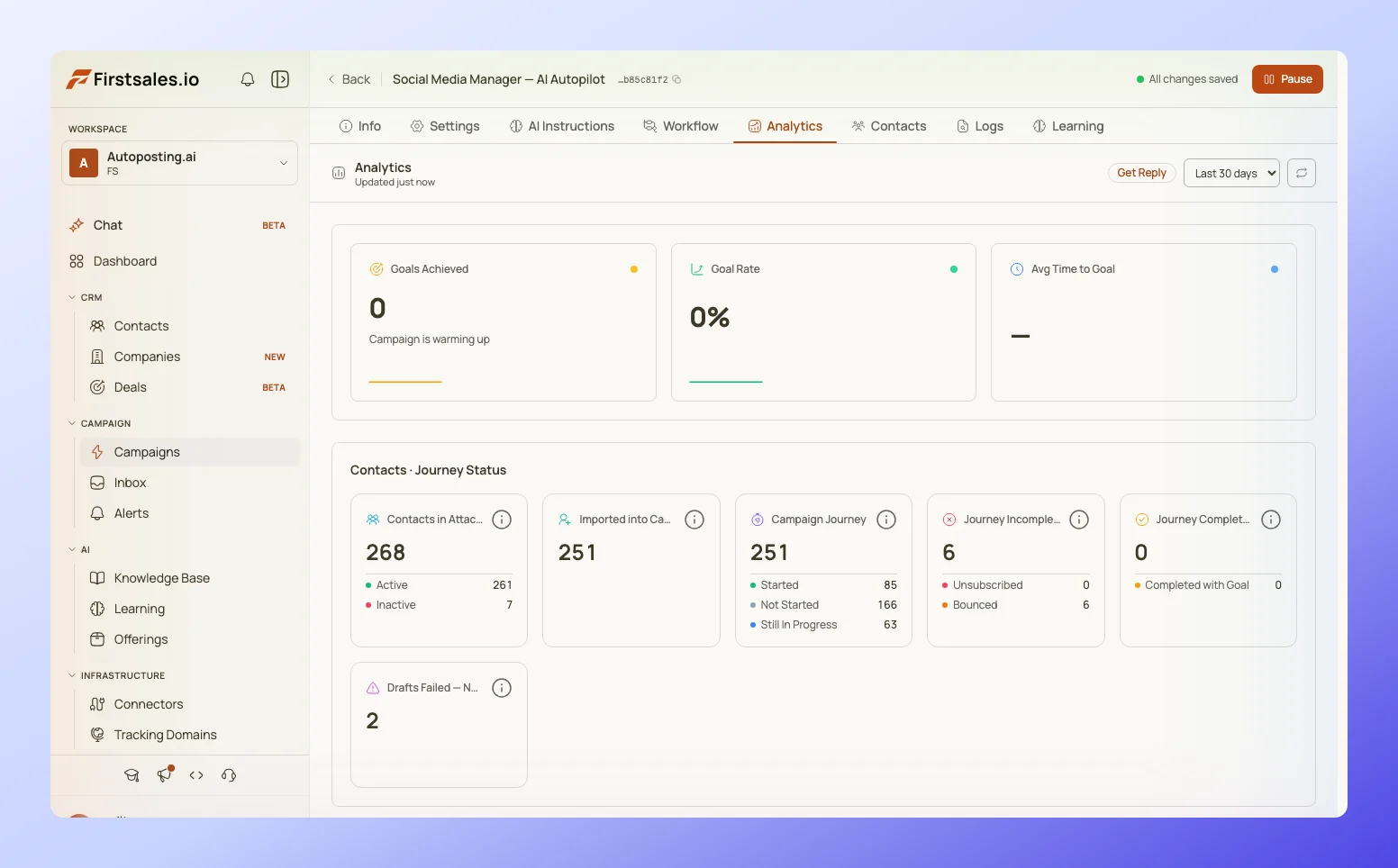 Campaign sequence builder showing a three-touch conference-triggered sequence
#How this fits a broader channel mix
Conference-triggered outbound rarely stands alone.
It pairs naturally with a warm intro pipeline when a conference reveals that a portfolio company, existing customer, or mutual connection is also attending, since a warm path beats a cold one on the same target every time it exists.
For higher-value accounts, a physical note timed to arrive the week before a conference, referencing the same session or speaker slot, compounds the same signal through a second channel.
Track it inside a channel mix cost-per-reply model rather than in isolation, since the real comparison that matters is whether the hours spent building a conference list beat the reply rate of your standard prospecting for the same time investment.
For teams already logging trigger context as a standard field, folding conference attendance into the why-now field in the CRM keeps this from becoming a one-off project that nobody repeats for the next event on the calendar.
#FAQ
#Do I need to attend the conference for this to work?
No. This entire approach assumes you are not there. Attending changes the play into normal event follow-up, which is a different, well-covered motion with its own playbook.
#Where do I find a conference's speaker list if it is not published yet?
Most conferences publish a partial speaker list months out and the full agenda four to six weeks before the event. Check back weekly if the page is thin early on, since speaker rosters get added incrementally.
#Is it legal to build a list from a public speaker page?
Public business contact information used for legitimate B2B outreach is generally permitted under most frameworks, but rules vary by jurisdiction. Check current legal guidance before running this at volume, particularly for EU-based targets.
#What if the conference has no LinkedIn event page?
Skip that data source and lean harder on the speaker page and sponsor list. A missing LinkedIn event page is common for smaller or more traditional industry events, and it is not disqualifying on its own.
#How big does a conference need to be before this is worth the effort?
If the speaker page has fewer than twenty named speakers and the sponsor list has fewer than ten companies, the data is usually too thin to build a meaningful list. Larger regional or vertical-specific shows with fifty or more speakers tend to work best.
#Should I mention the conference in the subject line?
Yes, for the during-event and post-event touches. It is the single strongest piece of context you have, and hiding it in the body wastes the open-rate lift a specific, timely subject line gets.
#What is the ideal list size for this play?
Fifty to two hundred names per conference is typical for a hand-researched list. Beyond that, quality per name drops fast unless you have a dedicated researcher or a longer runway before the event.
#Can I automate the research step?
Parts of it, yes. Scraping public agenda pages into a spreadsheet is mechanical. The part that should stay manual, or at least human-reviewed, is picking the specific claim or session detail to reference in each message, since that is what separates this from a generic mail-merge.
#Does this work for virtual or hybrid conferences?
Yes, and the data is often easier to get, since virtual conferences frequently publish attendee lists or chat participant lists more openly than in-person shows do.
#What if the same person attends the same conference every year?
Track that. A repeat attendee at a niche vertical conference is a strong recurring signal, and referencing "you were at this last year too" (if true and verifiable) adds a layer of attention most senders will never bother with.
#Is it better to reach out before or after the speaker's actual talk?
Before, for the initial touch, since it gives the speaker time to reply before they get busy with event logistics. Reference the talk itself only after it has happened, once you can speak to what was actually said rather than the abstract.
#How does this differ from generic intent data?
Generic intent data infers interest from anonymous website or content behavior. A conference attendee list is a named, self-declared commitment of time and often budget, which is a stronger and more specific signal even though it covers fewer people.
#Should sales or marketing own this motion?
Whichever team owns the list-building effort should own the sequence, since the research quality is what makes or breaks the reply rate. In most setups that is an SDR or a marketing ops person with sales oversight on the actual send.
#What is a realistic reply rate to expect?
There is no published, conference-specific benchmark you should trust blindly. Compare against your own standard cold email reply rate for the same segment and treat any lift over that baseline as the real signal.
#Can this be used for account-based marketing accounts specifically?
Yes, and it works especially well there, since ABM already requires the kind of per-account research this play demands. Checking whether a target account is attending a relevant conference is a natural addition to an existing ABM trigger list.
#What happens if a prospect calls out that I was not at the booth?
Nothing bad, as long as you never claimed to be. The copy in this piece never implies attendance. If asked directly, say plainly that you tracked the conference and reached out because the topic matched, which is true and defensible.
#Does personalizing at this level scale past a handful of conferences a quarter?
Not without support. Trying to hand-build this for a dozen conferences simultaneously usually collapses into templated copy, which defeats the purpose. There is a line between real research and personalization theater, and this play only works on the right side of it.
#Should this replace having a booth at major conferences in our category?
No. This is a way to work events you cannot afford to attend or that are adjacent to your core market. For your top two or three category-defining conferences, a booth or sponsorship still buys direct conversations this method cannot replicate.
#What is the single biggest reason this fails in practice?
Timing discipline. Teams build a great list and then send it five or six weeks late because list-building took longer than planned, by which point the context has expired and the email reads as generic no matter how well-researched it actually was.
#Conclusion
A conference is a trigger event whether or not you show up.
The list is public, the timing window is predictable, and the competition for that attention is mostly absent, because 80% of the leads collected at the actual booth get no follow-up at all from the vendor who scanned them.
The work is in the research, not the tooling.
Pull the speaker page, the sponsor list, and the LinkedIn event attendance, pick a real detail to reference, and hit the three-touch window around the event dates instead of guessing at a generic follow-up weeks later.
Done well, this beats a rented booth on cost per reply for any conference outside your top two or three must-attend shows, and it compounds every quarter the event calendar repeats.