TL;DR: Zero-party data is information a prospect deliberately hands you (a quiz answer, a calculator input, a preference-center choice), and it is the only personalization input a prospect can neither dispute nor find creepy. Forrester coined the term in 2018 to separate declared intent from data you infer, buy, or scrape. Building one or two low-friction capture points (a pricing calculator, an onboarding survey) and wiring them into your sequencing tool turns cold outbound into warm, declared-fit outbound.
Most cold email personalization is a guess dressed up as insight.
You pull a title, a company size band, maybe a recent funding round, and you stitch it into a first line that reads like a mail-merge with better grammar.
The prospect can tell. They always can.
Zero-party data breaks that pattern because the prospect wrote the input themselves. When someone tells your ROI calculator they are losing 15 hours a week to manual data entry, and your follow-up email opens with exactly that number, nothing about it feels inferred: it feels heard.
This matters more in 2026 than it did two years ago, not because cookies finally died (they did not, more on that below), but because every other personalization input has gotten noisier, more contested, and easier for a prospect to spot as AI-generated guesswork. AI slop in cold email taught buyers to distrust anything that sounds like it was inferred from a database. Declared data sidesteps that problem entirely.
#What zero-party data actually is
Zero-party data is information a customer or prospect intentionally and proactively shares with a brand. Forrester analyst Fatemeh Khatibloo introduced the term in a 2018 report, drawing a line between data a person hands over on purpose and data a company observes, infers, or buys.
That line matters because it changes what the data can be used for without feeling like surveillance.
A quiz answer is not a behavioral inference, and a preference-center toggle is not a scraped signal. Both came from a form the prospect filled out because they wanted something back: a result, a recommendation, a resource.
Forrester's original framing covered four categories: purchase intentions, personal context, how a person wants to be recognized, and their preferences. In B2B outbound, those categories translate into things like "I'm evaluating vendors this quarter," "my team has 40 reps," "call me by my first name, not my title," and "I want product updates, not sales pitches."
None of that shows up in a scraped LinkedIn profile or a third-party intent database. It only exists because someone typed it into a form.
The defining trait of zero-party data is consent baked into the collection. The prospect knows exactly what they shared and usually why. That single property is what makes it safe to reflect back in an email without triggering the "how do they know that" reaction that kills trust.
#The four-party data hierarchy
B2B teams throw around "first-party data" and "zero-party data" interchangeably. They are not the same thing, and the difference decides how you are legally and ethically allowed to use each one.
Zero-party data is declared. The prospect typed it into a form, answered a quiz, or picked an option, on purpose, knowing you would see it.
First-party data is observed. It is what your own systems record about someone's behavior: page visits, email opens, product usage, purchase history.
The prospect did not sit down and tell you they visited your pricing page four times. Your analytics noticed.
Second-party data is someone else's first-party data, shared with you directly through a partnership. A webinar co-host giving you their registrant list with permission is second-party data.
It is still first-party from the originating company's perspective, just handed to you under an agreement.
Third-party data is aggregated from many sources you have no direct relationship with, then sold or licensed. Data broker lists, enriched contact databases, and most "intent data" platforms fall here. The prospect has no idea their data ended up in your CRM.
| Data type | Source | Prospect awareness | Typical B2B example | Personalization risk |
|---|---|---|---|---|
| Zero-party | Prospect declares it directly | ✓ Full awareness | Quiz answer, calculator input, preference toggle | ✓ Low, feels earned |
| First-party | Your own tracked behavior | ✗ Partial, often unaware | Page visits, product usage, email opens | ✗ Medium, can feel surveilled |
| Second-party | Partner's first-party data, shared | ✗ Usually unaware | Co-marketing webinar list | ✗ Medium-high, unclear consent chain |
| Third-party | Aggregated, licensed, brokered | ✗ Rarely aware | Purchased intent data, scraped enrichment | ✗ High, most likely to feel creepy |
The risk column is the point. As you move right on this table, the odds that a personalized line lands as "impressive" instead of "invasive" go down.
Zero-party data is the only category where personalization risk stays low no matter how specific you get. If a prospect told your calculator their team sends 3,000 emails a month, quoting that number back is not creepy, just accurate.
#Why 2026 changes the calculus
 Why 2026 changes the calculus
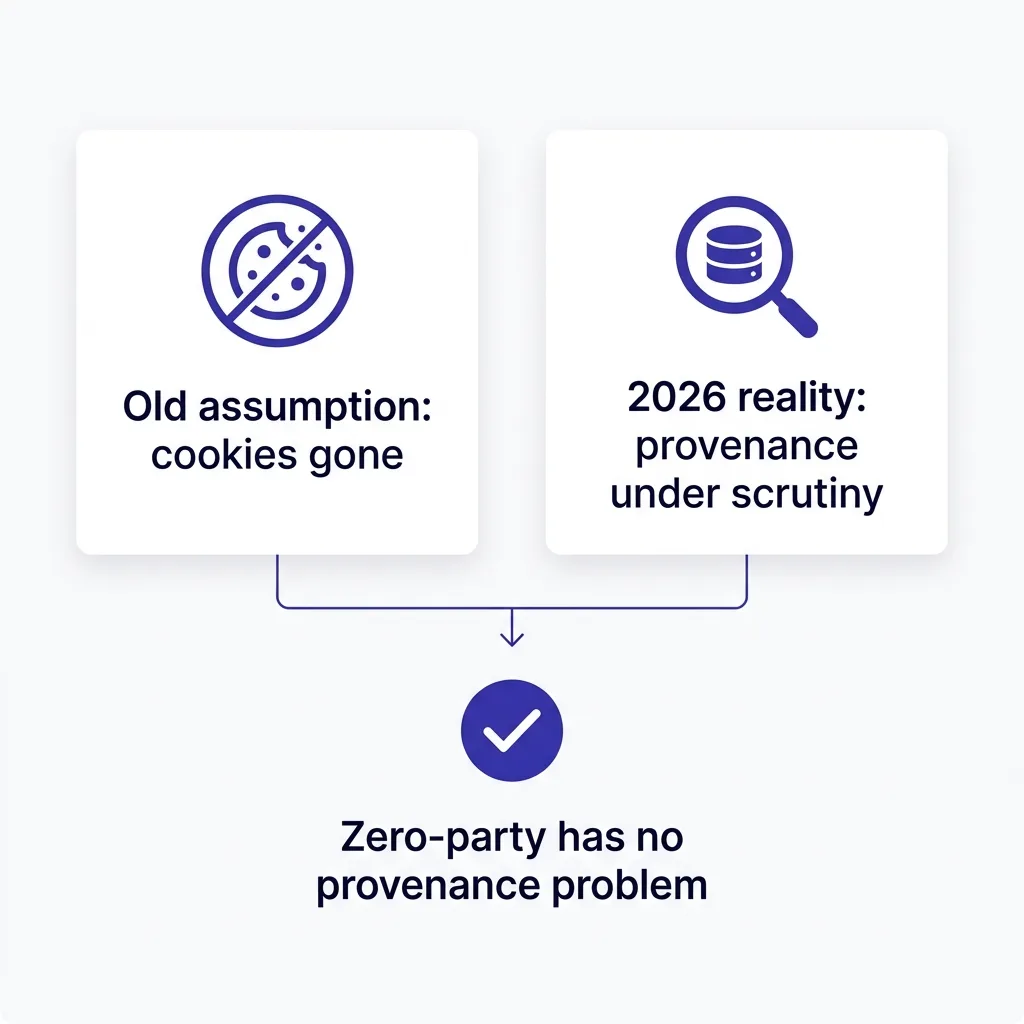
Most 2026 content gets one fact wrong: Google did not kill third-party cookies. In July 2024, Google reversed its own plan and kept third-party cookies on by default in Chrome, replacing forced deprecation with a user-choice prompt, and as of 2026 Chrome still does not block them universally.
That reversal does not mean privacy pressure eased. It moved.
Safari's Intelligent Tracking Prevention and Firefox's Enhanced Tracking Protection have blocked third-party cookies by default for years already, unaffected by whatever Chrome decides. State-level privacy laws in the US have expanded well past California, and data broker scrutiny has intensified through FTC enforcement actions and new state registries that require brokers to disclose what they collect and who they sell it to.
The practical effect for B2B outbound teams: third-party enrichment data is getting harder to trust, not because it stopped existing, but because its provenance is under more scrutiny than ever. Waterfall enrichment stacks multiple vendors to fill gaps, and each additional vendor in that stack is another point where stale or wrong data enters your CRM. B2B data decay already degrades contact records fast. Add uncertain sourcing on top of decay, and personalizing from third-party data becomes a bet on data you cannot fully verify.
Zero-party data has none of that provenance problem. The prospect is the source, with no waterfall, no broker, and no decay clock running on an inferred job title.
There is also a demand-side shift worth naming plainly. Buyers now see AI-generated personalization constantly, in cold email, in LinkedIn messages, in ad copy.
How prospects spot AI-written emails covers the tells: generic specificity, inferred pain points that almost fit, compliments that could apply to any company in the vertical. Declared data sidesteps every one of those tells because it did not come from a model guessing; it came from the prospect's own keyboard.
None of this means third-party enrichment is useless. It still earns its place for firmographic basics like company size or industry.
It just should not carry the weight of your opening line anymore. That job belongs to something the prospect actually said.
#How B2B teams collect zero-party data
Collecting zero-party data means building something worth answering a question for. Nobody fills out a form for a company's convenience; they fill it out because the trade is worth it.
#Gated interactive tools
An ROI calculator, a pricing estimator, or a benchmark tool asks for inputs to produce a result, and each input is zero-party data. Build something genuinely useful, gate the result (not the tool itself) behind a light form, and the inputs become your personalization fuel.
A cold email outreach calculator that asks "how many emails does your team send per week" and "what's your current reply rate" collects two declared numbers you can reference in a follow-up: "You mentioned you're sending 800 emails a week at a 1.2% reply rate. Here's what changed for a team at similar volume."
#Preference centers
Most preference centers only ask "how often do you want emails." That is a wasted opportunity. A well-built preference center asks what topics matter, what format the prospect prefers (case study vs. data vs. how-to), and what stage of buying they are in.
Every answer is a targeting input. A prospect who selects "I'm actively evaluating vendors" self-identifies as sales-ready in a way no buying signal inferred from web activity can match with the same certainty.
#Quiz-based lead magnets
"What's your outbound maturity level" or "Which cold email mistake is costing you the most replies" style quizzes work because the format is low commitment (multiple choice, thirty seconds) and the payoff (a personalized result) feels earned.
Each answer maps to a segment and a set of declared pain points. A prospect who answers "I don't warm up my domain before sending" just told you, unprompted, exactly which problem to lead with in outreach, and that beats any guess your enrichment vendor could make about their inbox placement rate.
#Onboarding surveys
If your product has a free trial or freemium tier, the onboarding survey is the highest-intent zero-party data source you have. "What are you hoping to solve with this tool" and "What's your current process" answers describe the prospect's actual situation in their own words.
Even prospects who churn out of a trial leave behind declared context that outbound teams routinely ignore. A trial user who selected "deliverability issues" as their top concern during onboarding is a better outbound target eight months later than a cold list lookalike, because you already know what to say to them.
#Pricing and packaging calculators
A "build your plan" or seat-based pricing calculator collects team size, feature priorities, and budget range, all declared. Even abandoned calculator sessions (someone who configured a plan but did not submit) are usable, provided your capture mechanism grabs the inputs before the person leaves, with clear disclosure that partial sessions may be followed up on.
#Waitlist and early access forms
Asking "why do you want early access" or "what's your current workaround" on a waitlist form turns a simple signup into a rich data point. Most companies just collect an email address here and throw away the context that would make follow-up outreach land.
flowchart TD
    A[Prospect engages a gated tool] --> B{Type of interaction}
    B -->|ROI calculator| C[Declares usage numbers, team size]
    B -->|Preference center| D[Declares topic and format preference]
    B -->|Quiz lead magnet| E[Declares specific pain point]
    B -->|Onboarding survey| F[Declares current process, goal]
    C --> G[Zero-party data stored on contact record]
    D --> G
    E --> G
    F --> G
    G --> H{CRM or sequencing tool trigger}
    H -->|Segment by declared pain point| I[Personalized sequence variant A]
    H -->|Segment by declared intent stage| J[Personalized sequence variant B]
    H -->|Segment by declared preference| K[Personalized sequence variant C]
    I --> L[Cold email references exact declared input]
    J --> L
    K --> L
    L --> M[Reply or no reply]
    M -->|Reply| N[Route to human, update record]
    M -->|No reply after N touches| O[Re-segment or pause]
#Personalizing cold email with declared data
Having the data solves half the problem. The other half is using it without sounding like you are reading from a form.
The rule: reference the input, not the fact that you collected it. "I saw you filled out our calculator" is worse than no personalization at all. It announces surveillance even when the data is fully consensual, because it makes the prospect think about the mechanism instead of the message.
Compare these two openers, both built from the same declared data point (prospect entered "12 SDRs, 40% response rate drop in Q3" into an ROI calculator):
Weak: "I noticed you used our calculator and entered some interesting numbers about your team."
Strong: "A 40% response rate drop across 12 SDRs in one quarter usually means the same three things: burned domains, stale segments, or generic copy. Which one matches what you're seeing?"
The strong version never mentions the calculator. It uses the number as if it were common knowledge between two people who already understand the problem, because in a real sense it is: the prospect told you.
#Match the ask to the declared intent stage
A prospect who declared "just researching" through a preference center gets a different cadence than one who declared "evaluating vendors now." Custom pain points work best when they are scoped to where the prospect said they are, not where your lead score guesses they are.
Researchers get education-forward sequences: a comparison guide, a benchmark report, no meeting ask in the first two touches. Evaluators get direct sequences: a specific claim tied to their declared numbers, a meeting ask by touch two.
#Use declared preferences to pick format, not just content
If a preference center captured "I prefer data over case studies," honor that in every touch, not just the first. A prospect who declared a format preference and then gets three straight case-study emails will notice the mismatch even if they never say why the sequence felt off.
#Let quiz results set the subject line
A prospect who took a quiz and landed in the "manual personalization is eating your SDR's week" segment should see that exact framing in the subject line of the first email in their triggered sequence. Cold email subject line work usually optimizes for curiosity or urgency. Declared-data subject lines skip that entirely and just state the prospect's own answer back to them, because relevance beats cleverness when the line is true.
#Do not over-personalize past what was declared
The line between "impressively relevant" and "uncomfortably specific" is real, and zero-party data does not erase it. If someone answered three quiz questions, reference the theme those answers point to, not a granular recombination of all three that reads like a dossier.
One well-placed declared fact outperforms three stacked into a single sentence.
A good test: would the prospect be surprised you know this, or would they expect you to? If they filled out a calculator with their email attached, they expect a follow-up referencing their inputs. If you combine that with an inferred detail about their company's recent layoffs pulled from a news scraper, the surprise flips from pleasant to unsettling.
#The collect-store-trigger workflow
 The collect-store-trigger workflow
Zero-party data only pays off if it gets from the form to the outbound sequence without a manual export step somewhere in the middle. Most teams collect it and let it rot in a spreadsheet.
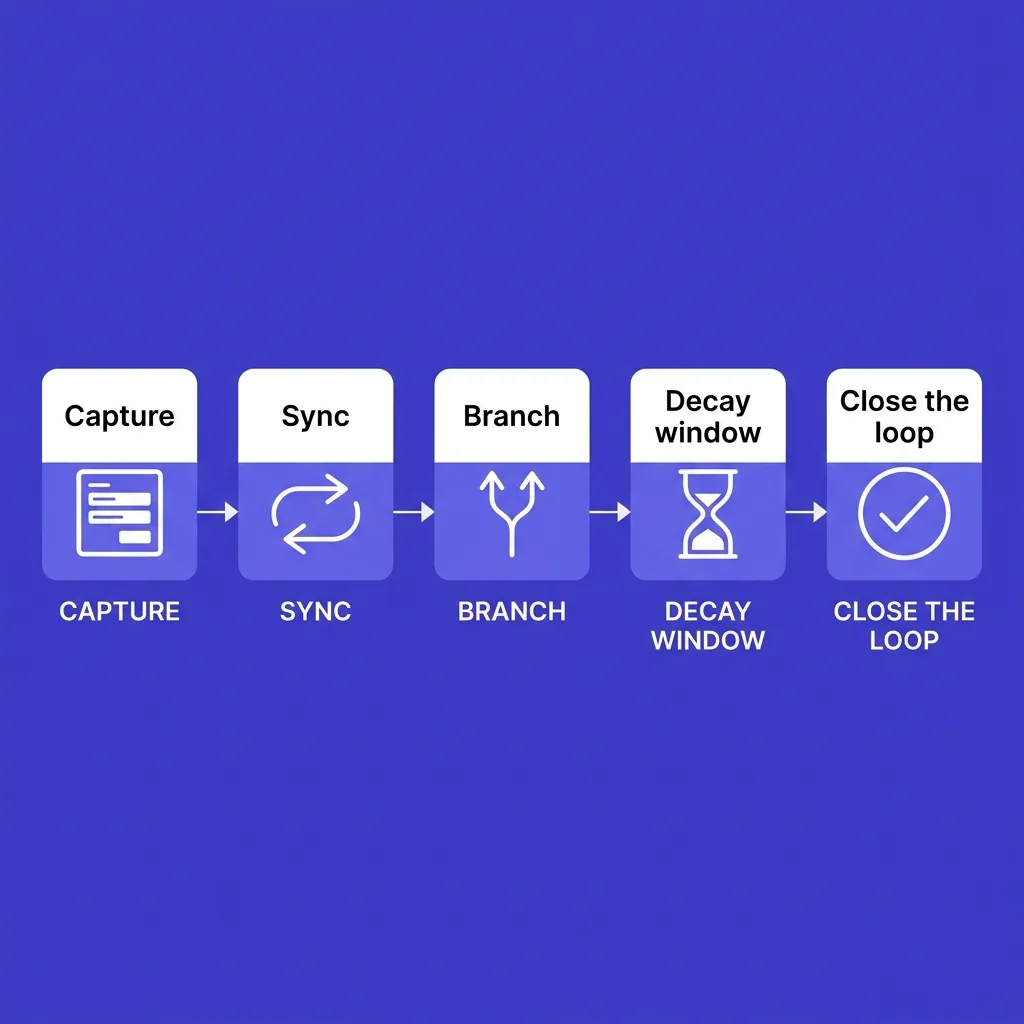
Step one: capture with structure, not free text. A quiz or calculator should write discrete field values (pain_point, team_size, intent_stage) to the contact record, not a paragraph a rep has to read and interpret later. Structured fields are what let a sequencing platform branch logic on the answer.
Step two: sync to the CRM or sequencing tool on submission, not on a batch schedule. A prospect who declares "evaluating now" today and gets contacted three weeks later because of a weekly sync job has lost the moment. Speed to lead research consistently shows response rates fall the longer the gap between signal and outreach.
Step three: build sequence branches keyed to the declared field, not a generic template. One sequence with a merge tag is not the same as three sequences built around three distinct declared pain points. The merge-tag version still reads like a template with one word swapped. The branched version reads like it was written for that specific prospect, because the opening line, not just a variable, changes based on what they said.
Step four: set a decay window on the data itself. A declared "evaluating now" from four months ago is not the same signal it was on day one. Build a rule that downgrades intent-stage fields after a set window (30 to 60 days is reasonable for active-evaluation signals) so stale declarations do not keep triggering high-urgency sequences indefinitely.
Step five: close the loop when a rep learns something new. If a call reveals the prospect's actual situation differs from what they declared on a form six months ago, update the record. Zero-party data is a starting point, not a permanent label.
Platforms built for AI-assisted outbound, including FirstSales, are increasingly built to ingest exactly this kind of structured, declared signal (form fields, quiz results, preference selections) and trigger sequence branches automatically, which matters because the value of zero-party data collapses fast if it sits in a spreadsheet instead of driving the next email.
#Where zero-party data breaks down
Zero-party data is not a complete replacement for every other signal type, and treating it that way creates its own problems.
Volume is the first limit. Only prospects who engage with your calculator, quiz, or survey generate zero-party data. That is a fraction of any total addressable market. You still need ideal customer profile targeting and intent-based prospecting to reach everyone who has not yet interacted with your gated content.
Declared data can be inaccurate. People misjudge their own team size, round numbers, or answer a quiz honestly but inconsistently with their actual situation. Treat declared inputs as a strong signal, not ground truth, especially for anything that affects pricing or deal sizing.
Stale declarations mislead. A calculator input from fourteen months ago describes a company that may have grown, shrunk, or pivoted since. Pair zero-party data with a freshness policy, similar to how you would treat any other field in b2b data decay work.
Gating too aggressively kills the funnel. A ten-field form in front of a simple calculator will collect rich data from almost nobody, because most visitors bounce before finishing. Ask for the minimum that produces a usable segment, and add fields only where the marginal data point earns its friction cost.
It only works as personalization if someone actually reads the reply. Collecting declared data and then routing every reply through a generic autoresponder defeats the entire point. Human-in-the-loop cold email matters more here, not less, because a prospect who took the time to declare something specific expects a human-quality response when they engage.
#Zero-party data and deliverability
There is a quieter benefit to zero-party-driven outreach that rarely gets discussed: it tends to produce better engagement metrics, and engagement metrics are what Gmail and Microsoft weight most heavily in 2026's bulk sender rules.
A cold email that opens with a prospect's own declared pain point gets opened, read, and replied to at higher rates than a generic template, simply because it is more relevant. Higher reply rates and lower complaint rates feed directly into inbox placement, which is why cold email reply rate benchmarks put average cold reply around 3.4% while the top-performing segments, the ones doing real personalization, land in the 10 to 20% range.
Declared-data sequences also tend to have lower unsubscribe and spam-complaint rates, since the prospect already engaged once (filled out a form) before receiving the email. That prior engagement is a soft form of consent that a completely cold list, sourced from third-party enrichment alone, does not have.
None of this replaces the mechanical basics. SPF, DKIM, and DMARC setup still has to be correct, and a warmed-up sending domain still matters regardless of how good your personalization is.
Zero-party data improves what happens once the email lands. It does not fix what happens if the email never lands at all.
#Frequently asked questions
#What is zero-party data in simple terms?
Zero-party data is information a person deliberately and knowingly shares with a company, such as a quiz answer, a calculator input, or a preference selection. The person is the direct source, and they know exactly what they shared.
#Who coined the term zero-party data?
Forrester analyst Fatemeh Khatibloo introduced the term in a 2018 research report, defining it as data a customer intentionally and proactively shares, distinct from data a company observes or infers.
#How is zero-party data different from first-party data?
First-party data is behavior your own systems observe, like page visits or product usage, often without the person actively thinking about it. Zero-party data is information the person consciously chose to tell you, like an answer on a form.
#Is zero-party data the same as consented data?
Not exactly. Consented data means someone agreed to let you collect or use information, which could include tracked behavior under consent. Zero-party data specifically means the person declared the information themselves, which inherently includes consent but adds the layer of active disclosure.
#Did third-party cookies actually get deprecated in 2026?
No. Google reversed its Chrome cookie deprecation plan in July 2024 and kept third-party cookies on by default, replacing forced removal with a user-choice setting. Safari and Firefox have blocked third-party cookies by default for years regardless of Chrome's decision.
#Why does zero-party data matter for B2B if cookies are not fully gone?
Privacy pressure in B2B comes less from browser cookie policy and more from data broker scrutiny, state privacy law expansion, and buyer distrust of AI-inferred personalization. Zero-party data sidesteps all three because the prospect is the direct, consenting source.
#What is a good example of zero-party data in cold email?
A prospect enters their team's monthly email volume and current reply rate into an ROI calculator. That declared reply rate becomes the opening line of a follow-up email, referenced directly rather than inferred.
#How do I collect zero-party data without hurting conversion rates?
Ask for the minimum number of fields that produce a usable segment. A two or three-question quiz converts far better than a ten-field form, and the marginal data point from field four rarely justifies the drop-off it causes.
#Can I use zero-party data for cold prospects who never interacted with my company?
No. Zero-party data by definition comes from someone who engaged with your form, quiz, calculator, or survey. Prospects who have never interacted with you require other targeting methods, like ideal customer profile fit or firmographic segmentation.
#Does referencing zero-party data in an email feel creepy to prospects?
Generally no, because the prospect knows they shared it. It only feels invasive if you combine it with inferred or scraped details, or if you explicitly mention the data collection mechanism ("I saw you filled out our form") instead of just using the content naturally.
#What's the difference between zero-party and intent data?
Traditional intent data is usually inferred from browsing behavior across many sites, aggregated by a third-party vendor, and sold without the prospect's direct knowledge. Zero-party intent, like a "we're evaluating vendors now" preference selection, is declared directly by the prospect on your own property.
#How long does zero-party data stay accurate?
It depends on the field. Declared pain points and preferences tend to stay relevant for months. Declared intent stage ("evaluating now") should be treated as time-sensitive and downgraded after 30 to 60 days without further engagement.
#Should I gate my ROI calculator results behind a form?
Gate the result, not the tool. Let prospects interact freely, then ask for contact details to see the full calculated output or receive a personalized summary. This keeps friction low while still capturing the declared inputs.
#What tools do I need to act on zero-party data automatically?
You need a capture mechanism (form, quiz, or calculator builder) that writes structured fields to a contact record, a CRM or sequencing platform that can branch logic based on those fields, and a sync that fires on submission rather than a batch schedule.
#Can zero-party data replace third-party enrichment entirely?
No. Zero-party data only covers prospects who engaged with your content, which is a fraction of any total addressable market. Third-party enrichment still fills firmographic gaps for prospects you have not reached yet.
#How specific should personalization get before it feels invasive?
Reference one declared theme clearly rather than stacking multiple declared data points into a single hyper-specific sentence. The test: would the prospect expect you to know this because they told you, or would they be surprised?
#What's an onboarding survey and why does it matter for outbound?
An onboarding survey asks a new trial or free-tier user what they hope to solve and what their current process looks like. Even users who churn leave behind declared context that makes future outbound outreach far more targeted than a cold list lookalike.
#Do preference centers only control email frequency?
They can, but a well-built preference center also captures topic interests, content format preference, and buying stage, all of which are zero-party data usable for segmentation and personalization, not just frequency control.
#How does zero-party data affect deliverability?
Sequences built on declared data tend to earn higher open and reply rates and lower spam complaints, because the prospect already engaged once before the email. That engagement pattern helps inbox placement under providers' 2026 bulk sender thresholds.
#What happens if a prospect's declared data turns out to be wrong?
Treat it as a strong signal, not verified fact. If a sales call reveals a different reality than what was declared on a form months earlier, update the record. Declared data is a starting point for the conversation, not a permanent label.
#Building outbound on what prospects actually say
Zero-party data works because it removes the guessing that makes cold email feel cold in the first place.
A quiz answer, a calculator input, a preference selection: each one is a fact the prospect chose to hand over, which means using it back in an email is never a violation of trust. It is just accuracy.
Start with one low-friction capture point. A pricing calculator, a three-question quiz, an onboarding survey field that actually gets read. Wire the output into a sequence branch instead of a spreadsheet nobody opens.
The gap between a cold email that gets ignored and one that gets a reply usually is not clever copy. It is whether the first line proves the sender already knows something true, and zero-party data is the cheapest, most consensual way to make that true every time.