
TL;DR: Cold email ownership should follow the buyer's journey stage, not org chart tradition. Founders own it pre-product-market fit, the first SDR hire owns execution once volume outgrows one person, and RevOps should own the shared infrastructure (domains, deliverability, sequencing tools) once both sales and marketing send from the same email stack.
Ask five people at the same company who owns cold email and you often get five different answers.
The founder says they still write half the emails.
The head of sales says it belongs to the SDR team.
The marketing lead says outbound is really just another demand-gen channel.
Nobody is entirely wrong, and that is the actual problem.
Each answer reflects a real piece of the motion that person actually touches, the founder still writes copy, the sales lead manages the reps who execute, and marketing genuinely does own adjacent channels that share tooling with cold outbound.
Ownership that shifts depending on who you ask usually means nobody is accountable for deliverability, nobody owns the sequence quality bar, and two teams are quietly sending from the same warmed domains without coordinating send volume.
This piece maps ownership to company stage, not job title, and covers the handoff points that most companies get wrong.
#Why "sales or marketing" is the wrong first question
The instinct is to frame this as a two-way turf question: does cold email belong to sales or to marketing.
That framing misses the actual driver of ownership, which is not department but motion.
Cold email is fundamentally a 1:1, personalized outbound motion, closer in mechanics to sales prospecting than to a marketing email blast, even when marketing is the team running it.
The real question is not which department, but which function: who owns list quality, who owns message personalization, who owns deliverability infrastructure, and who owns the follow-up when a prospect replies.
Splitting those four functions across the org chart, rather than assigning cold email as a single monolithic channel to one department, produces a cleaner answer than the sales-versus-marketing framing ever does.
graph TD
    A[Company stage] --> B{Pre-PMF, under 10 employees}
    A --> C{Post-PMF, first SDR hired}
    A --> D{Scaling, 3+ SDRs, marketing sends too}
    B --> E[Founder owns everything: list, copy, sends, replies]
    C --> F[SDR owns execution; founder or sales lead owns strategy]
    D --> G[RevOps owns infrastructure; SDR owns sequences; marketing owns nurture overlap]
#Stage one: founder-led outbound
In the earliest stage, before product-market fit is confirmed, cold email should sit with the founder or a founding team member, full stop.
This is not a resourcing shortcut. It is the fastest way to learn what resonates, because the person writing the emails is the same person who can change the product roadmap based on what prospects say back.
Pre-launch outbound validation covers this stage directly: outbound at this point functions as market research disguised as pipeline generation, and delegating it too early removes the founder from the feedback loop that matters most.
A founder sending 20 to 30 personalized emails a week, reading every reply, and adjusting messaging weekly learns more in a month than a hired SDR running the same volume against a script the founder never sees fail.
#When founder-led outbound should end
The signal to move ownership away from the founder is not a calendar date, it is volume and repeatability.
Once the founder can articulate a consistent ICP, a message that reliably gets replies, and a sequence structure that works, the motion has become repeatable enough to hand off without losing the learning that made it valuable.
Handing it off before that point means training a hire on an unproven process, which usually produces worse results than the founder simply continuing a while longer.
#Stage two: the first SDR hire
Once outbound volume outgrows what a founder or a single sales rep can sustain alongside other responsibilities, the first dedicated SDR hire typically takes over day-to-day execution.
This is the most common ownership transition point, and it is also where most of the friction shows up, because the founder often struggles to fully let go of message quality control.
The healthiest version of this handoff splits ownership cleanly: the SDR owns sending volume, sequence cadence, and reply handling, while the founder or a sales leader retains ownership of the ICP definition and message strategy for a defined transition period, then hands that off too as the SDR builds a track record.
SDR roles and responsibilities lays out what this role should actually cover day to day, and cold email ownership at this stage is usually one part of a broader prospecting mandate that includes cold calling and LinkedIn outreach as well.
#What the first SDR needs to own outright from day one
List building and enrichment. The SDR should own sourcing and qualifying the target list, using an ideal customer profile the founder or sales lead has already validated.
Sequence execution and cadence timing. Once message strategy is set, the SDR should control send timing, follow-up cadence, and day-to-day sequence adjustments without needing sign-off on every touch.
Reply triage. The reply handling playbook should sit with the SDR, since they are closest to the conversation and best positioned to route replies quickly.
Deliverability hygiene, at a basic level. The SDR should understand inbox warmup and sending limits well enough to flag problems early, even if a more senior owner handles infrastructure decisions.
#Stage three: shared ownership under RevOps
The friction gets worse, not better, once a company scales past one or two SDRs and marketing starts sending its own outbound-style campaigns from the same domain infrastructure.
This is the point where two teams sending uncoordinated volume from shared domains creates real deliverability risk, since emails per inbox per day limits apply to the domain and IP reputation as a whole, not to each team's usage independently.
A company where sales sends 40 emails a day per rep and marketing separately launches a 5,000-contact re-engagement campaign from the same domain infrastructure, without coordination, can blow through sending thresholds that took months of warmup to establish.
Cold email domain burn rate explains the mechanics of why this happens and why domain and inbox planning has to be centralized once more than one team touches the same sending infrastructure.
#What RevOps should own once shared infrastructure exists
RevOps, or whichever function centralizes revenue tooling, should own the infrastructure layer: domain and inbox provisioning, SPF, DKIM, and DMARC setup, sending limit governance, and the shared calendar that prevents two teams from launching large sends into the same domain pool simultaneously.
Sales and marketing retain ownership of their respective message strategy and list targeting, but neither team should provision or manage sending infrastructure independently once shared risk exists.
Subdomain versus separate domain strategy becomes a RevOps decision at this stage too, since isolating sales and marketing sending onto separate subdomains is one of the more effective ways to let both teams operate without one team's mistakes tanking the other's deliverability.
#A worked example: the ownership gap that caused a blocklisting
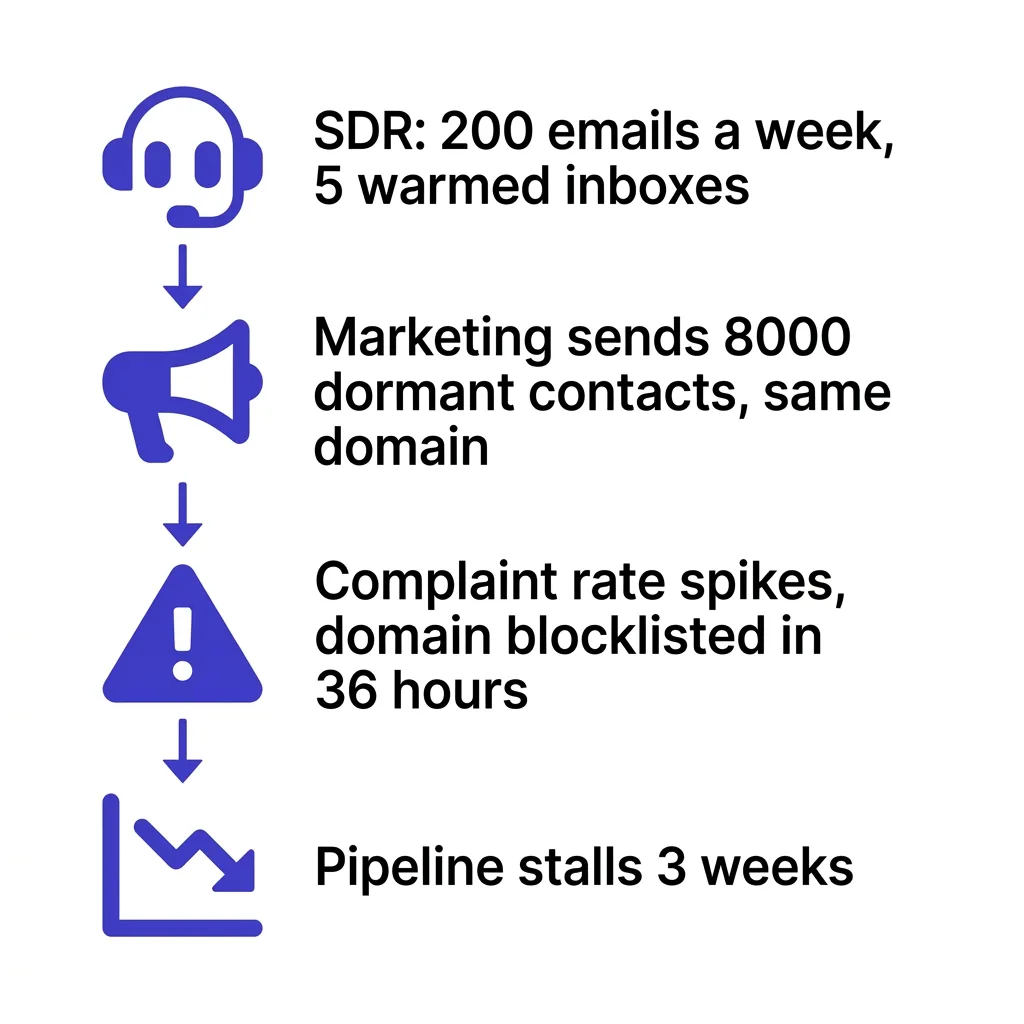 A worked example: the ownership gap that caused a blocklisting
A 45-person B2B software company had one SDR sending roughly 200 emails a week from five warmed inboxes on a dedicated subdomain.
Marketing hired a lifecycle manager who inherited a re-engagement project: emailing 8,000 dormant trial signups who had never converted.
Nobody flagged that the lifecycle manager's tool routed through the same sending domain the SDR team had spent four months warming up.
The re-engagement send went out in a single batch, spiked complaint rates past the threshold most inbox providers tolerate, and the shared domain landed on a major blocklist within 36 hours.
The SDR team's pipeline generation stopped cold for nearly three weeks while the domain recovered, an outage entirely caused by an infrastructure ownership gap, not a message quality problem.
The postmortem was simple once it happened: nobody owned the question of which teams were allowed to send from which domains, so nobody was in a position to catch the conflict before it caused damage.
The fix that followed is the same fix most companies land on eventually: a named infrastructure owner, a shared sending calendar, and a rule that any new campaign above a set volume threshold gets a domain-capacity check before it launches.
That rule costs almost nothing to implement and would have prevented three weeks of stalled pipeline entirely.
#How ownership questions differ by company size
The right ownership model at 5 employees looks nothing like the right model at 500, and applying a scaled-company structure too early usually just adds friction without adding safety.
Under 10 employees. One person, usually the founder, should own the entire motion end to end. Formal process adds overhead without adding value at this scale, since coordination between teams is not yet a real risk.
10 to 50 employees, one or two SDRs. Ownership should split cleanly between message strategy (sales leadership) and execution (the SDR), with infrastructure still simple enough for one person to manage part-time alongside other responsibilities.
50 to 200 employees, multiple SDRs plus marketing sending. This is the range where shared infrastructure risk becomes real, and where a dedicated infrastructure owner, whether a RevOps hire or a sales operations lead, starts paying for itself through avoided incidents rather than added headcount cost alone.
200+ employees, multiple teams and regions sending. Infrastructure ownership typically formalizes into a dedicated RevOps or deliverability function, often with documented policies for domain provisioning, sending calendars, and cross-team volume coordination, since the coordination cost of informal ownership at this scale usually exceeds the cost of a dedicated role.
Matching the ownership model to actual company size, rather than either under-investing at scale or over-formalizing too early, is the practical test for whether a given ownership structure is working.
#The ownership matrix: who should own what
| Function | ✓ Pre-PMF (founder-led) | ✓ Post-first-SDR | ✓ Scaling (RevOps shared) | ✗ Common mistake |
|---|---|---|---|---|
| ICP and message strategy | ✓ Founder | ✓ Sales lead, SDR executes | ✓ Sales leadership, RevOps informs | ✗ Marketing sets ICP without sales input |
| List building | ✓ Founder | ✓ SDR | ✓ SDR or dedicated ops role | ✗ Purchased lists with no qualification |
| Sending infrastructure | ✓ Founder (manual setup) | ✓ Founder or sales ops | ✓ RevOps, centralized | ✗ Each team provisions its own domains independently |
| Sequence cadence | ✓ Founder | ✓ SDR | ✓ SDR, within RevOps-set limits | ✗ No shared calendar across teams sending from the same domains |
| Reply handling | ✓ Founder | ✓ SDR | ✓ SDR, with defined handoff to AE | ✗ Replies sit unanswered because ownership is unclear |
| Deliverability monitoring | ✓ Founder (basic) | ✓ SDR flags issues | ✓ RevOps owns metrics and alerts | ✗ Nobody checks bounce or complaint rate until domains are already flagged |
#Where marketing legitimately owns part of the motion
Marketing should not be excluded from cold email ownership entirely, and treating outbound as purely a sales function misses cases where marketing genuinely owns the better motion.
Welcome email sequences and other post-signup nurture flows sit squarely in marketing's domain, even though they share tooling and sometimes infrastructure with cold outbound.
List growth strategy, meaning how new contacts enter any sending system in the first place, is also typically a marketing-owned function, even when the resulting contacts eventually feed into a sales-owned outbound sequence.
The distinction that matters is intent: outreach to someone who has never engaged with the company is prospecting, and belongs with whichever team owns pipeline generation, usually sales at smaller companies and a hybrid sales-marketing function at larger ones.
Outreach to someone who has already engaged, downloaded content, visited pricing pages, or signed up for a trial, is nurture, and marketing typically owns that motion regardless of company size.
Inbound versus outbound sales covers this distinction in more depth, and cold email ownership questions usually resolve faster once a team agrees on which category a given campaign actually falls into.
#What good ownership looks like in practice, week to week
Ownership on paper means little if it does not show up in the actual weekly rhythm of the team.
A company with clear ownership usually has a short, recurring check-in, weekly at smaller scale, where whoever owns infrastructure reports domain and inbox health: bounce rate, spam complaint rate, and any inboxes that have dropped out of the primary tab or landed in spam during test sends.
The same check-in surfaces upcoming large sends from any team, whether that is a new SDR cadence launch or a marketing re-engagement campaign, so a capacity conflict gets caught before it happens rather than after a blocklisting.
Message strategy ownership shows up differently: a monthly or biweekly review of reply rates by segment and message variant, owned by whoever holds ICP and messaging strategy, feeding learnings back into the next cadence rather than treating the current sequence as fixed indefinitely.
Reply handling ownership shows up as a service-level expectation, typically same-day or next-business-day response to any inbound reply, tracked as a real metric rather than an informal best effort.
None of this requires heavyweight tooling. A shared spreadsheet or a simple dashboard tracking these three things, infrastructure health, message performance, and reply response time, covers most of what a growing team needs before dedicated RevOps tooling becomes worth the investment.
The companies that get ownership wrong are rarely missing a sophisticated system. They are missing the weekly habit of actually looking at these three things and having one clearly named person accountable for each.
#Common ownership failure patterns
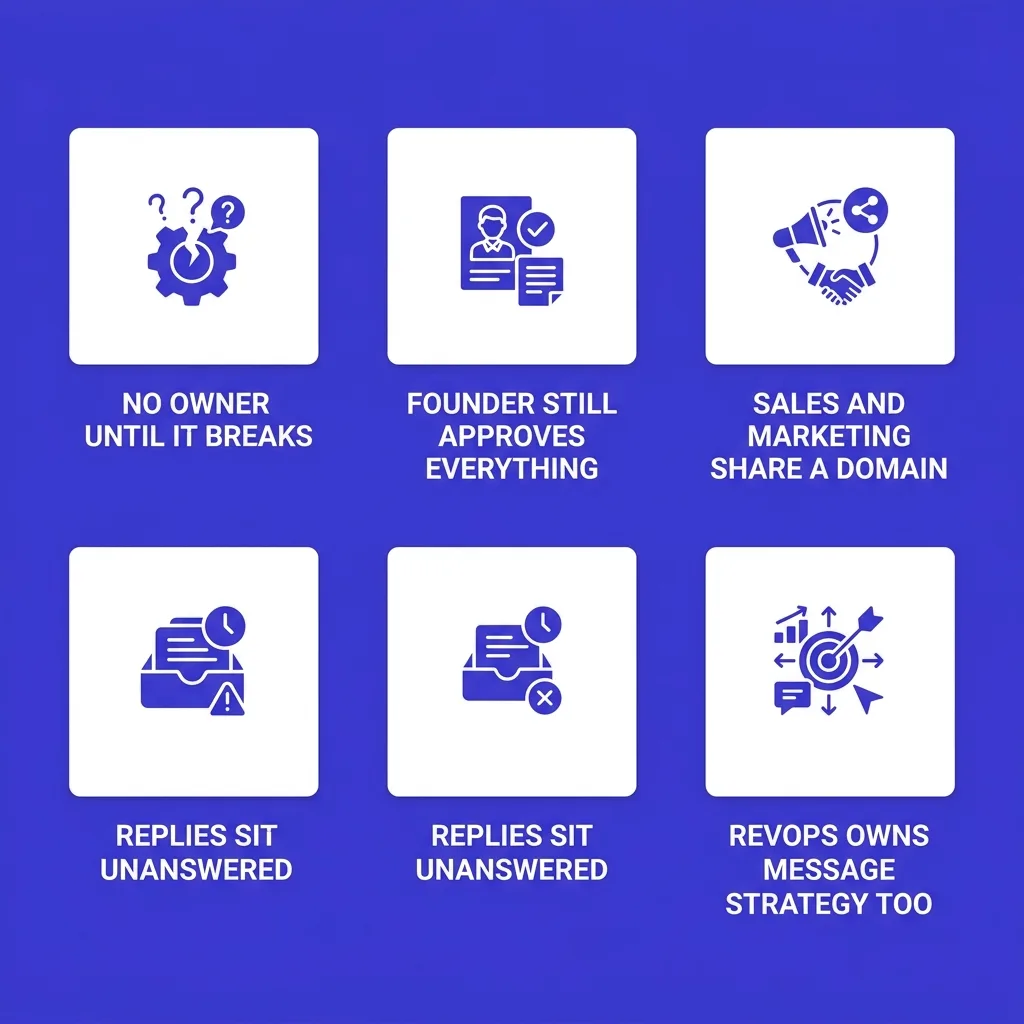 Common ownership failure patterns
No owner until something breaks. Cold email runs fine with informal ownership until a domain gets blocklisted or a compliance complaint arrives, and only then does anyone ask who was actually responsible for deliverability.
Ownership frozen at the founder-led stage. A founder who built the original playbook keeps final sign-off on every message long after the company has hired a team built to own it, which slows execution without improving quality.
Marketing and sales sending from the same domains with no coordination. This is the single most common technical failure, and it is almost always an ownership failure first, a technical one second.
Reply handling with no clear handoff. A prospect replies to a cold email and the reply sits unanswered for three days because nobody was assigned to own that inbox, which is often the most expensive ownership gap of all, since a warm reply is the hardest-won asset in the entire funnel.
RevOps owns everything, including message strategy. Centralizing infrastructure ownership is correct. Centralizing message and ICP decisions away from the reps closest to the prospect usually produces generic, disconnected messaging.
#How to formalize ownership without adding bureaucracy
The goal is not a heavyweight RACI chart for a two-person outbound motion.
For a company with one or two people running outbound, a single paragraph in a shared doc naming who owns infrastructure, who owns message strategy, and who owns reply handling is enough.
For a company with sales and marketing both sending from shared infrastructure, the ownership split needs to be explicit and revisited whenever a new team starts sending, since the most common trigger for a deliverability incident is a new team quietly starting to send without anyone updating the shared sending calendar.
Human-in-the-loop cold email practices matter here too: whoever owns message strategy should still review AI-drafted or templated sends before they go out, regardless of which team technically owns the sending action.
#Where a platform like FirstSales fits
Ownership clarity gets easier when the tooling itself enforces some of the boundaries that used to depend entirely on process discipline.
FirstSales lets a founder run outbound solo in the early stage and then hand execution to a first SDR hire without switching platforms, since the same AI-assisted drafting with human approval workflow scales from one person to a small team.
As sending volume grows, shared visibility into inbox health and sending limits gives whoever owns infrastructure, whether that is still the founder or a dedicated RevOps hire, a single place to see whether multiple senders are competing for the same domain capacity.
That does not resolve the organizational question of who should have final say on message strategy. It does remove one of the more common causes of ownership confusion: two teams sending from the same infrastructure with no shared visibility into what the other is doing.
#Signs the current ownership setup needs to change
A few recurring symptoms tend to show up before a company formally realizes its ownership model is broken.
Reply rates are declining even though message quality has not obviously changed, often because deliverability has quietly degraded under an infrastructure owner who is not actively monitoring it.
Two teams discover, usually after the fact, that they both launched large sends in the same week from overlapping domains, a sign that no shared calendar or coordination point exists.
The founder is still personally approving every send months after hiring a dedicated SDR, a sign that ownership was assigned on paper but never actually transferred in practice.
Replies sit for days before anyone responds, a sign that reply handling ownership was never explicitly assigned to begin with.
Any one of these symptoms is worth investigating on its own. Two or more happening at once usually means the ownership model needs a real conversation, not another workaround.
#Frequently asked questions
#Should cold email belong to sales or marketing?
Neither department owns it outright by default. Ownership should split by function, list building and infrastructure typically sit with whoever runs prospecting, while message strategy and reply handling should stay close to whichever team is actually in the conversation with the prospect.
#Who should own cold email at a very early-stage startup?
The founder, or a founding team member directly involved in early customer conversations, since outbound at this stage functions as much as market research as it does pipeline generation.
#When should a founder hand off cold email to a hire?
Once the founder can articulate a repeatable ICP, a message that reliably gets replies, and a sequence structure that works consistently, rather than on a fixed timeline or headcount trigger.
#What should the first SDR hire own from day one?
List building and enrichment, sequence execution and cadence timing, and reply triage, typically working from an ICP and message strategy the founder or sales lead has already validated.
#Why does shared sending infrastructure cause ownership problems?
Because sending limits apply to the domain and inbox as a whole, not per team, two teams sending independently from the same infrastructure can exceed thresholds neither team intended to breach, creating a deliverability incident nobody planned for.
#What should RevOps own once a company scales past one or two SDRs?
Domain and inbox provisioning, authentication setup, sending limit governance, and a shared sending calendar that coordinates volume across every team using the infrastructure.
#Does marketing ever legitimately own cold email?
Marketing typically owns nurture sequences to contacts who have already engaged with the company, such as welcome sequences and re-engagement campaigns, while true cold outreach to unengaged prospects usually sits with whichever team owns pipeline generation.
#How do you tell the difference between marketing-owned and sales-owned outbound?
The distinguishing factor is prior engagement. Outreach to someone who has never interacted with the company is prospecting and typically sales-owned. Outreach to someone who has already engaged is nurture and typically marketing-owned.
#What is the biggest risk of unclear cold email ownership?
Deliverability incidents caused by uncoordinated sending across teams, and unanswered replies caused by no clear handoff for who monitors and responds to inbound engagement.
#Should the founder keep approving every cold email after hiring an SDR?
Only during a defined transition period. Keeping approval indefinitely slows execution without improving quality once the SDR has demonstrated they understand the ICP and message strategy.
#How should reply handling be assigned?
Reply handling should sit with whoever is closest to the conversation, typically the SDR who sent the sequence, with a clear and fast handoff process to an account executive once a reply indicates real buying interest.
#What is the most common technical failure caused by unclear ownership?
Two teams, usually sales and marketing, sending from the same domain infrastructure without coordinating volume, which can exceed sending thresholds and trigger deliverability problems for both teams at once.
#Does a two-person startup need a formal ownership document for cold email?
A single paragraph naming who owns infrastructure, message strategy, and reply handling is usually enough at that scale, rather than a full RACI chart.
#How often should ownership be revisited as a company grows?
Whenever a new team or hire starts sending from shared infrastructure, since that is the most common trigger point for gaps in coordination and deliverability incidents.
#Should RevOps control message strategy along with infrastructure?
No. Centralizing infrastructure ownership under RevOps is effective, but message and ICP decisions should stay with the team closest to the prospect, usually sales, to avoid generic, disconnected messaging.
#What happens if ownership stays informal too long?
Cold email typically runs fine under informal ownership until a domain gets blocklisted or a compliance issue arises, at which point the lack of a clear owner becomes very visible very quickly.
#Can a single SDR own both cold email and cold calling?
Yes, and at smaller companies this is common, since the SDR roles and responsibilities for prospecting typically span multiple channels rather than being siloed by channel.
#Who should own the decision to pause or resume outbound sending?
Whoever owns infrastructure and deliverability monitoring, typically RevOps at scale or the founder at an early stage, since pausing decisions are usually driven by domain health signals rather than sales targets.
#Does hiring a dedicated deliverability or RevOps role make sense for a small team?
Usually not until multiple teams are sending from shared infrastructure. Below that threshold, the founder or first SDR can typically manage infrastructure alongside their other responsibilities.
#How does human-in-the-loop review fit into cold email ownership?
Whoever owns message strategy should review AI-drafted or templated sends before they go out, regardless of which team or role technically controls the sending action, to keep message quality consistent as ownership shifts across company stages.
#The takeaway
Cold email ownership should track the buyer's journey stage and the company's growth stage, not a fixed department assignment.
Founders own it early because the learning loop matters more than volume.
The first SDR owns execution once volume outgrows one person, working from strategy the founder has already validated.
RevOps owns shared infrastructure once multiple teams send from the same domains, while sales and marketing keep ownership of their respective message strategy.
Get that split explicit before a deliverability incident forces the conversation, not after.
The companies that handle this well do not treat ownership as a one-time org chart decision.
They revisit it at each growth inflection, when the first SDR is hired, when marketing starts sending its own campaigns, and when infrastructure risk crosses the threshold that justifies a dedicated RevOps role.
That habit of revisiting, more than any specific reporting line, is what keeps cold email from becoming the channel nobody was actually watching when it broke.
Write the current ownership split down somewhere the whole team can see it, even if it fits in a single paragraph.
The document matters less than the clarity it forces the first time someone has to write it out loud.