TL;DR: Most teams treat a lead list as something you only add to. The faster win is subtraction. A negative signal, a hiring freeze, a hard bounce, a role-based inbox, a recent unsubscribe, a competitor already under contract, tells you to remove an account before you ever draft a line to it. Suppression is cheaper than sourcing and it protects the domain reputation that every other campaign depends on.
#Why suppression beats more sourcing
Sourcing feels like progress.
Every new list import feels like momentum, even when half the rows were never going to convert.
Suppression feels like loss, even when it is the thing actually protecting your numbers.
That asymmetry is why most teams under-invest in it.
Here is the math that makes suppression the higher-impact move.
Google's bulk sender rules now cap spam complaints at 0.1% and bounces under 2%, measured across your whole sending volume, not per campaign.
A list padded with dead domains, role-based inboxes, and accounts that already marked a similar vendor as spam does not get a pass because the good accounts in the same list are behaving.
The whole domain pays for the bad rows.
Cut the bad rows, and the complaint rate and bounce rate improve immediately, before you write a single new email.
Systematised campaigns that target a genuinely qualified segment hit 10-18% reply rates.
Generic sends into an unfiltered list get 1-3%.
The gap between those two numbers is not better copy.
It is almost entirely list quality, and list quality is a suppression problem before it is a sourcing problem.
#The six negative signal categories
Negative signals cluster into six groups.
Some are permanent (this account should never be emailed again).
Others are temporary (not now, revisit in a quarter).
Knowing which bucket a signal belongs to changes what you do with the account, so treat these as separate decisions, not one blanket "remove."
#Firmographic misfit signals
This is the most basic filter and the one teams skip because it feels too obvious to formalize.
If your product needs a minimum of 50 employees to justify the price, every account under 20 employees is a negative signal by definition, regardless of any other data point.
The same logic applies to industry exclusions.
If you have never closed a deal in a regulated vertical because your product cannot meet their compliance requirements, that vertical is a standing negative signal, not a one-off judgment call each time it shows up.
Write these down as hard rules, not vibes.
A rule that says "under 20 employees, auto-suppress" gets applied consistently by whoever is building the list next month.
A vague sense that "small companies don't usually work" gets applied inconsistently and half the misfit accounts slip through anyway.
#Technographic misfit signals
A company running a tech stack that is structurally incompatible with your integration is a negative signal, even if the company itself is a great firmographic fit.
This shows up constantly in categories like sales engagement tools, where a prospect already running a competing platform under a multi-year contract is not a near-term opportunity no matter how good the outreach is.
It also shows up in the other direction.
Some products only make sense for teams already using a specific CRM, and an account without that CRM is not a "maybe with more nurturing," it is a "not a fit, remove it."
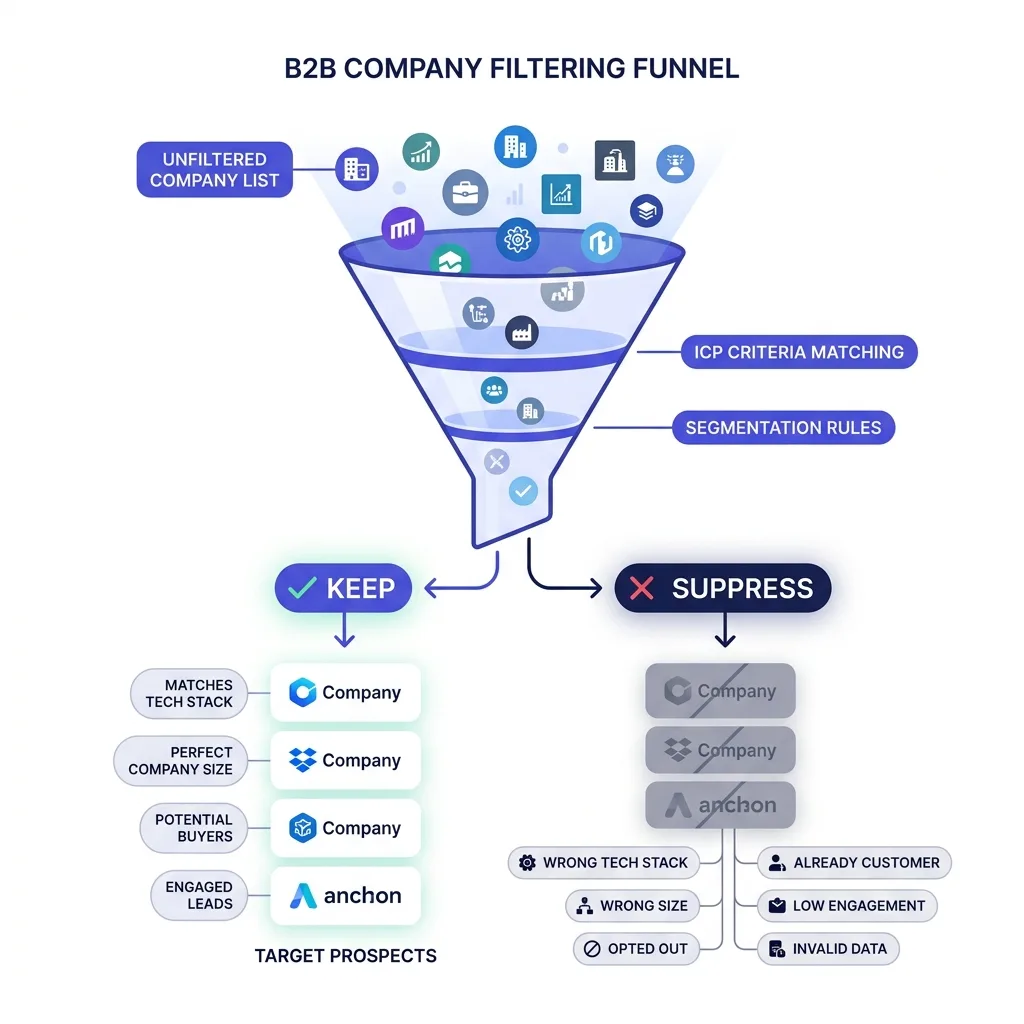 Technographic filters flagging incompatible tech stacks in a lead list
The mistake here is treating technographic data as enrichment instead of as a filter.
Enrichment adds a field to a row.
A filter decides whether the row belongs in the list at all.
Most negative technographic signals should be applied at the filter stage, before the account ever reaches a sequence, not flagged after the fact when someone notices the reply saying "we already use X."
#Compliance and consent signals
This category is not optional and it is not a judgment call.
If a contact has unsubscribed from any campaign, whether yours or a past one you inherited through a list purchase, they are permanently suppressed.
Re-adding them under a different campaign name is the fastest way to turn a minor annoyance into a spam complaint, and spam complaints are the metric with the least room for error under current bulk sender rules.
The same applies to GDPR and CASL opt-outs, and to any contact who has explicitly asked not to be contacted through a different channel that your team tracks.
Consent signals travel with the person, not with the specific list they showed up on.
Build the suppression check at the contact level, checked against every list before a send, not at the list level where a new import can quietly reintroduce someone who already opted out.
Our one-click unsubscribe breakdown covers the mechanics of capturing this signal cleanly at the point of opt-out, which is the easiest place to get it right and the hardest place to fix retroactively.
#Engagement decay signals
Not every negative signal is a hard stop.
Some are a pattern that only becomes visible after a few touches.
An account that has gone through two full sequences with zero opens, zero clicks, and zero replies is not a "try again next quarter" candidate by default.
It is a signal that either the targeting was wrong or the account genuinely has no active need, and either way, a third sequence into the same inbox with no new information is unlikely to change the outcome.
Set a hard rule: after two complete sequences with zero engagement, the account moves to a long-hold list, not back into active rotation.
This single rule alone prevents a huge share of wasted sends, because dead accounts left in an active list keep getting swept into every new campaign a different rep runs.
Watch this pattern differently from a hard bounce, though.
Zero engagement with a delivered email is a soft signal about fit or timing.
A hard bounce is evidence the domain itself is broken, and that is a data quality problem, covered further down.
#Timing and lifecycle signals
Some negative signals are about the calendar, not the account's fit.
A company that just went through layoffs is a bad target for the next 60 to 90 days, not permanently.
Budgets are frozen, the buying committee is unstable, and any outreach lands in an inbox that is already anxious about job security.
The same applies to a company mid-way through a funding round, an acquisition, or a leadership transition.
None of these make the account a permanent no.
They make it a "not now," and the correct action is a timed hold, not deletion and not active outreach.
Our piece on hiring signal outbound covers the positive side of this same signal type, since hiring freezes and hiring surges are read from the same data source and point in opposite directions.
A recently closed-lost account is a similar case.
If a deal died on price six weeks ago, going straight back in with a new campaign reads as tone-deaf.
Hold it until there is a new trigger, a budget cycle reset, a new stakeholder, a product change that addresses the original objection, and then re-approach with that specific reason.
#Data quality signals
This is the least interesting category and the one most teams get right by accident, through basic email verification.
Catch-all domains, role-based addresses like info@ or sales@, and previously hard-bounced addresses should never re-enter a sequence.
Our cold email domain burn rate piece covers what happens to sender reputation when this category gets ignored at scale, since hard bounces are one of the two metrics, alongside spam complaints, that Google and Microsoft actually gate bulk sender status on.
The less obvious version of this signal is a stale enrichment record.
A title, company, or email pulled more than 12 months ago has a meaningfully higher chance of being wrong, especially at companies with fast headcount turnover.
Treat records older than a set age as needing re-verification before a send, not as ready-to-go inventory.
#Building a suppression list that works
A suppression list only works if it lives in one place and every send checks it, no exceptions.
The most common failure mode is not the absence of a suppression list.
It is having three of them: one in the CRM, one in the sending tool, and one in a spreadsheet someone built during a compliance scare, none of which talk to each other.
Centralize it.
One list, one source of truth, checked automatically before any campaign, any sequence, any one-off send a rep fires manually.
Tag each suppressed contact with a reason and a review date where relevant.
"Unsubscribed" is permanent.
"Zero engagement, two sequences" gets reviewed in 90 days.
"Hiring freeze" gets reviewed in 60 days.
Without a reason code, someone eventually re-imports the whole list wholesale because nobody remembers why half of it was excluded in the first place.
Here is how the categories compare on how they should be handled operationally.
| Signal type | ✓ Correct handling | ✗ Common mistake |
|---|---|---|
| Unsubscribe or opt-out | Permanent suppression, checked at contact level | Re-added under a new campaign name |
| Hard bounce | Permanent removal, address never reused | Retried after "waiting a bit" |
| Hiring freeze / layoffs | Timed hold, 60-90 days | Treated as a permanent no |
| Zero engagement after 2 sequences | Long-hold list, needs new trigger to re-enter | Cycled into every new campaign |
| Technographic conflict | Filtered out before list build | Discovered mid-sequence from a reply |
| Firmographic misfit | Excluded by standing rule | Judged case by case, inconsistently |
| Role-based inbox | Never enters active sequence | Left in because "it might get forwarded" |
#Where suppression sits in the pipeline
Suppression has to happen before the sequence starts, not after a rep notices something is off.
By the time a rep reads a reply that says "we don't fit your ICP" or gets a bounce notification, the send has already happened and the reputation cost is already paid.
The check needs to sit between list-building and sequence launch, as a gate, not a cleanup step.
flowchart TD
    A[Raw sourced list] --> B{Firmographic + technographic filter}
    B -->|Fails fit rules| S[Suppression list]
    B -->|Passes| C{Compliance check}
    C -->|Opted out / GDPR flag| S
    C -->|Clear| D{Data quality check}
    D -->|Hard bounce history / role inbox| S
    D -->|Verified| E[Active sequence]
    E --> F{Engagement after 2 sequences}
    F -->|Zero engagement| S
    F -->|Engaged| G[Continue nurture or hand to sales]
This is also where signal-based prospecting tools earn their keep, since the same trigger data that surfaces a positive buying signal, a new hire, a funding round, a tech migration, is the same feed that should be flagging the negative version of that signal at the same time.
FirstSales pulls both directions from one signal feed, so an account showing a hiring freeze or a recent unsubscribe gets routed to suppression automatically instead of relying on a rep to catch it after the fact.
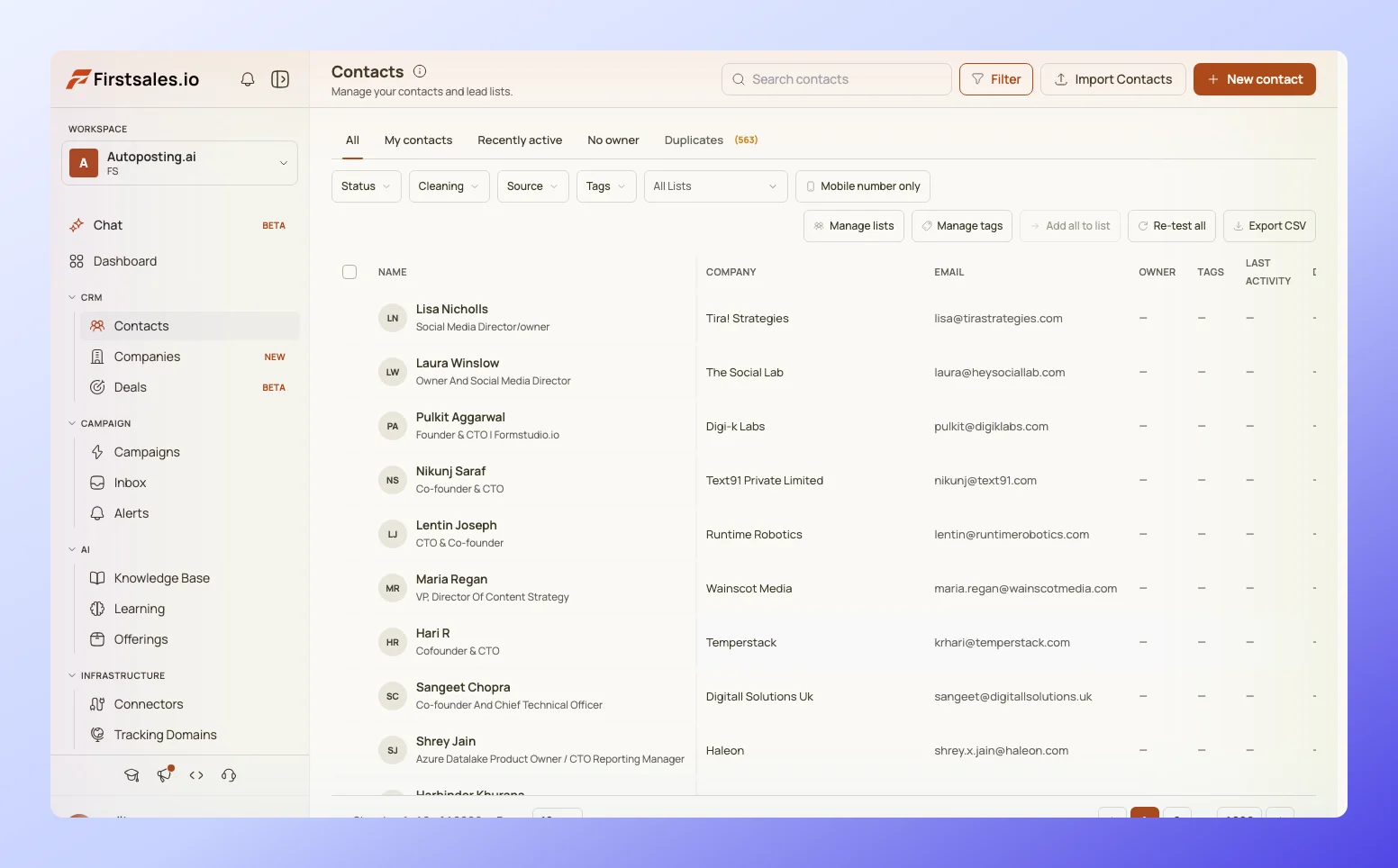 FirstSales prospecting dashboard showing signal-based account flags
That is not a reason to skip building your own rules first.
A tool applies rules faster.
It does not decide what the rules should be, and the firmographic and technographic exclusions in the sections above are decisions only your team can make correctly.
#The marginal account problem
Most suppression decisions are easy.
A hard bounce is a hard bounce.
The harder case is the account that is not a clear yes or no, the company at 18 employees when your minimum is 20, or the account that engaged lightly (one open, no click) across two sequences.
Resist the urge to write a rule for every marginal case.
Instead, route marginal accounts to a smaller, slower-touch list with a human reviewing before send, rather than either auto-including or auto-excluding them.
This is exactly the kind of judgment call that benefits from human-in-the-loop review rather than a fully automated gate, because the cost of a wrong exclusion (a real opportunity suppressed) and the cost of a wrong inclusion (a wasted send that dents reputation) are not symmetric, and a person weighing the specific account usually gets it right faster than a rule trying to cover every edge case.
If your total addressable market is small enough that every marginal account actually matters, the calculus shifts further still.
Our small TAM outbound playbook covers why volume-first suppression rules can cost you more than they save when there are only a few hundred accounts that could ever buy.
#Measuring what suppression actually saves
Track two numbers before and after you build a real suppression process: spam complaint rate and reply rate on the accounts that remain.
Complaint rate should drop first, usually within the first two or three sends after suppression rules go live, because you have removed the accounts most likely to mark you as spam out of irritation rather than genuine mistargeting.
Reply rate on the remaining list should climb next, not because the remaining accounts changed, but because the denominator got smaller while the numerator, actual qualified replies, stayed roughly flat.
That is the entire mechanism.
You are not making anyone more likely to reply.
You are removing the people who were never going to.
Run this as a controlled comparison if you can: hold one segment on the old, unfiltered list and run suppression on a matched segment, then compare complaint rate and reply rate across the same window.
Our segment validation test covers the mechanics of running that kind of controlled comparison cleanly, with enough volume to trust the result instead of reacting to noise from a small sample.
If you are sourcing from a data provider and want to know whether the source itself is producing too many negative-signal accounts in the first place, the b2b data provider comparison test is the companion piece, since a provider with poor coverage on firmographic accuracy will keep feeding misfit accounts back into your list no matter how good your suppression rules are downstream.
#FAQ
#What counts as a negative signal in a lead list?
A negative signal is any data point that indicates an account should be removed or held rather than emailed, including firmographic misfit, technographic conflict, a compliance opt-out, a hard bounce, layoffs or a hiring freeze, or two full sequences with zero engagement.
#Is suppression the same thing as list cleaning?
Not quite. List cleaning usually means fixing or removing bad email addresses, which is one category, data quality. Suppression is broader and includes accounts with valid, deliverable addresses that should still not be contacted right now.
#How often should a suppression list be reviewed?
Permanent suppressions, opt-outs and hard bounces, do not need review. Timed holds, hiring freezes, recent closed-lost, zero-engagement accounts, should carry a review date, typically 60 to 90 days out, so they can re-enter rotation once the underlying condition has likely changed.
#Should I suppress an entire company or just one contact?
It depends on the signal. An unsubscribe or opt-out applies to the individual contact only. A firmographic or technographic misfit applies to the whole account, since the reason has nothing to do with the specific person.
#What is the difference between a hard bounce and a soft bounce for suppression purposes?
A hard bounce means the address does not exist or the domain rejected delivery permanently, and that address should never be reused. A soft bounce is often temporary, a full inbox or a server timeout, and does not need permanent suppression on its own, though repeated soft bounces on the same address are worth treating as a hard bounce.
#Does suppressing accounts hurt my total addressable market?
No, because suppressed accounts in your database were never going to convert with the current data or timing. Suppression does not shrink your real TAM, it just stops you spending sends on accounts your own data already told you were the wrong target.
#How do hiring freezes function as a negative signal?
A hiring freeze usually correlates with a broader budget freeze, since headcount and discretionary spend get cut together in most cost-control cycles. It is a strong signal to hold outreach for 60 to 90 days rather than push a budget-dependent pitch into a company that just froze spending.
#Can a competitor's customer ever become a valid target?
Yes, but not through normal-cadence outreach. Treat an account under an active competitor contract as a timed hold tied to that contract's renewal date rather than a permanent exclusion, and re-approach closer to the renewal window when switching costs are lowest.
#Should role-based inboxes like sales@ or info@ ever be used?
Generally no for cold outreach. They are shared inboxes with low individual accountability for replying, they trigger spam filters at a higher rate than named addresses, and they rarely reach a specific decision maker.
#What should happen to an account after two sequences with zero engagement?
Move it to a long-hold list rather than a third sequence with the same message and the same targeting logic. Only re-enter it when a genuinely new trigger appears, a role change, a funding event, a product announcement relevant to your pitch.
#Does GDPR opt-out apply only to EU-based contacts?
No. If your sending infrastructure or company has any EU nexus, or if you are marketing into the EU regardless of where your company is based, GDPR consent rules generally apply to those contacts regardless of where your servers sit.
#How do I stop a suppressed contact from being re-imported later?
Suppression needs to be checked at the contact level against every new list before a send, not maintained as a separate list someone remembers to cross-reference manually. A new CSV import should automatically flag any row that matches a suppressed contact.
#Is a firmographic exclusion rule ever too strict?
Yes, if it is based on a single early failed deal rather than a pattern across multiple accounts. Set firmographic rules from a sample of at least 10-20 lost or unqualified deals in that segment, not from one bad experience.
#What is the cost of not suppressing bad-fit accounts?
The direct cost is wasted sending capacity and rep time. The larger cost is domain reputation damage from the resulting spam complaints and bounces, which can suppress deliverability for your entire sending infrastructure, including campaigns targeting genuinely qualified accounts.
#Should marginal accounts near a firmographic threshold be auto-included or auto-excluded?
Neither by default. Route them to a smaller list for a quick human review rather than letting an automated rule make the call in either direction, since the two outcomes carry different costs.
#How does list suppression interact with spam complaint thresholds?
Google's bulk sender requirements cap complaints at 0.1% of sent volume. Because complaints often come disproportionately from misfit or previously-opted-out accounts, suppressing those accounts directly reduces the numerator in that ratio, which is the single fastest lever most senders have for staying under threshold.
#Can suppression rules be different across campaigns for the same company?
Yes, for account-level fit rules that vary by product line, but not for compliance signals. An opt-out or unsubscribe applies across every campaign for that contact, regardless of which product or team is sending.
#What data source tells you an account just had layoffs or a hiring freeze?
Job posting velocity, LinkedIn headcount trend data, and public layoff trackers are the most common sources. A sudden drop in open roles combined with a headcount plateau or decline is the pattern worth watching.
#Is it worth paying for a data provider specifically to catch negative signals?
It depends on your volume. At meaningful scale, the cost of a provider that surfaces layoffs, funding events, and technographic data usually pays for itself in avoided spam complaints and wasted sends, but a smaller list can often be maintained manually with the rules in this piece.
#Conclusion
The instinct to source more is not wrong, it is just usually the second move, not the first.
Before adding a thousand new accounts, look hard at the ones already sitting in your list that a negative signal has already flagged.
An unsubscribe, a hard bounce, a hiring freeze, a technographic conflict, two dead sequences, these are not noise to work around.
They are the data telling you exactly where to stop spending effort.
Build the suppression rules once, centralize them in one place every send checks, and review the timed holds on a schedule instead of forgetting they exist.
The list gets smaller.
The complaint rate drops.
The reply rate on what remains goes up, not because anyone got more persuasive, but because the denominator finally reflects who was ever going to say yes.
That is the whole trade, and it is a better one than almost any amount of additional sourcing.