
TL;DR: Partnership outreach differs from sales outreach because you are proposing mutual value, not asking someone to buy. The best partner emails lead with a specific, researched reason the two companies fit, propose a concrete first step, and skip the pitch deck until there is real interest. Reply rates run higher than standard cold sales email, often 8% to 15% for well-targeted partnership asks, because the ask is collaboration, not a purchase decision.
#Why partnership outreach behaves differently than sales outreach
Every growing B2B company eventually runs out of pure outbound and inbound pull and starts asking what else could move pipeline.
Partnerships are usually the answer, since a single well-run integration or reseller relationship can produce ongoing pipeline that a one-time cold campaign cannot.
The challenge is that most sales and marketing teams apply sales-outreach instincts to partnership outreach, which explains why so many partnership emails get ignored or feel transactional.
A sales email asks a stranger to spend money.
A partnership email asks a peer to consider a relationship where both sides win.
That single difference changes everything about tone, structure, and pacing.
Partnership contacts, usually people with titles like Head of Partnerships, BD Lead, or a founder at a smaller company, expect to be pitched ideas regularly, so a well-researched proposal stands out rather than annoys.
That expectation gap is part of why partnership outreach reply rates run meaningfully higher than general cold sales email, which sits around 3.43% on average according to Whali's 2026 benchmark data.
Partnership-specific outreach, when targeted at the right contact with a concrete mutual-value proposal, commonly lands in the 8% to 15% range based on data reported by partnership platforms like PartnerStack and Crossbeam in their public benchmark reports.
graph TD
    A[Identify partnership type] --> B[Map ideal partner companies]
    B --> C[Find the right contact]
    C --> D[Send outreach: value-first, no pitch deck]
    D --> E{Reply?}
    E -->|Yes| F[Discovery call: explore mutual fit]
    E -->|No| G[Follow up with a specific idea, not a nudge]
    F --> H[Pilot or co-marketing test]
    H --> I[Formal partnership agreement]
#Types of partnerships worth pursuing by email
Not all partnerships are the same, and the outreach approach shifts based on type.
Integration partnerships connect two products technically, so a customer can use both together. These emails work best coming from a product or engineering-adjacent contact rather than pure sales.
Referral partnerships trade warm introductions between companies serving the same customer base without competing. These are the easiest to start since the ask is small: a handful of introductions to test fit.
Co-marketing partnerships combine audiences for content, webinars, or events. These move faster than integration deals since there is no engineering dependency.
Reseller or channel partnerships involve one company selling another's product, usually with a revenue share. These take longest to close because of contract and pricing complexity.
Match the outreach ask to the partnership type. A cold email proposing a full reseller agreement in the first message reads as premature; the same email proposing a 15-minute call to explore referral fit reads as reasonable.
#Finding the right partnership contact
Reaching the wrong person kills a partnership email before it has a chance.
Sales-focused contacts often forward or ignore partnership proposals, since it is not their job to evaluate them.
Search for titles like Partnerships, Business Development, Alliances, or Ecosystem on LinkedIn, filtered to the target company.
At smaller companies without a dedicated partnerships role, the founder or head of growth is usually the right person, since they make these calls directly.
This mirrors the targeting discipline in ideal customer profile work: define exactly who owns the decision before spending outreach effort on anyone else.
Verify the email before sending, since partnership lists built from scraped directories carry higher bounce risk than sales lists pulled from verified CRM exports, a point covered in email verification before sending.
#The partnership outreach sequence
A partnership sequence runs shorter and lighter than a typical sales cadence.
Email 1 proposes the specific idea with enough detail that the recipient can evaluate fit in 30 seconds, no deck attached.
Email 2, sent about a week later, adds one new piece of information: a specific customer overlap, a competitor who already partners with someone similar, or a relevant metric.
Email 3, the final touch, keeps it short and lowers the ask to a simple yes or no on interest, rather than repeating the full pitch.
Three emails is usually enough. Partnership contacts who are interested tend to respond by email two, and a fourth touch on a low-stakes ask like this starts to feel like pressure rather than persistence, unlike a sales sequence covered in follow-up email strategy where longer sequences are more tolerated.
#What a strong partnership email actually says
Lead with the specific mutual value, not your company's features.
"Our customers keep asking for a [specific integration], and I think your product is the best fit we've seen" works because it names a real customer need, not just company benefits.
Reference a concrete, verifiable detail: shared customers, complementary positioning, or a competitor's existing partnership that proves the model works.
Propose a small, specific first step. "Worth a 15-minute call to see if there's a fit?" beats "Let's explore a strategic partnership" because it is answerable in five seconds.
Keep the email under 150 words. Partnership leads get pitched constantly and skim fast.
Avoid attaching a partnership deck to the first email. Decks belong after interest is confirmed, not before.
| Element | ✓ Works | ✗ Fails |
|---|---|---|
| Opening line | ✓ Names a specific mutual opportunity | ✗ Generic "exploring partnership opportunities" |
| Proof | ✓ Cites a real shared customer or comparable partner | ✗ Vague claim of "great synergy" |
| Ask | ✓ Small, specific next step (15-min call) | ✗ Asks to "discuss a strategic partnership" broadly |
| Attachment | ✓ None in email one | ✗ Full partnership deck attached cold |
| Length | ✓ Under 150 words | ✗ 400+ word pitch |
| Sender | ✓ Person with partnership or BD title | ✗ Generic sales rep with no context |
#A real example, structured
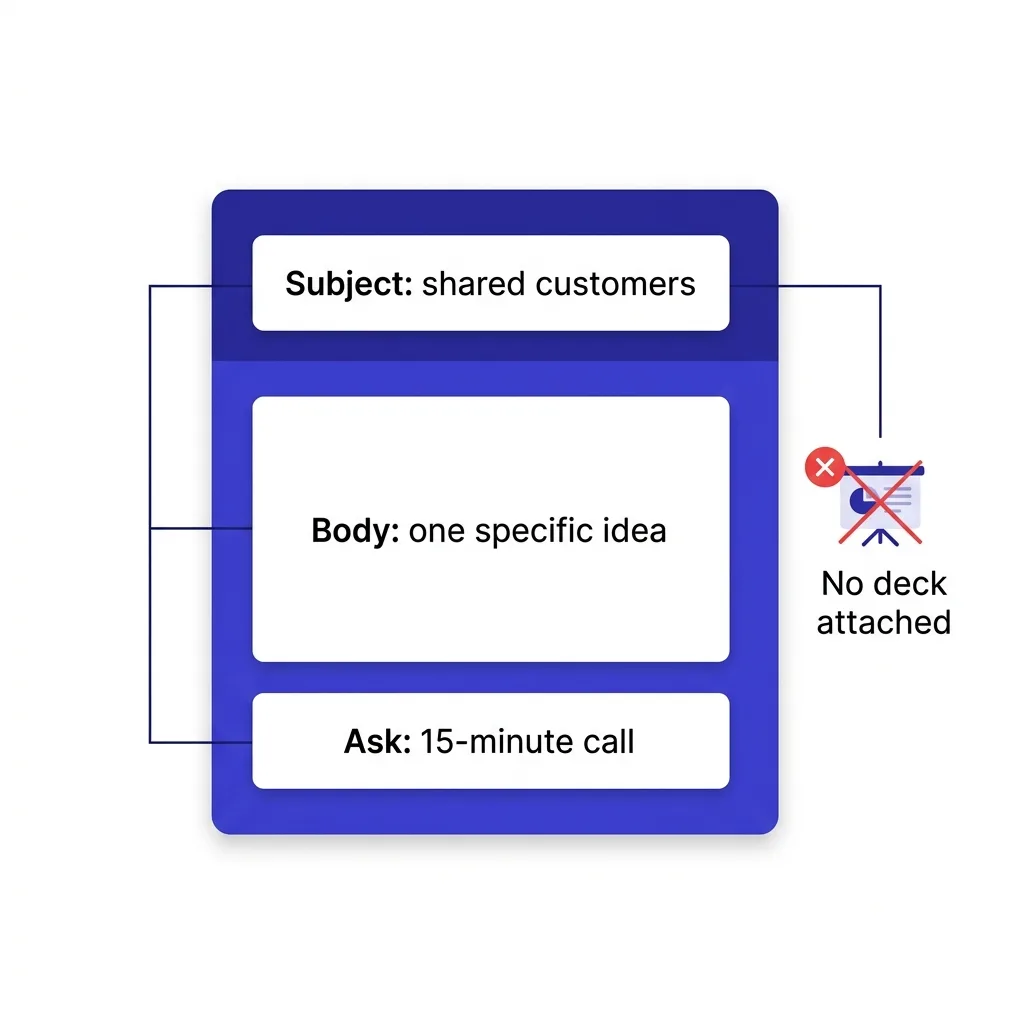 A real example, structured
Consider a hypothetical outbound tool reaching out to a CRM company about an integration.
The subject line names the specific idea: "Quick idea: [Tool] plus [CRM] for shared customers."
The body opens with the observation that several mutual customers have asked for the two products to sync data, names one specific workflow that would improve (contact enrichment flowing automatically into the CRM), and closes with the small ask of a 15-minute call to see if it is worth exploring further.
No deck, no pricing, no multi-paragraph company background. Just the specific idea and a low-commitment next step.
This structure works across partnership types with small adjustments: swap the specific idea for a co-marketing format, a referral test, or a reseller conversation depending on what fits the relationship.
The consistent thread across every effective version is specificity over enthusiasm, and a next step small enough that saying yes costs the recipient almost nothing.
#Handling the first partnership call
The first call is exploratory, not a negotiation.
Come prepared with two or three concrete ideas for how the partnership could work in practice, not just enthusiasm.
Ask directly about their current partnership priorities and what they measure success by, since that reveals whether your idea fits their actual roadmap or just sounds nice in theory.
Avoid over-promising resourcing or timelines on the first call. Partnership deals stall when one side commits to something engineering or leadership has not actually agreed to internally.
End the call with a specific next step: a follow-up email summarizing the discussion, a proposed pilot scope, or an introduction to a technical counterpart.
#From conversation to signed agreement
Most partnerships die in the gap between "this sounds interesting" and an actual signed agreement or shipped integration.
Momentum matters more than perfection here. A scrappy pilot, like a co-branded webinar or a manual referral test, proves value faster than a six-month legal negotiation over a full agreement.
Set a specific, short pilot window, 30 to 60 days, with a clear metric both sides agree defines success.
Document the pilot results, even informal ones, since that data becomes the case for scaling into a formal agreement or dropping the idea without burning the relationship.
Keep legal and contract complexity proportional to the deal size. A referral partnership does not need the same paperwork as a reseller agreement with revenue share and liability terms.
#Common mistakes in partnership outreach
Pitching a full partnership program before any relationship exists overwhelms a cold contact and reads as unrealistic.
Sending the same generic template to every prospective partner ignores the fact that partnership fit is highly specific, unlike broader B2B sales where more standardized messaging can still work.
Chasing partnerships with companies far larger than yours without a specific value proposition wastes effort, since large companies rarely prioritize small, unproven partners without a clear reason to.
Letting a promising conversation go cold after the first call, without a documented next step, is the single most common way partnerships die.
Over-engineering the legal agreement before proving any value in a pilot slows momentum and often kills deals that would have worked with a lighter first step.
#Integration partnerships in depth
Integration partnerships take longer to close than referral or co-marketing deals because engineering resources sit on both sides of the decision.
The outreach email for an integration partnership should come from someone who can speak credibly about the technical fit, even if that person is not the one writing code.
Reference the specific API, webhook, or data model overlap that makes the integration realistic, since vague "we should integrate" emails get ignored by technical partnership leads who evaluate feasibility constantly.
A lightweight proof of concept, even a manual or semi-automated version of the integration, demonstrates commitment faster than a signed agreement with no working example behind it.
Once a proof of concept works, the conversation shifts to who builds and maintains the official integration, how it gets listed in each company's marketplace or app directory, and how support gets split between the two teams.
Integration partnerships that stall usually stall on maintenance ownership, not the initial build, so raise that question early rather than after launch.
#Channel and reseller partnerships in depth
Reseller and channel partnerships carry the most complexity because they involve revenue, pricing, and often exclusivity terms.
The outreach ask here should stay light initially, proposing a conversation about the reseller's current customer base and whether a revenue-share model makes sense, rather than presenting full contract terms cold.
Reseller partners want clarity on margin, deal registration to avoid channel conflict, and marketing support before committing meaningfully to selling a new product.
A pilot reseller agreement, limited to a small number of accounts or a specific region, lets both sides test the model before locking in broader terms.
Deal registration, a process where a reseller claims a specific opportunity to avoid two partners competing for the same deal, prevents the internal conflict that kills channel programs within their first year.
Channel programs that scale successfully usually start with two or three hand-picked pilot resellers, not a broad open application process, since early partners need more hands-on support than a mature program requires.
#Co-marketing partnerships in depth
Co-marketing partnerships move fastest of the four types because there is no product or legal dependency, just shared audience and content.
A strong co-marketing pitch names a specific format: a joint webinar, a co-authored guide, or a shared email to both audiences, rather than a vague offer to "collaborate on content."
Audience size overlap matters less than audience relevance. A smaller, highly relevant partner audience often outperforms a larger, loosely related one for lead quality.
Track co-marketing results with the same rigor as a paid campaign: registrations, attendance, and downstream pipeline, since informal partnerships without measurement tend to fizzle after one event.
A single successful co-marketing event often becomes the proof point that opens the door to a deeper partnership, whether that is an integration or a formal referral agreement, so treat the first collaboration as an audition, not a one-off.
#Measuring a partnership program
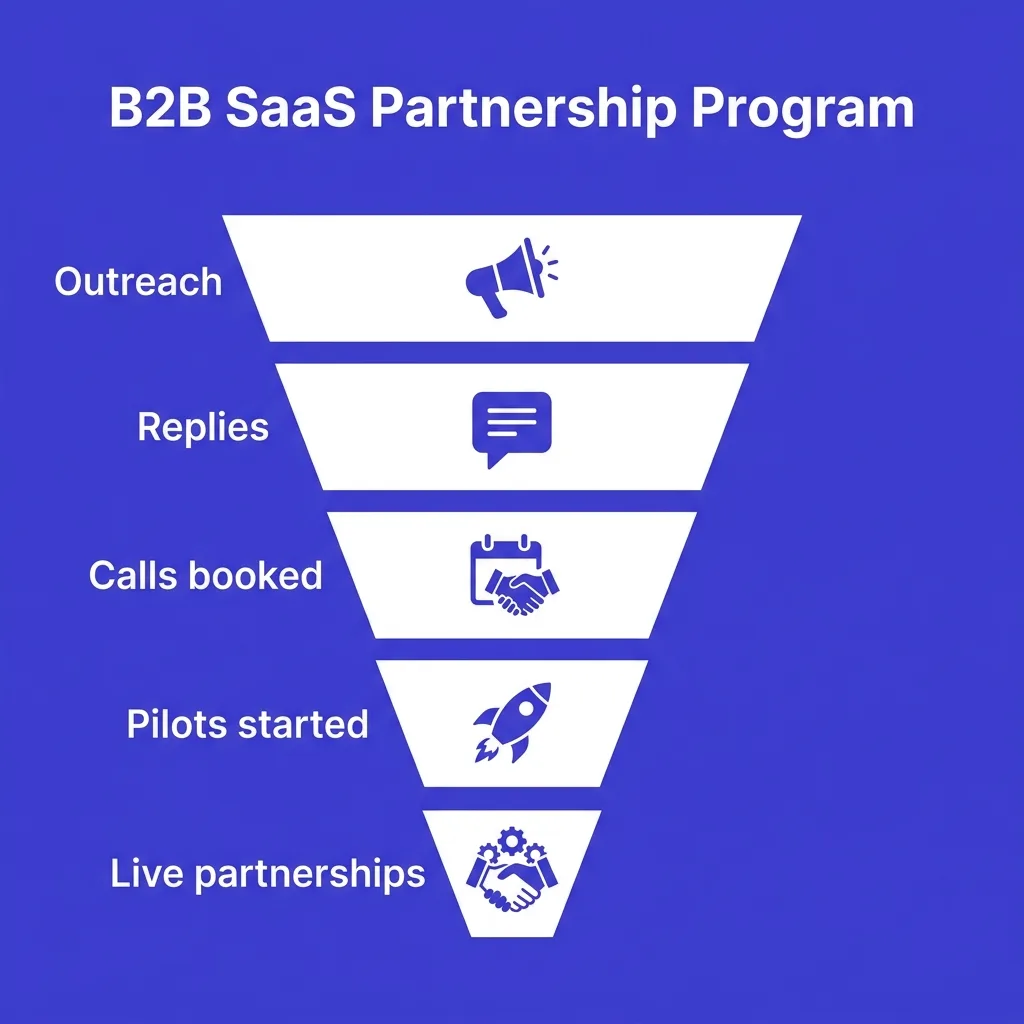 Measuring a partnership program
A partnership program without metrics becomes impossible to defend internally when budget or headcount gets reviewed.
Track outreach volume, reply rate, calls booked, pilots started, and pilots that convert to live partnerships, the same funnel discipline used in outbound lead scoring models for sales pipelines.
Attribute pipeline or revenue back to specific partnerships wherever possible, even if the attribution is imperfect, since directional data beats no data when making the case to keep investing in the program.
Review the partnership pipeline monthly, flagging any partnership stuck in "interested but no next step" for more than three weeks, since that stage is where most partnerships quietly die.
A partnerships lead who can show, even roughly, that partner-sourced pipeline costs less per opportunity than cost per meeting from cold outbound alone makes a much stronger case for continued investment in the channel.
#Tools for running a partnership program
A simple CRM view tracking partnership stage (outreach, call, pilot, live) keeps a partnership pipeline visible the same way a sales pipeline would be.
AI-assisted drafting tools with human review, like FirstSales, help partnership teams research and personalize outreach at the volume needed to test multiple partner types without losing the specific detail that gets replies.
Tools like Crossbeam or Reveal that surface overlapping customer accounts between two companies turn a vague partnership pitch into a data-backed one, since "we share 40 customers" is a far stronger opener than a guess about fit.
A shared tracking doc or lightweight partner portal, even a spreadsheet early on, keeps both sides aligned on pilot metrics and next steps instead of relying on scattered email threads.
This same infrastructure discipline shows up in cold email systems that generate leads: the tool matters less than having a consistent, trackable process behind it.
#Negotiating terms without stalling momentum
Partnership negotiations stall most often over revenue share percentages, exclusivity clauses, and support obligations.
Start negotiations with the smallest binding commitment that lets both sides test the relationship, such as a 60-day pilot with no exclusivity, rather than trying to lock every term before any results exist.
Revenue share terms should reflect actual effort. A partner doing the selling and support typically earns a larger share than one providing a simple referral with no ongoing involvement.
Avoid exclusivity in early-stage partnerships. Exclusivity limits both sides' optionality before either party has proven the relationship works, and it is far easier to add later than to remove once granted.
Put support ownership in writing early, even informally in an email recap, since ambiguity about who handles a joint customer's support ticket becomes a recurring friction point once the partnership goes live.
Legal review should scale with deal size. A referral agreement can often run on a one-page mutual agreement, while a reseller deal with revenue share and liability terms needs a fuller contract reviewed by counsel on both sides.
#When to walk away from a partnership conversation
Not every promising first call turns into a partnership worth pursuing, and recognizing that early saves months of wasted effort.
Watch for signals like a contact who cannot get internal buy-in after multiple attempts, since a partnership without executive support on the other side rarely survives past the pilot stage.
A partner whose customer base does not actually overlap with yours, despite an appealing conversation, will not produce meaningful pipeline even with a signed agreement.
If a pilot runs its full window without hitting the metric both sides agreed on upfront, that is a legitimate signal to end the relationship rather than extend indefinitely hoping results improve.
Ending a partnership conversation cleanly, with a clear explanation rather than silence, preserves the relationship for a future opportunity when circumstances change on either side.
#A realistic timeline for a first partnership
Most first partnerships, from initial outreach to a live, working relationship, take three to six months.
The first month typically covers outreach, the initial call, and early alignment on what a pilot would look like.
Months two and three usually cover the pilot itself, whether that is a co-marketing event, a manual referral test, or an early integration proof of concept.
Months four through six cover formalizing the relationship if the pilot worked, including any contract, marketplace listing, or broader rollout across both teams.
Setting this expectation upfront, both internally and with the partner, prevents the common frustration of treating a partnership like a sales deal that should close in a few weeks.
Teams that rush this timeline to hit a quarterly target usually end up with a signed agreement that never actually produces activity, since neither side did the real integration or process work to make it functional.
#Revisiting and expanding a partnership after year one
A signed partnership agreement is a starting point, not a finish line, and most of the value in a good partnership shows up well after the initial launch.
Put a specific date on the calendar, roughly eleven or twelve months after launch, to sit down with the partner and review what actually happened against what both sides expected when the agreement was signed.
Bring real numbers to that conversation.
Referral volume, integration usage, or co-marketing reach are all measurable, and a review built on actual data produces a very different conversation than one built on general impressions of how things have been going.
If the partnership underperformed, treat the review as a diagnosis, not a verdict.
A partnership can underperform for reasons that have nothing to do with the underlying fit, like a champion at the partner company leaving, a product change that broke an integration, or simply neither side prioritizing the relationship after the initial launch excitement faded.
Ask directly what got deprioritized on their end, and be honest about what got deprioritized on yours, before deciding whether the partnership itself was the problem.
If the partnership performed well, use the review as the moment to propose expansion rather than letting a good relationship coast on its original terms indefinitely.
That might mean a deeper integration, a co-marketing push around a shared audience segment that was not part of the original scope, or introducing the partnership to adjacent teams on both sides who were not involved in the initial agreement.
The strongest partnerships tend to compound this way, expanding in scope roughly once a year, rather than staying frozen at whatever the first contract happened to cover.
#Frequently asked questions
#What is partnership outreach?
Partnership outreach is the process of contacting other companies to propose mutually beneficial relationships, such as integrations, referrals, co-marketing, or reseller agreements, rather than selling a product directly.
#How is partnership outreach different from sales outreach?
Partnership outreach proposes mutual value between two companies, while sales outreach asks a buyer to purchase a product, which changes the tone, pacing, and expected reply rates.
#What reply rate should I expect from partnership emails?
Well-targeted partnership emails commonly land in the 8% to 15% reply range, higher than the roughly 3.43% average for general cold sales email.
#Who is the right person to contact for a partnership?
Look for titles like Partnerships, Business Development, or Alliances; at smaller companies without a dedicated role, the founder or head of growth usually owns the decision.
#Should I attach a partnership deck to the first email?
No. Decks belong after interest is confirmed on a call, not in the first cold email, since an unsolicited deck can overwhelm a cold contact.
#How long should a partnership outreach sequence be?
Three emails spaced about a week apart is usually enough, since partnership contacts who are interested tend to respond by the second email.
#What types of partnerships are easiest to start?
Referral partnerships are usually the easiest to start, since the ask is small, just a handful of introductions to test fit, with no engineering or legal complexity.
#How do I structure a partnership pilot?
Set a short window, typically 30 to 60 days, with one clear metric both sides agree defines success before committing to a broader formal agreement.
#What is the biggest reason partnerships fail after a good first call?
Losing momentum. Most partnerships die when a promising call is not followed by a documented, specific next step within days.
#Should partnership emails come from a sales rep or a partnerships lead?
A partnerships or BD-titled sender gets better replies, since partnership contacts expect proposals from a peer role, not a generic sales rep.
#How specific should the first partnership email be?
Very specific. Naming a real customer need, a shared customer overlap, or a comparable existing partnership beats a vague "let's explore synergies" every time.
#Can AI tools help with partnership outreach?
AI-assisted drafting with human review can speed up researching and personalizing outreach across many potential partners, as long as the specific fit detail stays accurate and not generic.
#How do I find companies with overlapping customers for partnership targeting?
Tools like Crossbeam or Reveal surface shared customer accounts between companies, turning a partnership pitch from a guess into a data-backed proposal.
#Should I chase partnerships with much larger companies?
Generally no, unless you have a specific, clear value proposition, since large companies rarely prioritize small, unproven partners without an obvious reason to.
#What is a reasonable first ask in a partnership email?
A small, specific next step, like a 15-minute call to explore fit, works far better than a broad ask to "discuss a strategic partnership."
#How do integration partnerships differ from referral partnerships?
Integration partnerships require technical work connecting two products and usually involve product or engineering contacts, while referral partnerships are simpler, faster, and involve just warm introductions.
#How do I avoid partnership outreach sounding generic?
Reference a specific, researched detail: a shared customer, a comparable partner the recipient's company already works with, or a concrete customer need your company has observed.
#What should the legal agreement look like for an early partnership?
Keep it proportional to the deal. A referral partnership needs minimal paperwork, while a reseller agreement with revenue share needs more formal contract terms.
#How often should I follow up on a partnership proposal that went cold?
A single, specific follow-up with new information, rather than a generic nudge, works better than repeated check-ins with nothing new to say.
#What metrics prove a partnership pilot is worth scaling?
Metrics tied to the original goal, such as referral volume, integration adoption, or co-marketing lead generation, documented clearly enough to make the case for a formal agreement.
#Building partnership outreach into an ongoing motion
A single successful partnership rarely justifies a dedicated program on its own, but a repeatable process for finding and testing new ones does.
Set a modest, consistent target, such as five new partnership conversations started per month, rather than treating outreach as a one-time sprint tied to a single initiative.
Review the partnership pipeline alongside sales and marketing pipeline in regular team meetings, so partnerships stay visible instead of becoming a side project that loses priority the moment someone gets busy.
Over a year, even a modest, consistent partnership outreach motion compounds into a meaningful channel, the same way consistent signal-based cold email outperforms sporadic bursts of sales outbound.
#Key takeaways
Partnership outreach earns higher reply rates than typical sales email because the ask is collaboration, not a purchase, but only when the pitch is specific, researched, and sent to the right contact.
Keep the first ask small, prove value through a scrappy pilot before over-engineering a formal agreement, and never let a promising call go cold without a documented next step.
The partnerships that scale usually started as a single, well-targeted email that named a real, specific opportunity instead of a generic pitch for "synergy."
Sources: